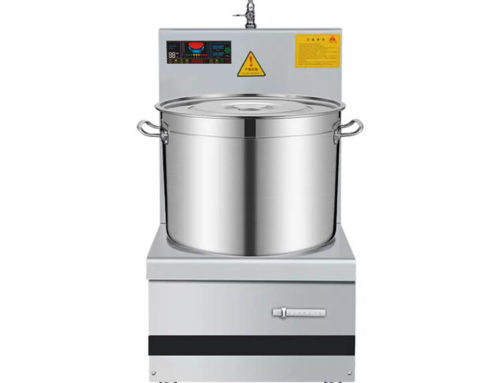
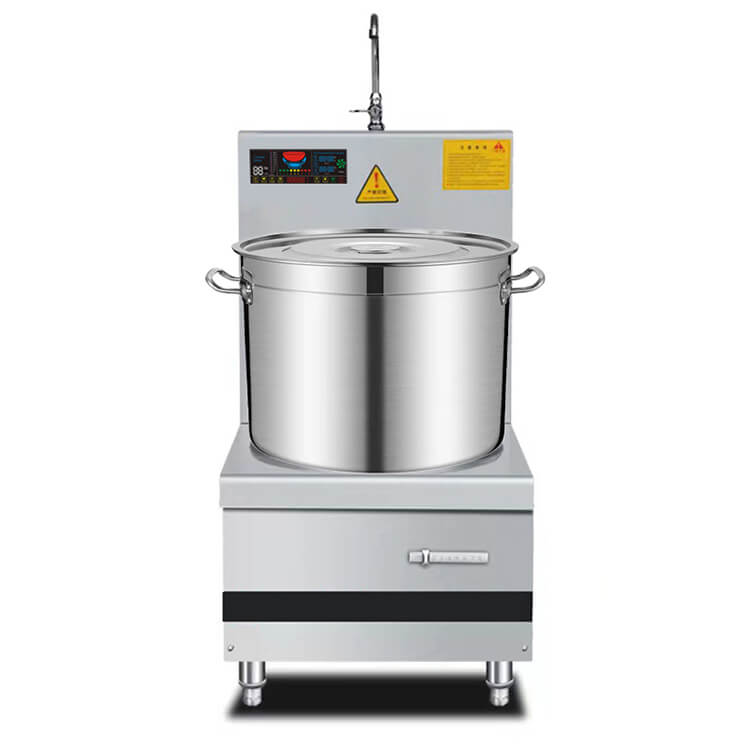
Paano naaapektuhan ng kapasidad ng soup kettle ang pagiging angkop nito para sa iba't ibang laki at pangangailangan ng kusina?
Un electric soup pot’s capacity—measured in liters (L)—is the most critical factor in matching it to your kitchen’s needs, whether you’re a food truck serving 50 daily customers or a banquet hall feeding 500. Capacity dictates batch size, energy use, space requirements, and even labor needs. AT Cooker, a leading manufacturer of commercial cooking equipment (via range-pot-stock-pot-burner), offers commercial soup kettle models from 98L to 400L, plus compact electric soup pan options. Below, we break down how capacity impacts suitability, with real product examples and data to guide your choice.
1. Mga Electric Soup Pot na Malaki ang Kapasidad (40-100L) para sa mga Kusinang Mataas ang Dami
Mga modelong electric soup pot models (40–100L) are engineered for high-demand settings like banquet halls, hospital cafeterias, and large restaurants—where 200+ portions of soup, stew, or broth are needed daily. These units, such as AT Cooker’s Panela grande de 400L (20–30KW), minimize batch frequency: one 400L batch can serve 400+ customers, vs. 8 batches with a 50L pot.
A hotel in Las Vegas uses two 400L pots for wedding buffets: “We used to cook soup nonstop during events—now we make two batches and have enough for 800 guests. It cuts 3 hours of cooking time and frees up staff.” Large capacity also pairs with features like jacketed steam kettle technology (for even heating) and automatic water valves (to simplify refilling).
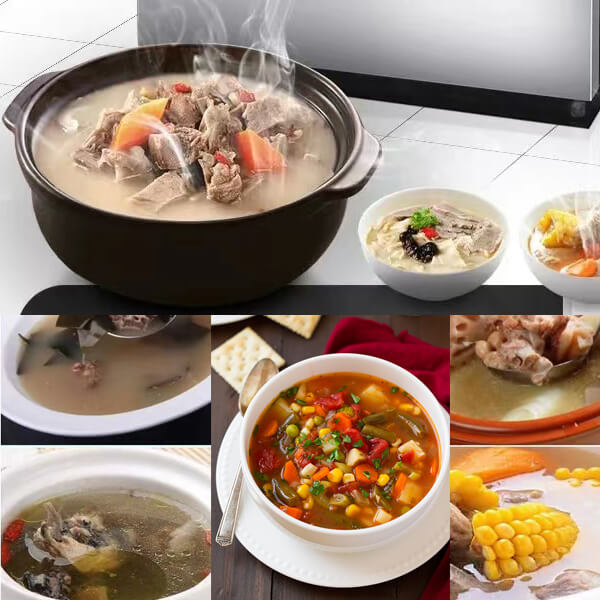
2. Compact Electric Soup Pans (10-20L) for Small Kitchens
Compact electric soup pan models (10–20L) are designed for space-constrained environments like food trucks, small cafes, and kiosks—where counter/floor space is limited (2–3 square feet) and daily output is 50–100 portions. These units are lightweight (30–45 lbs) and fit on standard countertops, making them easy to install and relocate.
AT Cooker’s 15L electric soup pan (5KW) is a popular choice for food trucks. A operator in Austin said: “My truck’s kitchen is only 4 feet wide—this pan fits next to my fryer, and I can still move around. It makes 50 portions of chili per batch, which matches my lunch rush.”
- Space requirement: 1–2 square feet (countertop)
- Power: 3–5KW (works with standard 240V outlets)
- Best for: Kitchens serving <100 portions of soup daily
| Saklaw ng Kapasidad | AT Cooker Model | Batch Output (Portions) | Potência | Tipo de cozinha ideal | Requisito de espaço |
|---|---|---|---|---|---|
| 10–20L (Compacto) | Panela elétrica de sopa de 15L | 50–100 | 3–5KW | Food trucks, small cafes | 1–2 pés quadrados (bancada) |
| 40–100L (Volume Médio) | Caldeira de sopa comercial de 98L | 200–300 | 8–15KW | Mid-sized restaurants, schools | 3–4 pés quadrados (piso/bancada) |
| 100–400L (Alto Volume) | Panela grande de 400L | 400–1200 | 20–30KW | Banquet halls, hospitals | 5–8 pés quadrados (piso) |
3. Capacidade e Cozimento em Lote para Demanda de Pico
Higher capacity directly reduces the number of batches needed during peak meal periods—critical for avoiding bottlenecks. For example:
- A 50L pot needs 4 batches to serve 200 customers (1 hour total cooking time).
- A 200L pot serves 200 customers in 1 batch (15 minutes cooking time).
AT Cooker’s 196L Electric Stock Pot Range (98L×2, 15KW×2) is designed for mid-volume peak demand. A diner in Chicago uses it: “Our 7 PM rush used to back up because we were cooking soup every 20 minutes. Now we make one batch at 5 PM and have enough until closing.”
— Lisa, restauranteier (Chicago, IL)
50L Gryte
For å servere 200 kunder
1 Hour Total Time
100L Gryte
For å servere 200 kunder
30 Minutes Total Time
200L Gryte
For å servere 200 kunder
15 Minutes Total Time
4. Dampkjeler med dobbeltvegg for jevn oppvarming av store volumer
Dampkjele med dobbeltvegg technology—used in AT Cooker’s 400L and 196L models—circulates steam between two layers of the kettle, ensuring uniform heat distribution across large volumes. This eliminates hot spots (common in direct-heat pots) that burn soup or leave it undercooked, critical for maintaining quality in high-volume operations.
A catering company uses AT Cooker’s jacketed 400L pot for vegetable soup: “With our old direct-heat pot, the bottom burned while the top was cold. The jacketed kettle cooks every spoonful evenly—no more wasted batches.” These kettles also heat 30% faster than direct-heat models, further reducing batch time.
5. Vippbare kjeler for sikker helling av store porsjoner
Vippbar kjele designs (like AT Cooker’s 30KW Commercial Tilting Boiling Pan) solve a major challenge of large-capacity cooking: safely pouring heavy batches (200+ lbs of soup). The electric tilt mechanism lets staff empty the kettle with a button, avoiding strains or spills.
A hospital cafeteria uses the 400L tilting kettle: “Our old stationary pot required two staff to lift and pour—we had spills weekly. The tilting kettle pours into serving vessels in 2 minutes, with no effort or mess.” These kettles are ideal for busy kitchens where speed and safety are priorities.
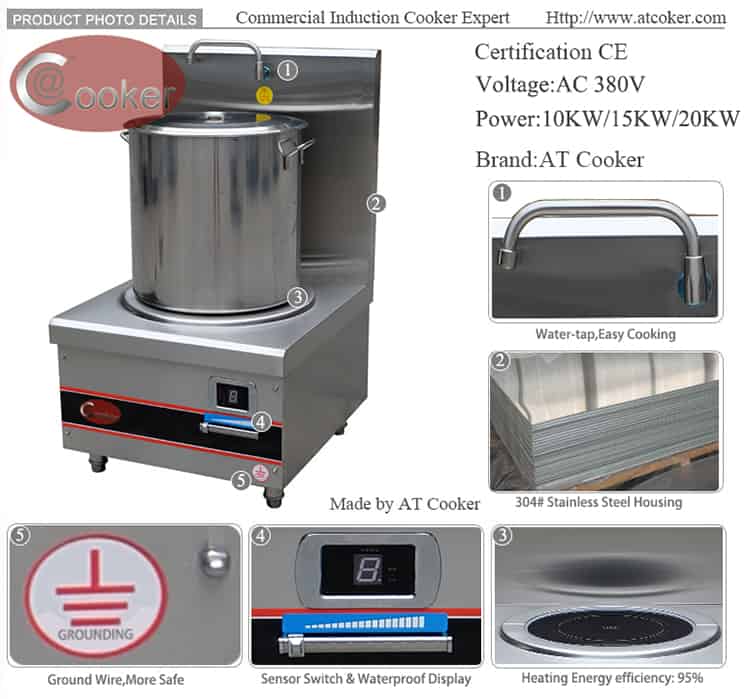
6. Capacity & Energy Efficiency
Energy consumption increases with capacity, but larger kettles have lower energy per portion. For example:
- 50L pot: 5KW × 20 mins = 1.67 kWh per 50 portions → 0.033 kWh/portion
- 200L pot: 20KW × 15 mins = 5 kWh per 200 portions → 0.025 kWh/portion
AT Cooker’s large kettles have 90–95% energy efficiency (vs. 45% for gas kettles), further reducing costs. A hotel calculated annual savings: “Our 400L electric kettle costs $532/month to run, vs. $1,309 for a gas kettle—saving $9,327/year.”
Piliin ang Tamang Kapasidad na Soup Kettle para sa Iyong Kusina
Share your daily soup volume and kitchen space—we’ll recommend an electric soup pot, jacketed steam kettle, or tilting kettle that fits your needs.