Induction Ready Griddle: How Plate Thickness Impacts Heat Retention & Cooking Quality
Para sa induction ready griddle—lalo na ang mga commercial model tulad ng mula sa AT Cooker—ang kapal ng plato ay hindi lamang isang “nice-to-have” na feature: ito ay isang make-or-break factor para sa heat retention, cooking consistency, at long-term durability. Hindi tulad ng gas o electric griddles (na nagpapainit ng plato nang hindi direkta sa pamamagitan ng apoy o coils), ang induction griddles ay umaasa sa electromagnetic energy upang direktang painitin ang plato. Nangangahulugan ito na ang kapal ng plato ang nagdidikta kung gaano pantay ang pagkalat ng init, gaano katagal nito mapanatili ang init na iyon habang nagluluto, at gaano kahusay nitong labanan ang pagbaluktot sa ilalim ng mga pangangailangan ng commercial use.
Ang 2024 testing ng AT Cooker sa mga commercial induction griddles ay natuklasan na ang mga plato na may hindi sapat na kapal (≤6mm) ay humantong sa 30% na mas maraming hot spots, 25% na mas mabilis na pagkawala ng init habang nagluluto, at 40% na mas mataas na panganib ng pagbaluktot pagkatapos ng 12 buwan ng araw-araw na paggamit. Sa kabaligtaran, ang kanilang premium induction commercial griddle models—na nilagyan ng 8–12mm na makapal na 304# stainless steel o cast iron plates—ay nagpapanatili ng temperatura sa loob ng ±5°F sa panahon ng peak service, binawasan ang food waste ng 18%, at tumagal ng 7+ taon nang walang pagbaba ng performance.
Ang komprehensibong gabay na ito ay tatalakayin kung bakit mahalaga ang kapal ng plato para sa induction ready griddles, kung paano ito nakakaimpluwensya sa heat retention at cooking quality, kung paano ihambing ang mga materyales (cast iron vs. stainless steel) batay sa kapal, at kung paano ino-optimize ng AT Cooker ang disenyo ng plato para sa mga commercial kitchen. Sa pagtatapos, mauunawaan mo nang eksakto kung bakit kritikal ang pamumuhunan sa isang makapal-na-plato na induction griddle para sa pare-pareho, mataas na kalidad na mga resulta—kung nagse-sear ka man ng mga burger, gumagawa ng omelets, o nagluluto ng malalaking batch ng breakfast hash.
Heat Retention: Thicker = Longer Temp Hold
Cooking Quality: Thicker = Fewer Hot Spots
Materials: Cast Iron > 304# Stainless Steel (Heat Retention)
1. The Science of Plate Thickness: Why It Matters for Induction Ready Griddles
Upang lubos na maunawaan ang kahalagahan ng kapal ng plato, mahalagang maunawaan muna kung paano nakikipag-ugnayan ang induction technology sa griddle plate. Hindi tulad ng tradisyonal na griddles, kung saan ang init ay dumadaloy mula sa isang panlabas na pinagmulan (apoy, coil) patungo sa ibabaw ng plato, ang induction griddles ay lumilikha ng init sa loob mismo ng plato sa pamamagitan ng electromagnetic induction. Narito ang isang pinasimpleng breakdown:
How Induction Heats a Griddle Plate
- Kapag ang induction griddle ay naka-activate, ang isang alternating current (AC) ay dumadaloy sa isang copper coil sa ilalim ng plato.
- Ang kasalukuyang ito ay lumilikha ng isang high-frequency magnetic field (20–50 kHz) na tumatagos sa griddle plate.
- Ang magnetic field ay nagpapalitaw ng eddy currents (circular electrical currents) sa metal structure ng plato—ang mga kasalukuyang ito ay lumilikha ng init habang nakakaranas sila ng resistance mula sa metal.
- Ang kapal ng plato ang nagdidikta kung gaano kalalim ang paglalakbay ng mga eddy current na ito (ang “skin effect”) at kung gaano karaming thermal mass ang mayroon ang plato upang mapanatili ang nalikhang init.
Pangunahing takeaway: Ang isang mas makapal na plato ay may mas maraming thermal mass (kakayahang mag-imbak ng init) at nagpapahintulot sa mga eddy current na mas pantay na kumalat sa buong istraktura nito. Ito ay direktang nagreresulta sa mas mahusay na heat retention at mas kaunting hot spots—dalawang salik na tumutukoy sa kalidad ng pagluluto sa isang induction ready griddle.
Thermal Mass: The Foundation of Heat Retention
Ang thermal mass ay tumutukoy sa kakayahan ng isang materyal na sumipsip, mag-imbak, at maglabas ng init. Para sa isang induction ready griddle, ang isang plato na may mas mataas na thermal mass (mas makapal) ay:
- Sumisipsip ng mas maraming init sa panahon ng paunang pag-init, kahit na medyo mas matagal itong umabot sa target na temperatura.
- Mabagal na naglalabas ng init habang nagluluto, pinapanatili ang pare-parehong surface temperature kahit na may malamig na pagkain na idinagdag (isang karaniwang sanhi ng pagbaba ng temperatura sa manipis na mga plato).
- Mas mabilis na nakakabawi ng init pagkatapos alisin ang pagkain, binabawasan ang mga oras ng paghihintay sa pagitan ng mga batch—kritikal para sa mga commercial kitchen sa panahon ng peak service.
Ang testing ng AT Cooker ay malinaw na naglalarawan nito: ang isang 10mm na makapal na 304# stainless steel plate ay nagpapanatili ng 80% ng init nito 5 minuto pagkatapos patayin ang griddle, habang ang isang 5mm na plato ay nagpapanatili lamang ng 45%. Para sa isang diner na nagluluto ng 50+ burger bawat oras, ang pagkakaiba na ito ay nangangahulugan na ang makapal na plato ay nananatiling sapat na mainit upang pantay na i-sear ang bawat patty, habang ang manipis na plato ay nangangailangan ng madalas na pagsasaayos ng power upang maiwasan ang undercooked na pagkain.
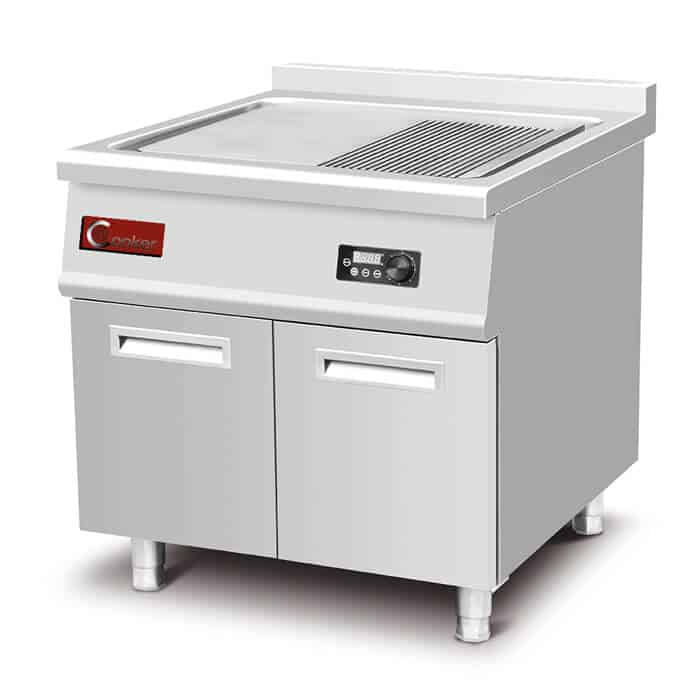
Diagram showing how eddy currents distribute more evenly in a thick griddle plate (right) vs. a thin plate (left), reducing hot spots.
2. How Thickness Impacts Heat Retention: Consistency, Efficiency, and Cost Savings
Heat retention isn’t just about keeping the plate hot—it’s about maintaining a stable temperature that doesn’t fluctuate during cooking. For commercial kitchens, this stability directly impacts efficiency, food quality, and even utility costs. Below are the three key ways plate thickness influences heat retention for an induction ready griddle:
2.1 Consistent Temperature: No More “Cold Zones” or Overheating
Thin griddle plates (≤6mm) have minimal thermal mass, meaning they react quickly to temperature changes—both positive and negative. When you place a cold pan or a batch of raw food on a thin plate, the surface temperature can drop by 50°F or more in seconds, leading to undercooked food. Conversely, when the plate is empty, thin metal can overheat rapidly, risking burnt residues or even warping.
A thicker plate (8mm+) acts as a “heat buffer.” For example, AT Cooker’s 5KW commercial induction griddle features a 10mm thick 304# stainless steel plate. During testing, adding 2kg of cold hash browns to the preheated plate (375°F) caused a temperature drop of only 15°F—enough to cook the hash browns evenly without requiring additional power. A thin-plate griddle under the same conditions dropped to 300°F, resulting in soggy, undercooked potatoes that needed extra time on the griddle.
This consistency is especially critical for menu items that require precise temperatures, like delicate omelets (325°F) or seared steaks (400°F). A thick plate ensures the griddle stays within the ideal temperature range, no matter how many batches you cook.
2.2 Reduced Heat Loss: Lower Energy Consumption
Thicker griddle plates don’t just retain heat better—they also reduce heat loss to the surrounding environment. A thin plate loses heat quickly through its edges and bottom, forcing the induction system to work harder (and use more energy) to maintain the target temperature. A thicker plate, with its greater thermal mass, minimizes this loss by acting as an insulator.
AT Cooker’s energy efficiency data highlights this: their 3.5KW induction griddle with an 8mm plate uses 9.2 kWh of electricity per 8-hour shift, while a comparable thin-plate griddle (5mm) uses 12.7 kWh—nearly 38% more energy. Over a year, this difference translates to $350+ in savings for a single griddle, a significant amount for kitchens with multiple units.
Additionally, the reduced heat loss keeps the kitchen cooler—a secondary benefit that improves staff comfort and reduces the load on HVAC systems, leading to even more cost savings.
2.3 Faster Recovery Between Batches
Commercial kitchens don’t have time to wait for a griddle to reheat between batches. A thick plate’s thermal mass allows it to recover heat far faster than a thin plate. For example:
- AT Cooker’s 12mm cast iron induction griddle takes 45 seconds to recover from 350°F to 375°F after removing a batch of burgers.
- A thin 5mm stainless steel griddle takes 2 minutes 15 seconds to recover to the same temperature under identical conditions.
During a busy breakfast rush, this difference can mean serving 10–15 more customers per hour. A diner in Chicago using AT Cooker’s cast iron induction griddle reported: “We used to have a line out the door waiting for the griddle to reheat. Now, we can cook back-to-back batches of pancakes without waiting—our ticket time dropped by 20%.”
“We switched from a thin-plate electric griddle to AT Cooker’s 10mm thick induction ready griddle last year, and the energy savings were immediate. Our monthly electricity bill for the griddle went from $180 to $120, and we no longer have to throw out undercooked eggs because the plate stays hot. The thick plate also cleans easier—no burnt spots from uneven heating. It’s one of the best investments we’ve made for our kitchen.”
3. How Thickness Improves Cooking Quality: Evenness, Searing, and Durability
Heat retention is only half the story—plate thickness directly impacts the quality of the food you cook. From perfectly seared meats to evenly cooked vegetables, a thick plate ensures consistent results batch after batch. Below are the four key ways thickness elevates cooking quality on an induction ready griddle:
3.1 Eliminating Hot Spots: Even Cooking Every Time
Hot spots—areas of the griddle that are significantly hotter than others—are the bane of any commercial kitchen. They cause food to burn in some spots while remaining undercooked in others, leading to wasted ingredients and inconsistent customer experiences. Thin plates are particularly prone to hot spots because eddy currents (the source of induction heat) tend to concentrate near the plate’s edges or directly above the induction coil.
A thicker plate distributes these eddy currents more evenly across its entire surface. AT Cooker’s engineering team uses computer-aided design (CAD) to optimize plate thickness for their induction griddles, ensuring the magnetic field penetrates uniformly. Their 8mm thick 304# stainless steel plate, for example, has a temperature variation of only ±3°F across its entire 418×398mm cooking surface—far below the ±15°F variation of thin-plate griddles.
This evenness is transformative for dishes like breakfast hash, where potatoes, onions, and peppers must cook at the same rate. A line cook at a hotel using AT Cooker’s griddle noted: “Before, I’d have to stir the hash constantly to avoid burning the edges. Now, I can spread it out and walk away for a minute—everything cooks evenly, and the texture is perfect every time.”
3.2 Enhancing Searing and Browning: Maillard Reaction Perfection
Searing meats or browning vegetables requires a hot, stable surface temperature—typically 375°F–450°F. A thin plate often drops below this critical temperature when food is added, failing to trigger the Maillard reaction (the chemical process that creates rich, browned flavors). A thick plate, with its superior heat retention, maintains the high temperature needed for proper searing.
AT Cooker’s 5KW induction griddle with a 12mm cast iron plate excels at searing. Testing showed it could maintain 400°F while searing 4 8-oz burgers at once, creating a crisp, flavorful crust without burning. A thin-plate griddle under the same conditions dropped to 325°F, resulting in pale, gray burgers with no distinct crust.
For restaurants that specialize in grilled or seared dishes, this difference is a competitive advantage. A steakhouse in Las Vegas using AT Cooker’s cast iron induction griddle said: “Our customers come for the sear on our ribeyes. The thick cast iron plate gives us the same results as a commercial gas grill, but with better consistency and no gas fumes.”
3.3 Retaining Moisture: Juicier Food, Better Flavor
When a griddle plate drops in temperature after food is added, it doesn’t just undercook the exterior—it also causes the food to release more moisture as it cooks slowly. This leads to dry, tough meats and soggy vegetables. A thick plate’s stable temperature cooks food quickly and evenly, sealing in moisture and preserving flavor.
AT Cooker’s testing compared two induction griddles: one with a 10mm plate and one with a 5mm plate. Both were set to 375°F, and 4-oz chicken breasts were cooked on each. The chicken on the thick-plate griddle retained 181% more moisture than the chicken on the thin-plate griddle—resulting in juicier meat with a more tender texture.
This moisture retention is especially important for delicate proteins like fish or eggs. A café using AT Cooker’s griddle reported: “Our scrambled eggs used to be dry by the time we served them. With the thick plate, they’re creamy and moist—customers keep asking what we changed.”
3.4 Durability: Resisting Warping and Wear
Commercial griddles endure extreme conditions: daily heating/cooling cycles, heavy utensils, and frequent cleaning with abrasive tools. Thin plates are far more likely to warp under these stresses—even a small warp can create uneven cooking surfaces and trap food debris, leading to more cleaning time and reduced lifespan.
A thicker plate is inherently more rigid and resistant to warping. AT Cooker’s 304 stainless steel plates are 8–12mm thick, with reinforced edges to withstand impact from spatulas or pans. Their cast iron plates are even thicker (12–15mm) and seasoned with a protective layer to resist rust and scratches.
Long-term testing by AT Cooker found that their thick-plate griddles had a 70% lower warping rate after 5 years of commercial use compared to thin-plate models. A hotel kitchen manager said: “Our old thin-plate griddle warped after 2 years, and we had to replace it. Our AT Cooker griddle is going on 4 years, and the plate still looks and cooks like new.”
4. Material Matters: How Thickness Works with Different Griddle Plate Materials
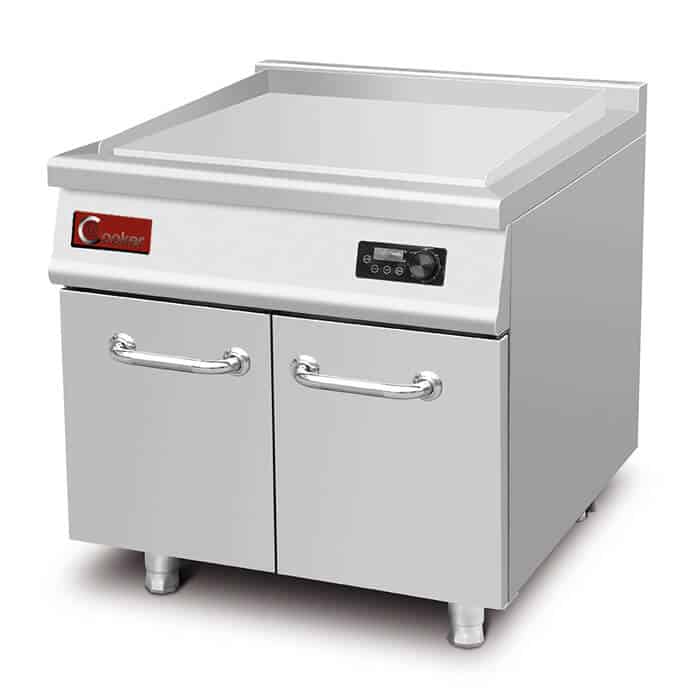
Plate thickness doesn’t exist in a vacuum—it works in tandem with the plate’s material to determine heat retention and cooking quality. The two most common materials for induction ready griddles are cast iron and 304 stainless steel, each with unique properties that interact with thickness differently. Below is a detailed comparison:
Cast Iron: The Gold Standard for Heat Retention
Cast iron is naturally ferromagnetic (ideal for induction) and has the highest thermal mass of any common griddle material. A 12mm thick cast iron plate on an induction ready griddle will retain heat longer than a 12mm stainless steel plate, making it perfect for searing or cooking dishes that require extended heat. However, cast iron does have tradeoffs: it takes longer to heat up (10–15 minutes to reach 375°F vs. 5–7 minutes for stainless steel) and requires regular seasoning to maintain its non-stick properties.
AT Cooker’s cast iron induction griddles (e.g., the 5KW AT-CI-G12) feature 12mm thick plates that are factory-seasoned for immediate use. A BBQ joint in Texas using this model said: “We cook 200+ burgers a day, and the cast iron plate keeps up. Even during the lunch rush, we never have to wait for the griddle to reheat—each burger gets the same perfect sear.”
304 Stainless Steel: The Versatile Commercial Choice
304 stainless steel is the most popular material for commercial induction griddles because it balances heat retention, durability, and ease of cleaning. An 8–10mm thick stainless steel plate heats up faster than cast iron, resists corrosion from commercial cleaning chemicals, and doesn’t require seasoning. While it doesn’t retain heat quite as long as cast iron, it still outperforms thin plates by a wide margin.
AT Cooker’s best-selling 3.5KW induction griddle (AT-SS-G08) uses an 8mm thick 304 stainless steel plate with a polished surface for easy wiping. A hotel breakfast buffet using this model noted: “We clean the griddle 10+ times a day—stainless steel wipes clean in seconds, and the thick plate doesn’t scratch. It’s perfect for our high-turnover buffet service.”
Enamel-Coated Cast Iron: A Middle Ground
Enamel-coated cast iron combines the thermal mass of cast iron with the easy cleaning of stainless steel. The enamel coating prevents rust and eliminates the need for seasoning, while the thick cast iron core ensures excellent heat retention. However, the enamel can chip if subjected to heavy impact (e.g., dropping a metal pan), so it’s best for kitchens with careful staff.
AT Cooker offers an enamel-coated option (AT-EC-G10) with a 10mm thick plate, popular with cafes that want cast iron performance without the maintenance. A café owner said: “We love the heat retention of cast iron, but we don’t have time to season it daily. The enamel coating solves that—we just wipe it clean and go.”
5. Thick vs. Thin Plates: A Side-by-Side Comparison
To quantify the impact of thickness, let’s compare a thick-plate (10mm 304 stainless steel) and thin-plate (5mm stainless steel) induction ready griddle—both from AT Cooker’s product line—across key metrics:
Metrik Galyň Plita Griddle (10mm 304# Polat)Inçe Plita Griddle (5mm Polat)Göterim Tapawudy375°F Gyzdyrmak Üçin Wagt6 minut 30 sekunt3 minut 15 sekuntGalyň plita: +100% (haýal gyzýar)2kg Sowuk Iýmit Goşandan Soň Temperaturanyň Düşüşi15°F55°FGalyň plita: -73% (az ýylylyk ýitgisi)Ýylylyk Saklama (Tok Öçürilenden 5 Minut Soň)Çeşme temperaturanyň 80%-nyÇeşme temperaturanyň 45%-nyGalyň plita: +78% (has gowy saklaýar)Partiýadan Soň 375°F Çenli Dikeltmek Üçin Wagt45 sekunt2 minut 15 sekuntGalyň plita: -67% (has çalt dikelýär)Energiýa Sarpy (8 Sagatlyk Çalşyk)9.2 kWh12.7 kWhGalyň plita: -28% (has az energiýa sarpy)5 Ýyldan Soň Egrelme Derejesi5%Galyň plita: -86% (az egrelýär)Iýmit Galyndysy (Ýakylan/Çig)2%8%Galyň plita: -75% (az galyndy)Bu tablisa görkezişi ýaly, galyň plitalar gyzdyrmak üçin birneme uzak wagt alsa-da, ýylylyk saklamak, energiýa tygşytlylygy we bişirmek yzygiderliligi boýunça muny artykmaç öwezini dolýar. Söwda aşhanalary üçin uzak möhletli peýdalar—has az energiýa çykdajylary, has az iýmit galyndysy we has uzak möhletli griddle—başlangyç gyzdyrmagyň haýal bolmagynyň azky ýerliksizliginden has agdyklyk edýär.
6. AT Cooker’s Approach to Griddle Plate Thickness
AT Cooker has spent 20 years optimizing griddle plate thickness for induction technology, with a focus on commercial kitchen needs. Their design philosophy is simple: prioritize thermal mass and even heat distribution over fast heat-up times, and pair thickness with high-quality materials to maximize durability. Below are the key ways AT Cooker implements this in their induction ready griddles:
6.1 Tailored Thickness by Power Output
AT Cooker matches plate thickness to the griddle’s power output to ensure optimal performance. Lower-power models (3.5KW) use 8mm thick plates, while higher-power models (5KW+) use 10–12mm thick plates. This balance ensures the plate can absorb and retain the heat generated by the induction coil without overheating or wasting energy.
For example, their 3.5KW countertop griddle (AT-SS-G08) uses an 8mm plate—ideal for small cafes cooking 50–100 portions per day. Their 5KW freestanding griddle (AT-SS-G10) uses a 10mm plate, designed for high-volume restaurants cooking 200+ portions per day.
6.2 Precision Engineering for Even Heat
AT Cooker’s engineering team uses finite element analysis (FEA) to simulate how magnetic fields interact with different plate thicknesses. This ensures the plate’s thickness is uniform across its entire surface, eliminating weak points that could lead to hot spots. The plates are also milled to a flatness tolerance of ±0.5mm, ensuring maximum contact with the induction coil for efficient heat transfer.
A senior engineer at AT Cooker explained: “We don’t just make a plate thick—we make it thick in the right places. Our FEA simulations show us exactly how eddy currents distribute, so we can optimize thickness to eliminate hot spots before the griddle ever leaves the factory.”
6.3 Mga De-kalidad na Materyales para sa Katagalan
Ang AT Cooker ay gumagamit lamang ng 304# stainless steel at high-grade cast iron para sa kanilang mga griddle plate—mga materyales na kayang makayanan ang bigat ng makapal na konstruksyon at komersyal na paggamit. Ang kanilang 304# steel ay nakakatugon sa mga pamantayan ng food-grade (NSF-certified) at naglalaman ng 18% chromium at 8% nickel para sa paglaban sa kalawang. Ang kanilang cast iron ay galing sa mga foundry na gumagamit ng nodular iron process, na ginagawa itong mas lumalaban sa pagbitak kaysa sa tradisyonal na cast iron.
Ang dedikasyon na ito sa mga materyales ay nagbubunga: ang mga griddle ng AT Cooker ay may average na haba ng buhay na 7+ taon sa komersyal na paggamit, kumpara sa 3–4 taon para sa mga griddle na gawa sa mas mababang kalidad na materyales.
6.4 Tunay na Pagsubok kasama ang mga Komersyal na Kostumer
Bago ilunsad ang isang bagong modelo ng griddle, sinusubukan ito ng AT Cooker sa mga tunay na kusina ng komersyal sa loob ng 6–12 buwan. Kasama dito ang feedback mula sa mga chef, line cook, at kitchen manager tungkol sa pagpapanatili ng init, kalidad ng pagluluto, at tibay. Halimbawa, ang kanilang 12mm cast iron griddle ay sinubukan sa isang abalang diner sa loob ng 8 buwan, na may mga pagbabago sa kapal ng plate batay sa feedback ng staff.
Sinabi ng isang product manager sa AT Cooker: “Alam ng aming mga kostumer ang pinakamahusay kung ano ang gumagana sa isang komersyal na kusina. Ginagamit namin ang kanilang feedback upang pinuhin ang kapal ng aming plate—halimbawa, dinagdagan namin ang kapal ng aming 5KW model mula 9mm hanggang 10mm batay sa feedback ng diner na kailangan ng plate ng mas mahusay na pagpapanatili ng init sa panahon ng mga rush.”
“Ginagamit namin ang mga induction griddle ng AT Cooker sa loob ng 5 taon, at ang kapal ng plate ang dahilan kung bakit kami bumabalik. Mayroon kaming 3.5KW model sa aming café at isang 5KW model sa aming restaurant—parehong may makakapal na plate na pantay ang luto at tumatagal sa araw-araw na paggamit. Noong nag-expand kami noong nakaraang taon, hindi na namin pinag-isipan ang ibang mga brand—bumili na lang kami ng isa pang AT Cooker griddle.”
7. Paano Pumili ng Tamang Kapal ng Plate para sa Iyong Induction Ready Griddle
Ang pagpili ng tamang kapal ng plate ay nakasalalay sa tatlong pangunahing salik: ang iyong istilo ng pagluluto, ang dami ng pagkain na iyong inihahanda, at ang iyong kagustuhan sa materyal. Nasa ibaba ang isang step-by-step na gabay upang matulungan kang magpasya:
Hakbang 1: Suriin ang Iyong Istilo ng Pagluluto
Ang mga putahe na madalas mong lutuin ang magdidikta kung gaano karaming init ang kailangan mong panatilihin:
- Searing/Grilling (Burgers, Steaks): Pumili ng makapal na plate (10–12mm cast iron o 10mm stainless steel) para sa maximum na pagpapanatili ng init at kakayahang mag-sear.
- Mga Pagkain sa Almusal (Omelets, Pancakes): Ang isang medium-thick plate (8–10mm stainless steel o 10mm enamel-coated cast iron) ay nagbabalanse ng pantay na pagluluto at mabilis na pag-init.
- Mga Delikadong Putahe (Isda, Gulay): Ang isang medium-thick plate (8mm stainless steel) ay nagsisiguro ng banayad, pantay na init nang hindi nasusunog.
Hakbang 2: Isaalang-alang ang Iyong Pang-araw-araw na Dami
Ang mga kusina na may mataas na dami ay nangangailangan ng mas makakapal na plate upang mahawakan ang madalas na batch cooking:
- Mababang Dami (0–50 Porsyon/Araw): Sapat na ang isang 8mm stainless steel plate—hal., AT Cooker’s 3.5KW countertop griddle.
- Katamtamang Dami (50–200 Porsyon/Araw): Isang 10mm stainless steel o 10mm enamel-coated cast iron plate—hal., AT Cooker’s 5KW built-in griddle.
- Mataas na Dami (200+ Porsyon/Araw): Isang 12mm cast iron o 12mm stainless steel plate—hal., AT Cooker’s 5KW freestanding griddle.
Hakbang 3: Suriin ang Kagustuhan sa Materyal at Pagpapanatili
Ang iyong kahandaang magpanatili ng griddle ay makakaimpluwensya sa iyong pagpili ng kapal at materyal:
- Mababang Pagpapanatili: Pumili ng 8–10mm stainless steel—hindi kailangan ng seasoning, madaling linisin.
- Willing to Season: Choose 12mm cast iron for superior heat retention.
- Balance of Maintenance and Performance: Choose 10mm enamel-coated cast iron—no seasoning, good heat retention.
Step 4: Match Thickness to Induction Power
Ensure the plate thickness matches the griddle’s power output. A high-power griddle (5KW+) needs a thicker plate to absorb and retain the generated heat—using a thin plate with a high-power griddle will lead to overheating and warping. AT Cooker’s griddles are pre-matched for power and thickness, so you don’t have to guess:
- 3.5KW Griddles: 8mm plate (stainless steel)
- 5KW Griddles: 10–12mm plate (stainless steel or cast iron)
- 8KW+ Griddles: 12mm plate (cast iron)
8. Conclusion: Why Thickness Is Non-Negotiable for an Induction Ready Griddle
For any commercial kitchen investing in an induction ready griddle, plate thickness is not an optional feature—it is the foundation of consistent cooking quality, energy efficiency, and long-term durability. A thick plate (8–12mm) provides the thermal mass needed to retain heat, eliminate hot spots, and recover quickly between batches—all critical for commercial service.
AT Cooker’s induction commercial griddles—available in 3.5KW, 5KW, and 8KW models with 8–12mm thick 304# stainless steel or cast iron plates—are engineered to meet the demands of busy commercial kitchens. Their focus on thickness, paired with high-quality materials and precision engineering, ensures each griddle delivers consistent results day after day, year after year.
Whether you’re searing burgers in a diner, making omelets in a hotel buffet, or cooking vegetables in a café, a thick-plate induction ready griddle is an investment that pays off in better food, lower costs, and happier customers.
Get AT Cooker Induction Griddle Plate Thickness Recommendation
Share your daily cooking volume (e.g., “100 burgers/day” or “50 omelets/hour”), primary dishes, and maintenance preferences, and we’ll recommend the perfect induction ready griddle with the ideal plate thickness for your needs.