5-year Warranty | 2-year Free Exchangeable | 1-year Free Return
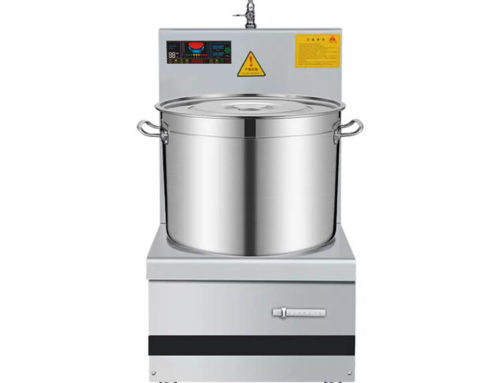
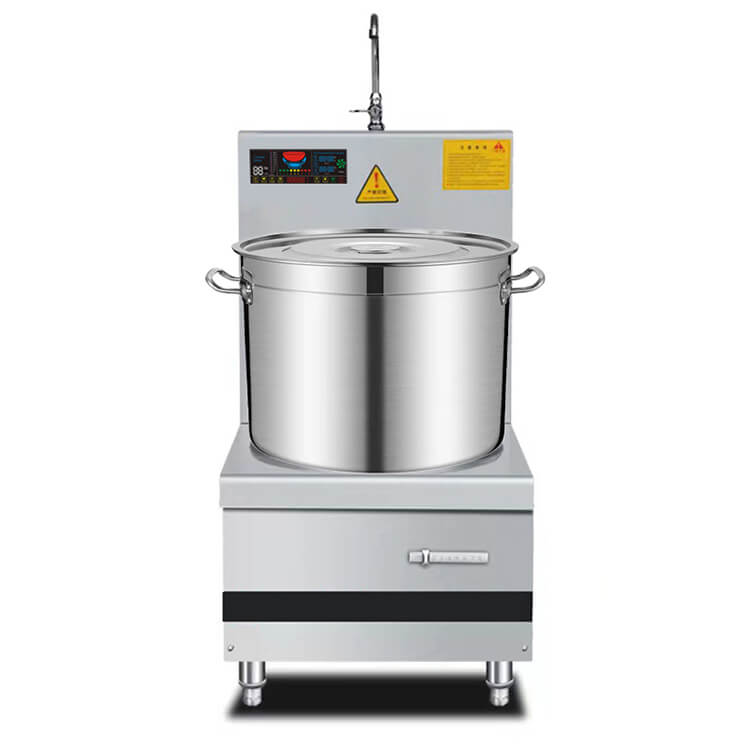
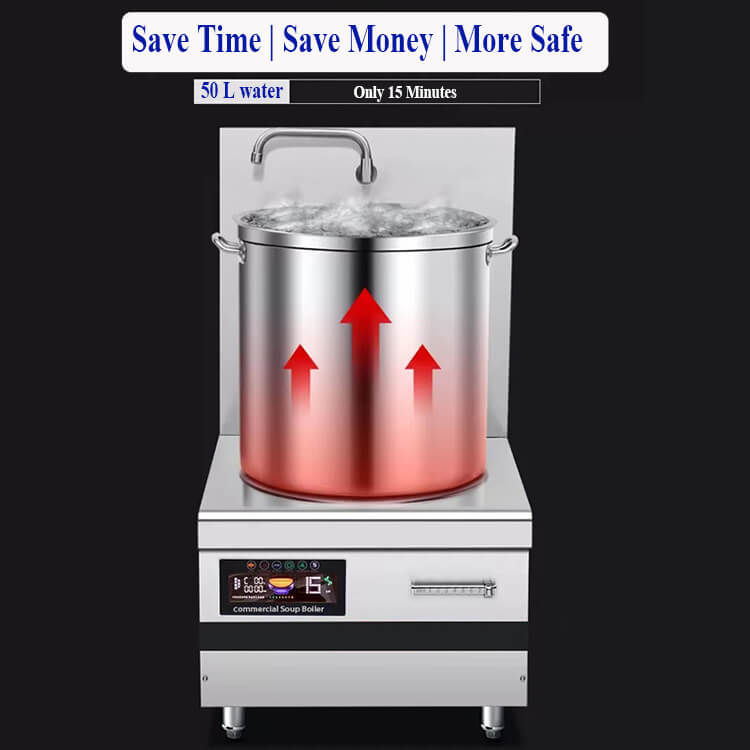
AT Cooker Executive Insight: The best bone broth takes time—12, 24, sometimes 48 hours. For restaurant owners, this means leaving equipment running overnight while the kitchen is empty. The anxiety of a gas fire or leak is a constant shadow. However, commercial induction safety for overnight cooking has revolutionized the industry. With flameless technology and intelligent sensors, AT Cooker stock pot burners allow you to produce premium stock without the sleepless nights. Here is why induction is the only responsible choice for unattended cooking. Every restaurant owner knows the feeling: waking up at 3:00 AM in a cold sweat, wondering, “Did we check the pilot light?” or “Is the stock pot boiling over?” Unattended cooking is necessary for many cuisines—from Japanese Ramen to French Consommé—but it is also the leading cause of restaurant fires. Traditional gas burners rely on a simple, dangerous principle: a continuous open flame. If that flame goes out, or if the liquid boils over, disaster can strike. Commercial induction technology removes the fire from the equation entirely. By using magnetic friction and digital intelligence, we can create heat with a safety factor that gas can never match. At AT Cooker , safety is our engineering priority. In this guide, we will analyze the 12 critical ways our induction stock pot burners protect your business, your staff, and your peace of mind.
1. Eliminating the Risk of Open Flame Flare-Ups in Unattended Kitchens
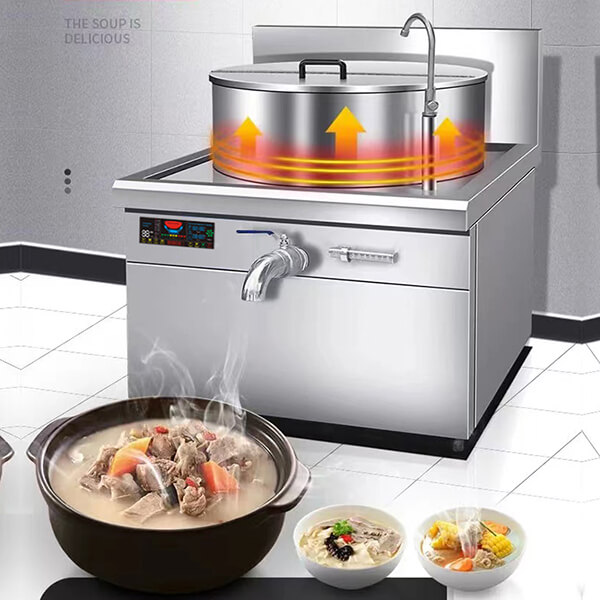
Fire is unpredictable. A slight draft from the HVAC system can push a gas flame toward a towel or an oily wall. When a kitchen is staffed, these flare-ups are managed. When the kitchen is empty at 2:00 AM, a small flare-up becomes a catastrophe. Induction is flameless. There is no ignition source. Even if a towel accidentally falls onto the AT Cooker unit, it won’t catch fire because the cooktop surface only heats up when a magnetic pot is present. This elimination of the “Fire Triangle” (Heat, Fuel, Oxygen) is the single biggest safety upgrade you can make.
2. The Silent Killer: Reducing Carbon Monoxide Buildup During Overnight Shifts
Gas burners produce Carbon Monoxide (CO) as a byproduct of combustion. In a busy day kitchen, the massive extraction hoods remove this gas. However, running huge extraction fans all night is noisy and expensive. If you turn the fans down or off while leaving gas burners on low for stock, CO can build up to lethal levels. Induction produces zero emissions. You can simmer 100 liters of stock in a sealed room without any risk of CO poisoning, making it the only safe choice for low-ventilation overnight cooking.
3. How Induction Technology Prevents Gas Leaks from Extinguished Pilot Lights
A pilot light is a tiny flame that can easily be blown out by a gust of wind or a cleaning crew’s mop. If the pilot goes out on an older gas unit, gas continues to flow. In an unattended kitchen, this gas fills the room, waiting for a spark. Induction has no gas lines. There is nothing to leak. If the power goes out, the unit simply stops. When power returns, it stays off until a human resets it (or resumes a program safely). The risk of an explosion is mathematically zero.
4. The Role of Intelligent Dry-Boil Protection Sensors in Preventing Fire Hazards
The most common cause of kitchen fires is a pot boiling dry. The liquid evaporates, the food burns, and the pot superheats until it ignites the residue or melts the metal. Smart Sensor Tech The AT Cooker induction controller monitors the temperature of the glass-ceramic plate 100 times per second. If it detects a sudden temperature spike (indicating the water has boiled off), it cuts power instantly. This “Dry-Boil Protection” is a fail-safe that gas burners simply cannot offer.
5. Reducing Insurance Premiums by Upgrading to Flameless Cooking Equipment
Insurance companies hate risk. Restaurants with 24-hour gas cooking operations pay some of the highest premiums in the industry. By switching to commercial bone broth equipment powered by induction, you reduce the fire risk profile of your establishment. Many owners find that declaring a “Flameless Kitchen” or specifying that overnight processes are electric-only can lead to significant reductions in insurance costs, helping to pay for the equipment upgrade over time.
6. The Importance of Programmable 24-Hour Timers for Automatic Shut-Off
Human memory is fallible. Chefs forget to turn stoves off. Gas ranges rarely have built-in timers that shut off the gas flow. Our commercial induction stock pot burners come with integrated, heavy-duty timers (often up to 24 hours). You can set the broth to simmer for exactly 12 hours. At the end of the cycle, the unit turns off automatically. This precision not only ensures consistency but guarantees the heat stops when it is supposed to.
7. Preventing “Boil-Overs” That Extinguish Gas Flames and Cause Dangerous Accumulation
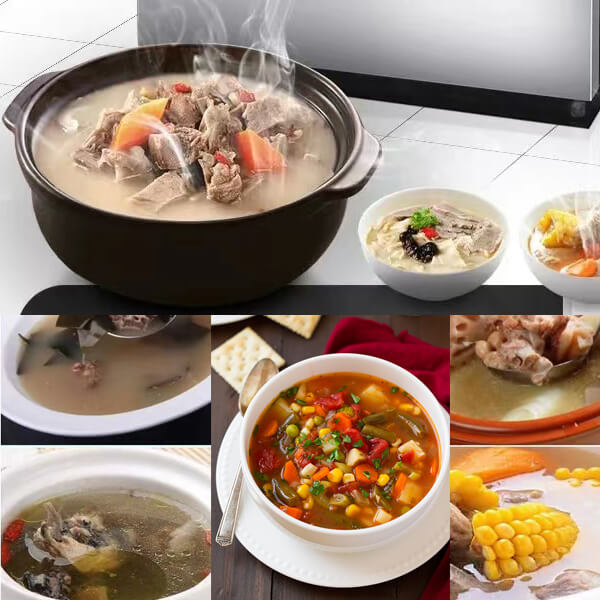
A boil-over is a mess on induction; on gas, it’s a hazard. If liquid spills over the side of a pot, it can extinguish the gas flame while the gas valve remains open. This leads to gas accumulation. Induction burners are sealed. A spill hits the glass, not a burner port. There is no flame to extinguish, and the electronic controls are protected by IPX4 waterproof ratings. A boil-over is just a cleaning issue, not a safety crisis.
8. Can You Turn Off Extraction Hoods at Night? Ventilation Rules for Induction Simmering
With gas, the answer is “No.” You must vent the combustion fumes. This means running expensive exhaust fans all night, sucking conditioned air out of your building. With induction, you are only boiling water. The byproduct is steam. While you still need some humidity control, you can often turn off the main high-powered grease hoods and rely on lighter ventilation or HVAC recycling. This massive energy saving is often overlooked in the gas vs induction safety comparison .
9. The Psychological Benefit: Reducing Owner Anxiety About “Checking the Stove” Remotely
Peace of mind has a value. Knowing that your stock pot is sitting on a device with thermal cut-offs, electrical surge protection, and automatic timers allows you to sleep. You don’t need to drive back to the restaurant at 11:00 PM to double-check the knobs. Advanced AT Cooker units maintain a stable state that is electronically monitored, removing the human error variable from the safety equation.
10. Maintaining Critical Food Safety Temperatures Without Constant Supervision
Food safety regulations (HACCP) require hot holding to stay above 60°C (140°F) to prevent bacterial growth. A gas flame on “low” might flicker and drop the temp, or burn too hot and spoil the stock. Induction offers precise temperature holding. You can set the unit to maintain a constant 90°C. The inverter pulses power to keep the liquid exactly there, ensuring you never drop into the “Danger Zone” during the long overnight cook.
11. The “Anti-Dry Burn” Algorithm: How Smart Chips Detect Low Water Levels Instantly
Our engineers have programmed an algorithm that detects the rate of temperature rise. If a pot has water, the temperature rises steadily (limited by the boiling point of 100°C). If the water disappears, the steel temperature skyrockets to 200°C+ in seconds. The AT Cooker chip detects this abnormal curve (Delta-T) and cuts the circuit before the pot can warp or smoke. This intelligence is your night watchman.
12. Ensuring “Wei Huo” (Micro-Heat) Stability to Prevent Broth Clouding While Sleeping
For clear broths (Consommé), the liquid must barely move. A rolling boil emulsifies fat, making the soup cloudy. Gas valves are hard to set to this “Micro-Heat” level reliably. Induction excels here. Low-power settings deliver gentle, intermittent pulses of energy that maintain temperature without agitation. You wake up to crystal-clear broth, every time. Safety Feature Gas Burner AT Cooker Induction Open Flame Constant Risk None Carbon Monoxide Produced Zero Dry Boil Protection None Auto Shut-Off Timer Shut-Off Manual Only Programmable
Final Thoughts from AT Cooker
Is your stock pot keeping you awake at night? It shouldn’t be. By upgrading to unattended commercial cooking safety standards with induction, you protect your investment and ensure your staff returns to a safe kitchen every morning. With stock ready in the USA, Germany, France, and Europe , AT Cooker can help you make the switch immediately. Don’t gamble with fire. Choose the safety of induction. Visit our About Us page to contact our safety experts.
Commercial Kitchen Equipment – from AT Cooker
- ✔As a brand manufacturer of the professional commercial induction cooking equipment, AT Cooker has responded to restaurants’ & hotels’ needs and research normative commercial cooking equipment using the very latest induction technology.
- ✔These seamless, real commercial quality commercial cooking equipment provides us with the opportunity to incorporate equipment of our choice into one seamless, multipurpose cooking equipment creating an efficient, low cost, safe, green and sustainable commercial kitchen. We have standerd equipment can service many commercial kitchens.
- ✔AT Cooker always offers professional service. From material, design, to producing, we focuse on quality, performance and reliability to ensures the best solution is delivered for each and every one of our customers. Have a commercial kitchen? We will be one of your best partners.
Work Voltage
Global In-Stock + Fast Pickup
Frequently Asked Questions
1. Eliminating the Risk of Open Flame Flare-Ups in Unattended Kitchens
Fire is unpredictable. A slight draft from the HVAC system can push a gas flame toward a towel or an oily wall. When a kitchen is staffed, these flare-ups are managed. When the kitchen is empty at 2:0…
2. The Silent Killer: Reducing Carbon Monoxide Buildup During Overnight Shifts
Gas burners produce Carbon Monoxide (CO) as a byproduct of combustion. In a busy day kitchen, the massive extraction hoods remove this gas. However, running huge extraction fans all night is noisy and…
3. How Induction Technology Prevents Gas Leaks from Extinguished Pilot Lights
A pilot light is a tiny flame that can easily be blown out by a gust of wind or a cleaning crew’s mop. If the pilot goes out on an older gas unit, gas continues to flow. In an unattended kitchen, this…
4. The Role of Intelligent Dry-Boil Protection Sensors in Preventing Fire Hazards
The most common cause of kitchen fires is a pot boiling dry. The liquid evaporates, the food burns, and the pot superheats until it ignites the residue or melts the metal. Smart Sensor Tech The AT Coo…
5. Reducing Insurance Premiums by Upgrading to Flameless Cooking Equipment
Insurance companies hate risk. Restaurants with 24-hour gas cooking operations pay some of the highest premiums in the industry. By switching to commercial bone broth equipment powered by induction, y…