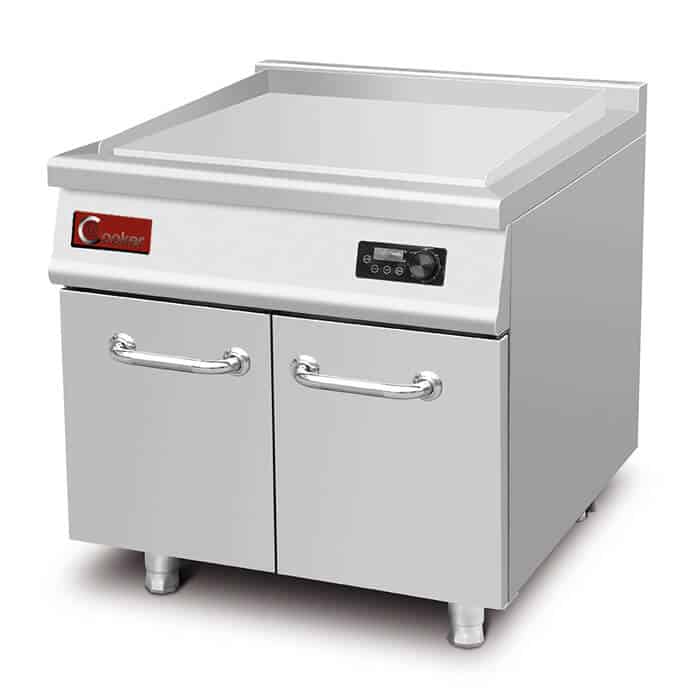
95% Efficiency vs 40% Gas: 11 Insights on Induction Griddle Utility Savings
5-year Warranty | 2-year Free Exchangeable | 1-year Free Return
In the high-stakes arena of modern food service, particularly for Chain Restaurants and Quick Service Restaurants (QSRs), the margin for error is razor-thin. For decades, the commercial kitchen has been dominated by the roar of gas burners and the intense heat of traditional griddles. These machines have been the workhorses of the line, searing steaks, flipping burgers, and scrambling eggs. Yet, a silent, invisible thief has been operating in kitchens worldwide, siphoning off profits hour by hour: energy inefficiency. The debate between commercial induction thermal efficiency and traditional gas heating is no longer just about environmental sustainability—it is a critical conversation about financial survival and operational profitability.
At AT Cooker, we have spent over 15 years analyzing commercial kitchen pain points, moving beyond simple manufacturing to understand the daily struggles of chefs and owners. We have witnessed firsthand how outdated gas equipment bleeds money, not just through the gas lines but through the HVAC systems struggling to combat the massive waste heat. With the rapid advancement of induction griddle energy cost savings technology, the landscape is shifting dramatically. Today, we are diving deep into the math, the physics, and the hard financial realities of why upgrading to induction is the smartest capital expenditure you can make this fiscal year.
Industry Reality Check: Did you know that a standard gas griddle wastes nearly 60 cents of every dollar you spend on fuel? In stark contrast, induction commercial griddles retain 95 cents of value directly in the cooking process, transforming your utility bill from a liability into an asset.
1. The Core Physics: 95% Thermal Efficiency vs. 40% Gas Waste
The most significant differentiator in the electric vs gas griddle efficiency comparison lies in the fundamental method of heat transfer. Traditional gas griddles operate on a surprisingly primitive principle: you burn fuel to heat air, which in turn heats a heavy metal plate, which finally transfers heat to the food. This multi-step process is riddled with “energy leaks” at every stage.
Thermal Efficiency Comparison
Data Source: AT Cooker Labs & Industry Standards
Gas Griddles (The 40% Trap): According to industry standards and reports from bodies like the Food Service Technology Center (FSTC), even well-tuned gas griddles often operate at a mere 40-50% efficiency. The remaining 50-60% of the energy you pay for escapes around the sides of the griddle plate as hot flue gas. You are essentially paying to heat your kitchen air, not your food.
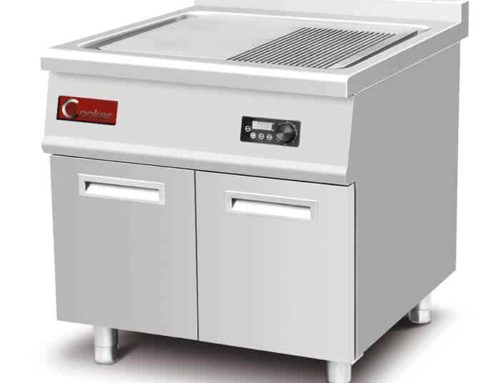
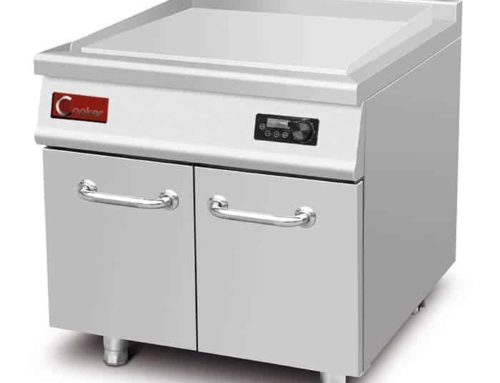
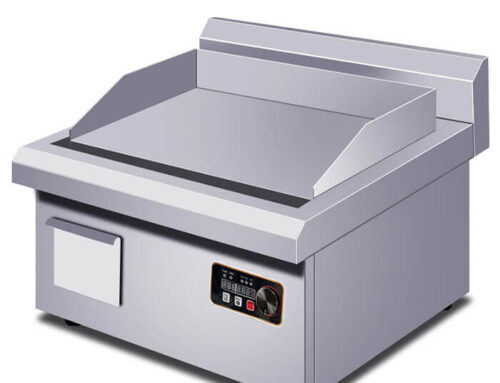
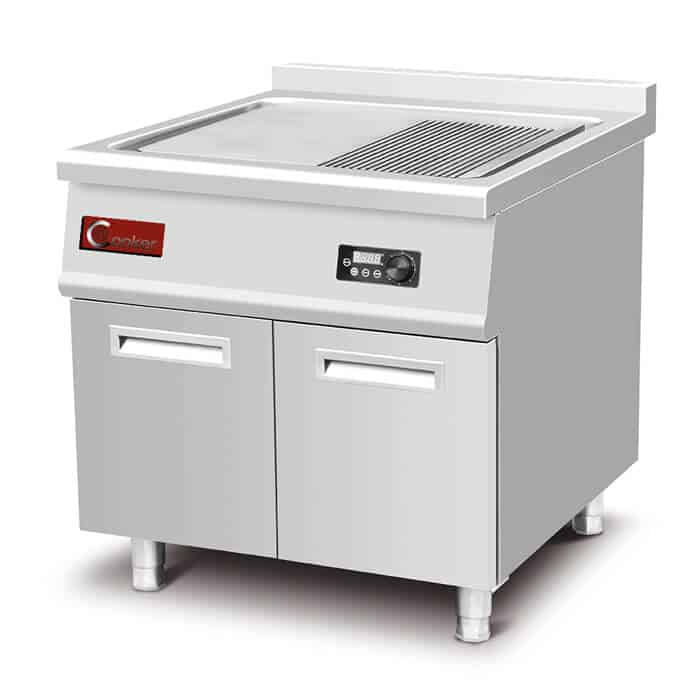
Induction Technology (The 95% Solution): Commercial induction thermal efficiency hits 90-95% because there is no intermediate heating element. The electromagnetic field excites the iron molecules within the griddle plate itself. The plate becomes the heat source. There is zero heat loss to the surrounding air during the generation phase. This difference isn’t just theoretical. For a QSR running equipment 12 to 16 hours a day, this efficiency gap translates into massive operational variances. When you utilize an AT Cooker Induction Griddle, you are harnessing direct energy transfer, ensuring that every kilowatt paid for is a kilowatt used for cooking.
2. The “Double Tax” of Gas: Hidden HVAC Loads
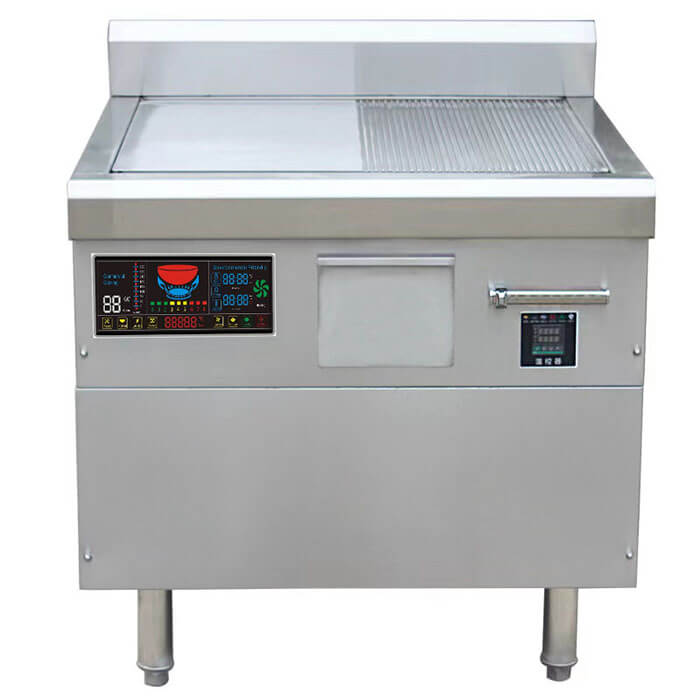
One of the most overlooked aspects of induction griddle energy cost analysis is what we call the “Double Tax.” When you run a 30,000 BTU gas griddle, roughly 18,000 BTUs are dumped directly into your kitchen environment as waste heat. In a busy commercial kitchen, this raises the ambient temperature significantly, creating a harsh environment for chefs and stressing other equipment.
This leads to the second tax: your HVAC system. Your air conditioning must work overtime to remove that 18,000 BTUs of waste heat. So, you pay the gas company to generate the heat, and then you pay the electric company to remove it. It is a financial hemorrhage that most restaurant owners accept as “the cost of doing business.” It doesn’t have to be.
Commercial Kitchen Equipment – from AT Cooker
- As a brand manufacturer of the professional commercial induction cooking equipment, AT Cooker has responded to restaurants’ & hotels’ needs and research normative commercial cooking equipment using the very latest induction technology.
- These seamless, real commercial quality commercial cooking equipment provides us with the opportunity to incorporate equipment of our choice into one seamless, multipurpose cooking equipment creating an efficient, low cost, safe, green and sustainable commercial kitchen. We have standerd equipment can service many commercial kitchens.
- AT Cooker always offers professional service. From material, design, to producing, we focuse on quality, performance and reliability to ensures the best solution is delivered for each and every one of our customers. Have a commercial kitchen? We will be one of your best partners.
Work Voltage
| Single-Phase | Three-Phase |
|---|---|
| 120V, 220V | 208V/ 240V, 380V, 480V |
Global In-Stock + Fast Pickup
| US | UK | Germany | France |
|---|---|---|---|
| Italy | Spain | Belgium | Bulgaria |
3. Break-Even Analysis: ROI in 12-18 Months
Many restaurant owners hesitate at the initial price tag of induction equipment. It is true: premium induction griddles often command a higher upfront cost than standard gas counterparts. However, viewing this through CapEx (Capital Expenditure) alone is a strategic error. You must look at OpEx (Operational Expenditure). The initial investment in AT Cooker technology is recouped rapidly through daily savings.
Based on our extensive market data and feedback from over 500 QSR clients, the average establishment switching from gas to commercial induction thermal efficiency systems sees a break-even point in just 12 to 18 months. This ROI is achieved solely through monthly utility bill reductions. After this period, the savings become pure profit, contributing directly to your bottom line. For a machine designed to last 8-10 years, that represents nearly a decade of higher profit margins.
Zero idle consumption plays a massive role here. A gas griddle with a standing pilot light burns gas 24/7 unless manually shut off. That pilot light alone can cost hundreds of dollars annually per unit. With induction, when you remove the pan or turn off the zone, energy consumption drops to near zero instantly. There is no “idling” cost.
5-year Warranty | 2-year Free Exchangeable | 1-year Free Return
4. The Myth of Power: Why 5kW Induction Beats 30,000 BTU Gas
A common misconception we hear from chefs is, “Gas has more power.” They see “30,000 BTU” on a spec sheet and compare it to “5kW” (approx. 17,000 BTU) and assume gas is stronger. This is a fundamental flaw in understanding effective power delivery in a commercial environment.
Because gas is only 40% efficient, a 30,000 BTU burner only delivers about 12,000 BTUs of actual heat to the cooking surface. In contrast, a 5kW induction coil, operating at 95% efficiency, delivers roughly 16,150 BTUs directly to the food. In real-world tests, a 5kW commercial induction griddle heats up faster, recovers temperature quicker, and sears more consistently than its gas rival. It is not about how much energy you burn; it is about how much energy actually reaches the steak.
5. Operational Advantages: Speed, Recovery, and Precision
Beyond the utility bills, the functional advantages of induction griddle energy cost savings extend deeply into food quality and speed of service—metrics that define customer satisfaction.
- Instant Recovery Technology: When a chef throws ten frozen patties onto a gas griddle, the plate temperature plummets. It takes significant time for the gas burners to drive heat back through the heavy metal plate. AT Cooker’s induction sensors detect this drop instantly and dump full power into the zone, recovering temperature in seconds, not minutes. This ensures consistent searing and food safety, even during the lunch rush.
- Precise Zone Control: Standard gas manifolds typically heat the entire plate or large, imprecise sections. Induction coils allow for laser-focused zone control. You can have one zone searing at 400°F and the adjacent zone keeping buns warm at 150°F, without heat bleeding between them. This level of control is simply impossible with standard gas setups.
- Ambient Temperature Benefits: As mentioned, less waste heat means a cooler kitchen. This has a secondary benefit: your refrigeration units (prep tables, walk-ins) don’t have to work as hard to maintain their temperatures. This extends the lifespan of your compressors and lowers electricity draw across the entire kitchen ecosystem.
6. Durability and The “Hidden” Engineering Quality
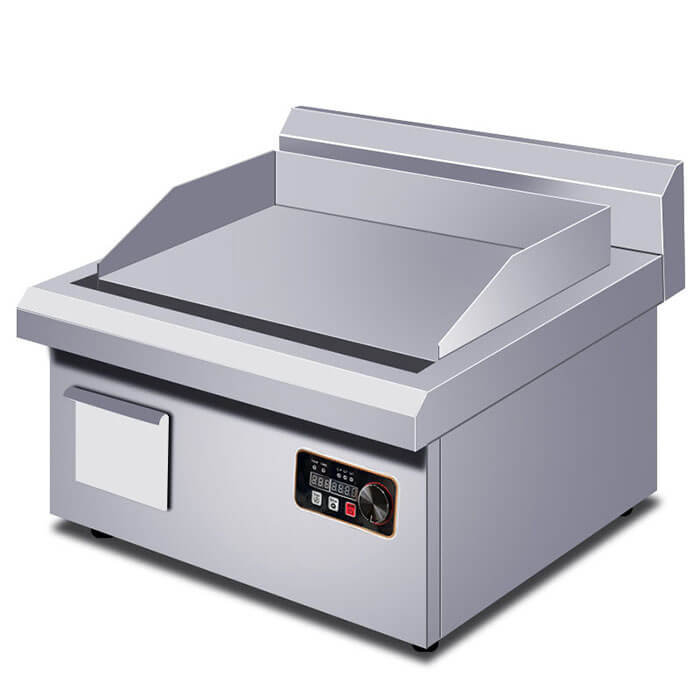
Why do some induction units last 10 years and others fail in 6 months? The secret lies in the components you can’t see. AT Cooker prioritizes internal build quality over flashy exteriors.
Sealed Induction Coils
One of the biggest maintenance headaches with gas is clogged nozzles. Grease, dust, and carbon buildup require frequent cleaning and calibration. AT Cooker uses fully sealed induction coils. These components are impervious to grease splashes and flour dust. They maintain their 95% efficiency for their entire lifespan because there are no physical nozzles to clog, ensuring consistent performance year after year.
The IGBT Factor (Insulated Gate Bipolar Transistor)
This is the brain of the induction unit. Many manufacturers cut costs here, using cheap generic transistors. At AT Cooker, we utilize premium German IGBTs (often from Infineon). While these cost 35% more than standard components, they reduce electronic failure rates by over 80%. In a busy commercial kitchen, reliability is not a luxury; it is a necessity.
“Manufacturing costs rise 8-12% for every real 1kW increase in commercial power output. Be wary of cheap units claiming high power; often, they are overdriving weak components that will fail under load.” – AT Cooker Engineering Team
7. Why Choose AT Cooker? The 5-Year Guarantee
We don’t just sell equipment; we partner with your business. We understand that adopting new technology feels risky. That is why we have structured our service to eliminate that risk entirely. Our commitment goes far beyond the sale.
| 5-Year Warranty | We stand behind our induction commercial griddles for half a decade. Most competitors offer 1 year. We know our build quality can endure the harshest kitchen environments. |
| 2-Year Free Exchange | If a unit fails due to a manufacturing defect within the first two years, we don’t just repair it; we exchange it. No downtime, no arguments. |
| 1-Year Free Return | Not satisfied? We offer a 1-year free return policy. We are that confident in our performance and the value we bring to your kitchen. |
| Global Stock | Need it now? We have stock in the US, UK, Germany, France, Belgium, Italy, Spain, and Bulgaria. No waiting for ocean freight. Get your equipment installed and running in days, not months. |
5-year Warranty | 2-year Free Exchangeable | 1-year Free Return
8. AT Cooker’s Final Verdict
The transition from gas to induction is not a trend; it is the inevitable future of commercial kitchens. With commercial induction thermal efficiency reaching 95%, the savings on utility bills, HVAC loads, and maintenance make the ROI undeniable. When you factor in the speed, precision, and cooler working environment, the choice becomes clear.
Whether you are retrofitting an existing line or building a new concept, we recommend analyzing your current utility spend. You will likely find that the “cheaper” gas griddle is actually the most expensive piece of equipment you own in the long run. Trust in AT Cooker’s 15 years of experience to guide you toward a more profitable, efficient, and modern kitchen.
For more detailed data on energy savings, you can refer to reports from Energy Star Commercial Griddles or research from the Food Service Technology Center. For our Chinese market insights, check the latest data on China Household Electrical Appliances Association regarding induction standards.
Frequently Asked Questions
How much energy does an induction griddle save compared to gas?
AT Cooker induction griddles reach 90-95% thermal efficiency because the electromagnetic field heats the plate directly, with no intermediate element. Gas griddles typically run at 40-50%, losing the rest as flue gas around the plate. In practice that means most of the energy you pay for goes into the food, not into the kitchen air.
Does switching to induction reduce kitchen cooling costs?
Yes. A gas griddle dumps waste heat into the room, so your HVAC works harder to remove it. Induction wastes far less heat into the space, which lowers the air-conditioning load on top of the cooking-energy saving. That second saving is real money on your electric bill every month.
How long does it take to break even on an induction griddle?
For a typical quick-service operation running the griddle 12 to 16 hours a day, the combined cooking-energy and HVAC savings usually recover the equipment premium in about 12 to 18 months. After that the monthly saving is pure margin.
Is a 5kW induction griddle really as powerful as a 30,000 BTU gas unit?
In usable heat, yes. Because induction transfers energy directly into the plate at 90-95% efficiency, a 5kW unit delivers more effective cooking power than a 30,000 BTU gas burner that loses over half its output. You also get faster recovery between batches and tighter temperature control.
What warranty does AT Cooker provide on induction griddles?
Every AT Cooker induction griddle carries a 5-year warranty, with 2-year free exchange and 1-year free return. The units use Infineon IGBT modules and pure-copper coils, and the 304 stainless body with a micro-crystal glass plate is built for continuous service in commercial kitchens.