Commercial Kitchen HVAC Savings: 11 Insights on Cutting AC Load via Induction
5-year Warranty | 2-year Free Exchangeable | 1-year Free Return
In the fiercely competitive world of Chain Restaurants and Quick Service Restaurants (QSRs), operators are constantly hunting for efficiency. Yet, one of the largest financial drains remains invisible: the ambient heat load. Traditionally, commercial kitchens are accepted as hot, uncomfortable environments where massive utility bills are just “the cost of doing business.” But what if the heat source itself is the problem? The conversation around commercial kitchen HVAC savings is shifting from “how to cool the kitchen” to “how to stop heating it.”
At AT Cooker, with 15 years of field research, we have identified that the primary culprit for skyrocketing electricity bills isn’t the AC unit—it’s the inefficient gas equipment fighting against it. Switching to induction commercial griddle technology doesn’t just lower cooking costs; it fundamentally changes the HVAC equation. Here are 11 professional insights into how induction drastically reduces your heat load.
The Thermal Reality Check
A standard gas kitchen acts like a radiator fighting your air conditioner. For every $1.00 you spend on gas, you might be spending another $0.50 on electricity just to remove the waste heat it generates. This is the hidden “thermal tax” of legacy equipment.
1. The Physics of Waste: Gas Radiates 60% Heat
To understand commercial kitchen HVAC savings, we must look at where the heat goes. A gas griddle operates on convection and radiation. In a typical scenario, only about 40% of the energy enters the food. The other 60%? It radiates directly into your kitchen air. Reports from Energy Star confirm that even efficient gas models struggle to minimize this ambient loss.
Imagine running a 100,000 BTU gas appliance. You are effectively dumping 60,000 BTUs of raw heat into your kitchen every hour. In contrast, AT Cooker’s induction technology utilizes electromagnetic fields to generate heat directly within the griddle plate. This results in 95% thermal efficiency.
Gas Griddle
60% Heat Loss
Radiated into Kitchen Air
AT Induction
Only 5% Loss
Cooler Kitchen Environment
2. Eliminating the “Double Tax”
The “Double Tax” is a cycle of financial inefficiency. First, you pay the gas utility to burn fuel. Second, because that fuel raises the ambient room temperature, you pay the electric utility to remove that same heat via AC. By switching to an induction commercial griddle, you break this cycle.
Our clients in hot climates like Texas have reported that their kitchen AC units cycle off for the first time in years during service hours after switching to induction. This is direct operational profit.
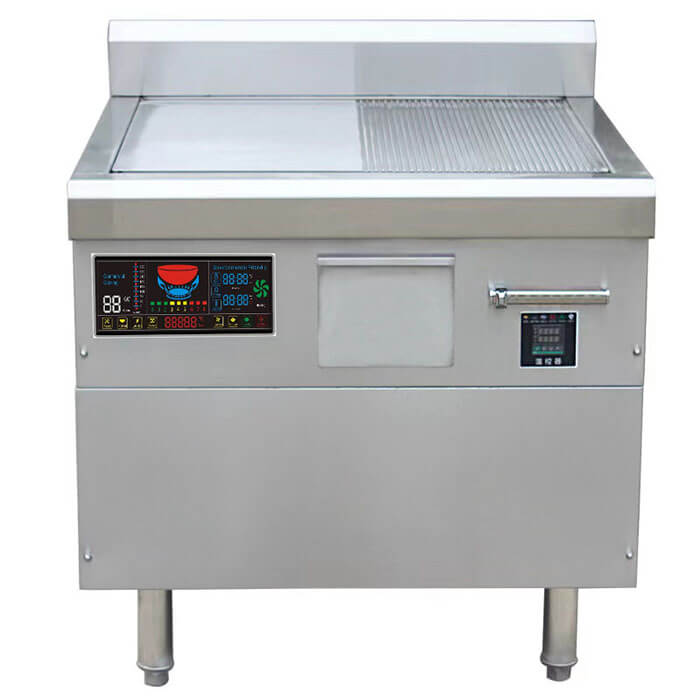
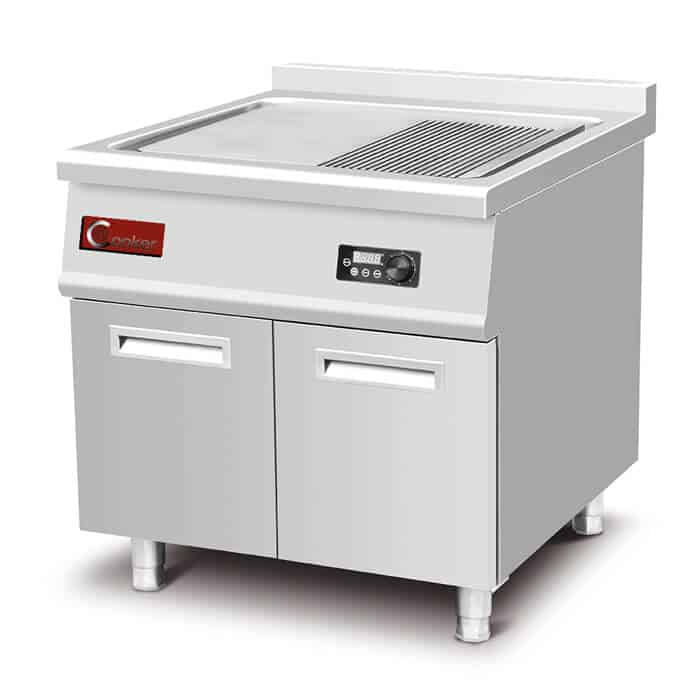
Fig 1. AT Cooker Induction Griddle: 95% Efficient, Zero Waste Heat.
Commercial Kitchen Equipment -from AT Cooker
- As a brand manufacturer of the professional commercial induction cooking equipment, AT Cooker has responded to restaurants’ & hotels’ needs and research normative commercial cooking equipment using the very latest induction technology.
- These seamless, real commercial quality commercial cooking equipment provides us with the opportunity to incorporate equipment of our choice into one seamless, multipurpose cooking equipment creating an efficient, low cost, safe, green and sustainable commercial kitchen. We have standerd equipment can service many commercial kitchens.
- AT Cooker always offers professional service. From material, design, to producing, we focuse on quality, performance and reliability to ensures the best solution is delivered for each and every one of our customers. Have a commercial kitchen? We will be one of your best partners.
Work Voltage
| Single-Phase | Three-Phase |
|---|---|
| 120V, 220V | 208V/ 240V, 380V, 480V |
Global In-Stock + Fast Pickup
| US | UK | Germany | France |
|---|---|---|---|
| Italy | Spain | Belgium | Bulgaria |
3. Reducing HVAC Tonnage (CapEx Savings)
When designing a new kitchen, the size of the HVAC system (tonnage) is determined by the total heat load. Because induction dumps so little heat, induction kitchens often require 30-40% less cooling tonnage.
For example, if a gas kitchen needs a 20-ton AC unit, an all-induction kitchen might only need 12 tons. The savings on the AC unit alone can often offset the premium cost of induction equipment.
4. Extending Compressor Lifespan
By lowering the ambient room temperature, you reduce the “Delta T” (temperature difference) your AC must fight. This reduction in mechanical stress extends the operational lifespan of your HVAC equipment. Instead of replacing blown compressors every 3-5 years, you might get 10-15 years out of your system.
5-year Warranty | 2-year Free Exchangeable | 1-year Free Return
5. Optimizing Demand Control Ventilation
Modern “Smart” hoods adjust fan speeds based on heat load. Gas griddles produce hot thermal plumes even when idle, forcing fans to run at high speeds. Induction produces significantly cooler plumes, allowing fans to run slower. Guidelines from the ASHRAE Design Guide for Commercial Kitchen Ventilation highlight the importance of heat plume management for energy conservation.
| Factor | Traditional Gas Kitchen | AT Cooker Induction Kitchen |
|---|---|---|
| Heat Source | Radiant (Heats air & food) | Magnetic (Heats cookware only) |
| Latent Load (Humidity) | High (Gas combustion releases water) | Low (No combustion) |
| AC Load Factor | High “Delta T” Stress | Reduced Load |
6. Humidity Control: The Latent Load
Air conditioning removes both heat (sensible load) and moisture (latent load). Gas combustion produces water vapor, increasing kitchen humidity. By removing gas, induction eliminates this moisture source, creating a crisper, drier environment that is cheaper to cool.
7. Protecting Refrigeration Units
For every 10°F rise in ambient temperature, refrigeration compressors consume 10-20% more energy. By dropping the ambient room temperature by 10°C (18°F) with induction, you are saving your fridges from overworking. A cooler kitchen means your refrigeration condensers can breathe.
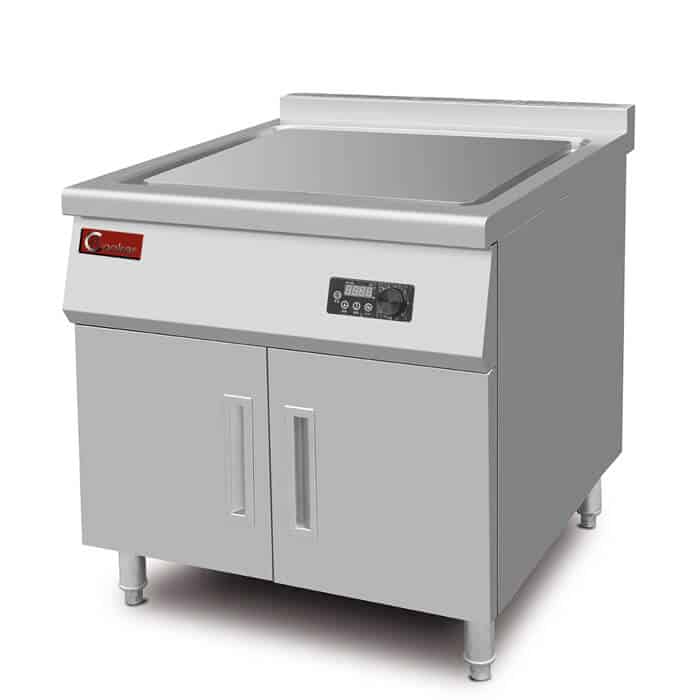
8. Focused Zones vs. Uncontrolled Radiators
Gas griddles act as uncontrolled radiators, heating the chef’s legs and the ceiling. AT Cooker’s commercial induction griddles feature precise “Zone Control,” ensuring heat is only generated where the food touches.
9. Flattening Seasonal Utility Spikes
Because induction minimizes internal heat gain, your kitchen’s base load remains stable. While competitors see energy costs double in July/August due to AC fighting gas heat, your induction kitchen remains consistent, allowing for better cash flow management.
10. “Green Kitchen” Standards & Mall Mandates
In dense Asian metropolises, malls are mandating “Green Kitchen” standards that prohibit open flame gas to control ambient temperatures. AT Cooker supplies compliant equipment for these strict codes. Adopting induction now positions your brand as future-proof.
11. Eliminating “Water-Wash” Hoods
Gas equipment often requires complex “water-wash” hoods to cool intense exhaust. With induction, exhaust temperatures are significantly lower, eliminating the need for these expensive, maintenance-heavy systems. A simpler hood means lower installation costs.
5-year Warranty | 2-year Free Exchangeable | 1-year Free Return
AT Cooker’s Final Verdict: The days of the “sweatbox” kitchen are numbered. By removing waste heat at the source, you trigger a cascade of benefits: lower utility bills, smaller HVAC requirements, and happier staff. The kitchen of the future is cool, quiet, and electric. We are ready to help you make the switch.