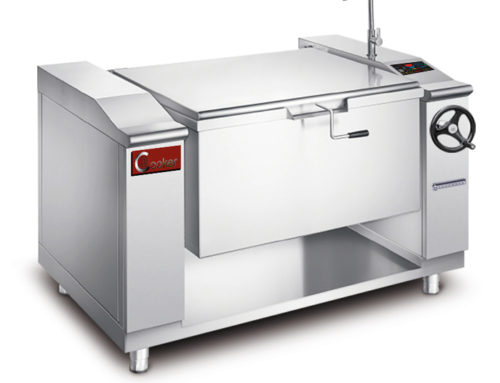
Deep Frying in a Bratt Pan: Can Induction Tilting Skillets Match Dedicated Fryer Recovery Speeds?
5-year Warranty | 2-year Free Exchangeable | 1-year Free Return
AT Cooker Executive Insight: The Commercial Bratt Pan (Tilting Skillet) is often called the “workhorse” of institutional kitchens. But can it truly replace a dedicated deep fryer for high-volume output? The limiting factor has always been heat recovery. Gas tilting skillets struggle to maintain oil temperature when cold batches are dropped. However, with commercial induction bratt pan deep frying technology, the game has changed. The AT Cooker Induction Bratt Pan delivers instant, uniform power, offering recovery speeds that rival dedicated fryers while providing unmatched versatility for braising and grilling.
In large-scale catering—hospitals, universities, and military canteens—floor space is tight. Dedicated deep fryers are single-purpose machines that sit idle for hours. The appeal of a Bratt Pan is its ability to do everything. But can you really fry 50kg of schnitzel or chips in a tilting skillet without them turning soggy?
The answer lies in thermal dynamics. Traditional gas skillets heat unevenly and recover slowly. Tilting skillet heat recovery powered by 20KW+ induction coils is instantaneous. This allows chefs to maintain the critical 180°C frying temperature even during heavy loading cycles. While it lacks the sediment “cold zone” of a tube fryer, its surface area and power density make it a formidable multi-purpose industrial cooking machine.
In this operational analysis, we explore the feasibility, speed, and safety of deep frying in an AT Cooker Induction Bratt Pan.
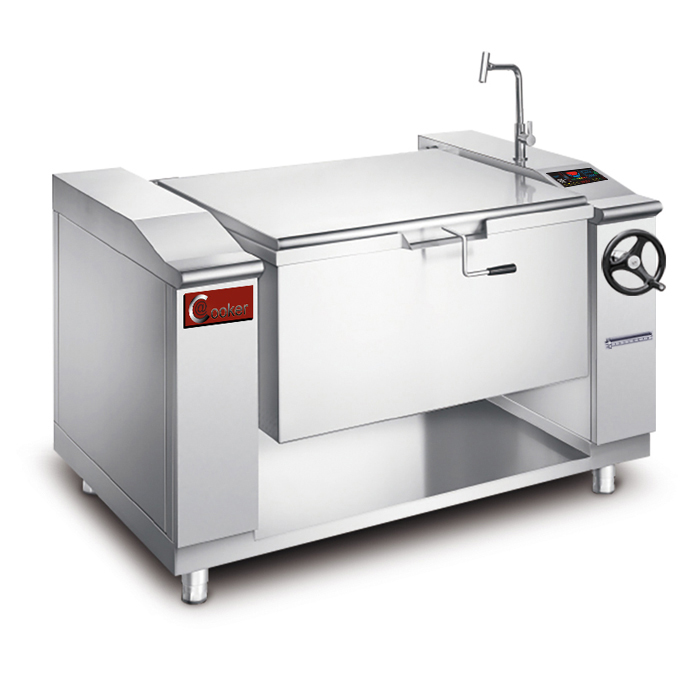
Commercial Kitchen Equipment -from AT Cooker
- As a brand manufacturer of the professional commercial induction cooking equipment, AT Cooker has responded to restaurants’ & hotels’ needs and research normative commercial cooking equipment using the very latest induction technology.
- These seamless, real commercial quality commercial cooking equipment provides us with the opportunity to incorporate equipment of our choice into one seamless, multipurpose cooking equipment creating an efficient, low cost, safe, green and sustainable commercial kitchen. We have standerd equipment can service many commercial kitchens.
- AT Cooker always offers professional service. From material, design, to producing, we focuse on quality, performance and reliability to ensures the best solution is delivered for each and every one of our customers. Have a commercial kitchen? We will be one of your best partners.
Work Voltage
| Single-Phase | Three-Phase |
|---|---|
| 120V, 220V | 208V/ 240V, 380V, 480V |
Global In-Stock + Fast Pickup
| US | UK | Germany | France |
|---|---|---|---|
| Italy | Spain | Belgium | Bulgaria |
1. Comparing Thermal Recovery Curves: Induction Bratt Pan vs. Dedicated Deep Fryer
In a deep fryer, heating elements are immersed directly in the oil. In a gas Bratt Pan, flames heat the bottom plate. This creates lag. When you drop a basket of frozen fries, the oil temp drops.
The AT Cooker Induction Bratt Pan uses the entire bottom surface as the heating element. With 95% efficiency, it recovers temperature almost as fast as a dedicated electric fryer, and significantly faster than a gas tilting skillet, making it a viable induction vs gas deep fryer speed competitor.
2. The Impact of Flat-Bottom Heating on Oil Temperature Uniformity
Tube fryers have cold spots. An induction Bratt Pan heats the entire rectangular base evenly. This means you can use the whole surface area for frying large items like whole fish or schnitzels without worrying about “dead zones.”
However, because the heat comes from the bottom, you must ensure the oil level is sufficient (at least 5-8cm deep) to allow convection currents to distribute that heat vertically.
3. Can High-Power Induction Prevent the “Soggy Crust” Syndrome in Bulk Batches?
Soggy food happens when oil temperature drops below 160°C. The food absorbs oil instead of searing.
With heavy duty electric braising pan power levels (up to 25KW), the AT Cooker unit punches energy into the pan instantly when a load is detected. This keeps the oil hot, sealing the crust immediately, even when cooking 10kg of product at once.
4. Managing Sediment: The Missing “Cold Zone” Challenge in Bratt Pan Frying
Dedicated fryers have a “Cold Zone” at the bottom where crumbs fall to prevent burning. Bratt pans do not; the bottom is the hottest part.
To fry successfully in a Bratt Pan, you must filter the oil more frequently. It is ideal for “clean” frying (fries, donuts) or shallow frying (schnitzel). For heavily breaded items (fried chicken), you will need to skim sediment actively to prevent carbonization.
5. The Safety Challenge: Tilting and Draining Large Volumes of 180°C Oil
Draining a standard fryer is messy. Draining a Bratt Pan is motorized. The AT Cooker unit features an automatic tilting mechanism.
You can pour hot oil directly into a disposal caddy with precision control. This eliminates the need for drain pipes that can clog or leak, making the oil change process safer and faster for staff.
5-year Warranty | 2-year Free Exchangeable | 1-year Free Return
6. Oil Volume to Food Ratio: Optimizing Frying Loads in Wide Surface Skillets
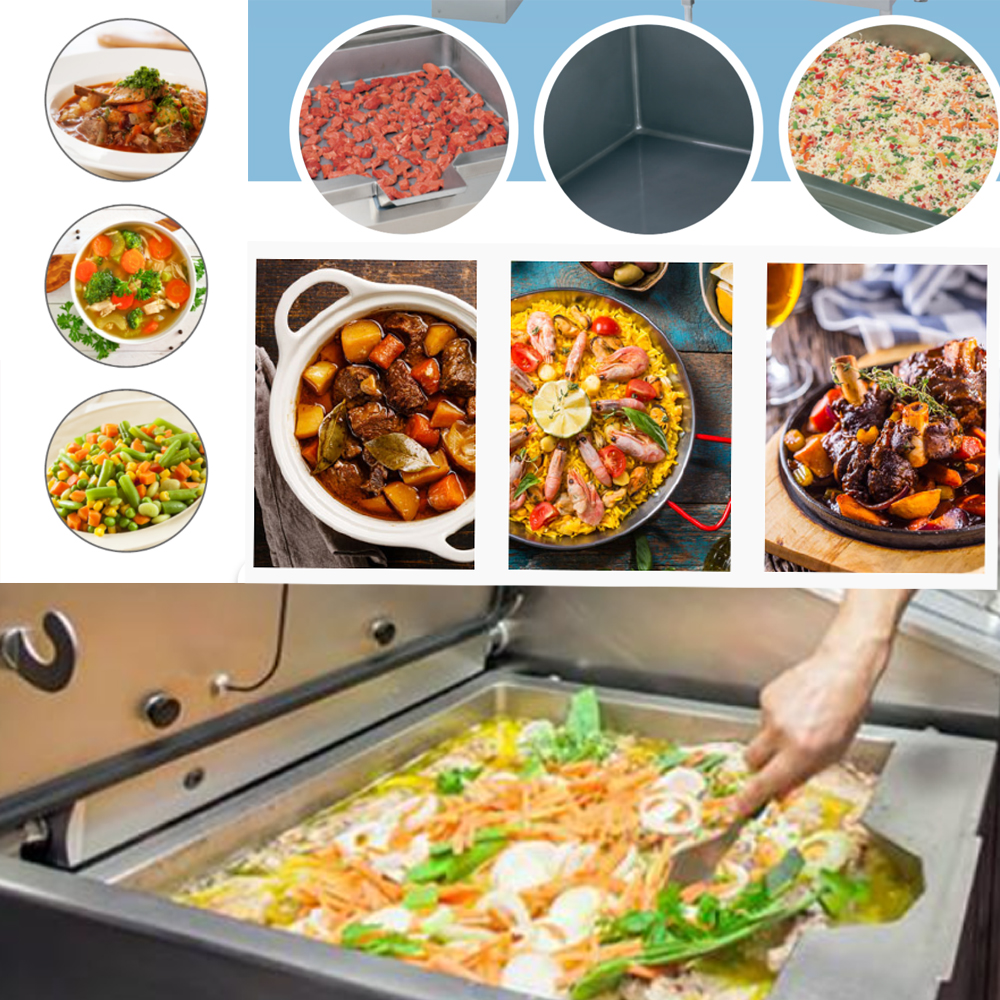
Bratt pans have a massive surface area but shallower depth compared to deep fryers. This is an advantage for “Swim Frying” (items that float).
Because you are spreading food out horizontally rather than stacking it vertically in a narrow basket, products cook more evenly and stick less. This is ideal for institutional catering frying equipment needs where presentation matters.
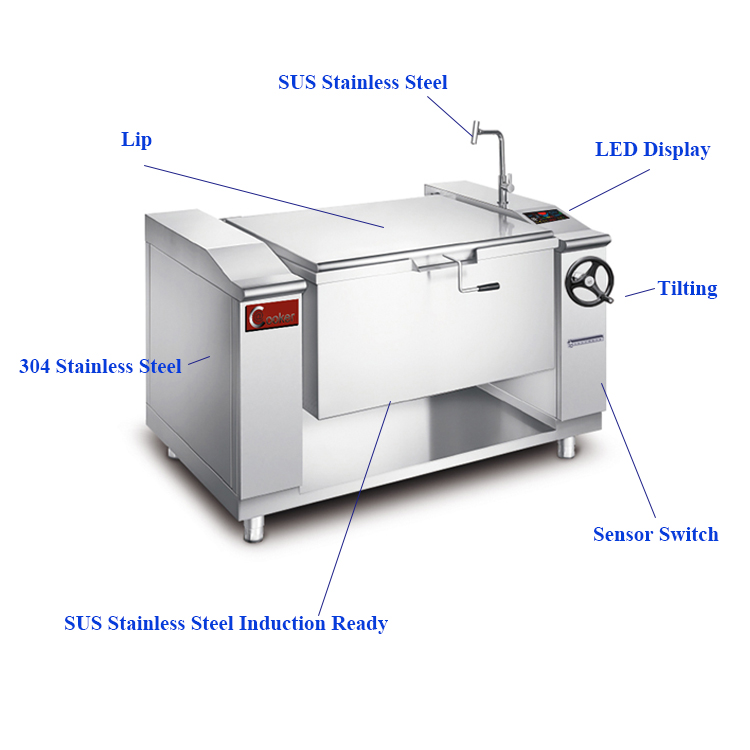
7. Energy Cost Analysis: Heating 80 Liters of Oil via Induction vs Gas Tubes
Heating oil takes a lot of energy. Gas tube fryers lose heat up the flue. Induction transfers heat directly to the pan floor.
The energy savings are significant, especially during idle times. You can keep the oil at a standby temperature of 100°C and ramp to 180°C in minutes when service starts, rather than keeping it at high heat all day.
8. Workflow Versatility: Switching from Deep Frying to Braising in One Shift
This is the killer feature. A fryer can only fry. An AT Cooker Bratt Pan can fry lunch, drain, wipe clean, and then braise beef for dinner.
This multi-purpose industrial cooking machine capability allows kitchens to do more with less equipment footprint, saving valuable real estate under the hood.
9. Throughput Reality: How Many Kilos of Fries Per Hour Can You Really Output?
With a 25KW generator, the AT Cooker Bratt Pan can match the output of two standard 50lb fryers. The wide surface area allows for massive batches.
For items like fish and chips, where the product needs space to batter-set, the Bratt Pan actually outperforms baskets because the food doesn’t touch.
10. Oil Degradation Rate: Why Flat-Bottom Heating Shortens Oil Life Span
Because there is no cold zone, sediment sits on the hot bottom and carbonizes. This degrades oil faster than a tube fryer.
To mitigate this, chefs should filter oil mid-shift if doing heavy breading. However, for many institutions doing “one-shot” frying cycles (e.g., Fish Friday), the oil is changed anyway, making this a moot point.
11. The “Pan-Fried” vs “Deep-Fried” Texture Difference in Shallow Bratt Pans
Because the product sits on or near the heated bottom, you get a unique texture—a hybrid of deep-fried crunch and pan-fried sear.
This creates a superior crust on breaded items like schnitzel or katsu, which is often preferred in high volume hospital kitchen equipment scenarios for texture variety.
12. Institutional Safety: Reducing Fire Risks with Precise Induction Temperature Limits
Oil fires happen when fryers overheat. Gas thermostats can fail. Induction uses digital temperature limits.
You can set the maximum temperature to 180°C. The unit will simply cut power if it reaches 181°C. This precise control makes an induction Bratt Pan one of the safest ways to deep fry large volumes of food.
| Feature | Dedicated Fryer | AT Cooker Induction Bratt Pan |
|---|---|---|
| Recovery Speed | Fast | Fast (20KW+) |
| Oil Life | Longer (Cold Zone) | Shorter (No Cold Zone) |
| Versatility | Fry Only | Fry, Boil, Braise, Grill |
| Cleaning | Difficult (Drain valve) | Easy (Motorized Tilt) |
5-year Warranty | 2-year Free Exchangeable | 1-year Free Return
Final Thoughts from AT Cooker
Can you deep fry in a Bratt Pan? Absolutely. For institutional kitchens that need flexibility, the AT Cooker Commercial Induction Bratt Pan offers a frying capability that matches dedicated units in speed, while offering a universe of other cooking functions.
With stock ready for delivery in the USA, Germany, France, UK, Belgium, Italy, Spain, and Bulgaria, you can consolidate your kitchen equipment today. Save space, save energy, and cook everything. Visit our About Us page to learn more.