Instant Ruin? Will Thermal Shock Warp Commercial Induction Cookware Bases?
5-year Warranty | 2-year Free Exchangeable | 1-year Free Return
Induction cooking is fast—sometimes too fast for inferior metals. A commercial induction hob can ramp a pan from room temperature to 300°C in seconds. This rapid energy transfer creates a phenomenon known as “Thermal Shock.” For chefs using cheap aluminum or thin stainless steel pans, this shock can be fatal to the cookware.
The result is instant warping. A flat base suddenly bows, turning a frying pan into a spinner that wobbles on the glass. At AT Cooker, we understand that commercial induction cookware warping isn’t just an annoyance; it’s a breakage of the magnetic link. In this article, we dissect the physics of warping and explain why heavy-duty construction is your only defense against the brute force of induction heat.
Commercial Kitchen Equipment -from AT Cooker
- As a brand manufacturer of the professional commercial induction cooking equipment, AT Cooker has responded to restaurants’ & hotels’ needs and research normative commercial cooking equipment using the very latest induction technology.
- These seamless, real commercial quality commercial cooking equipment provides us with the opportunity to incorporate equipment of our choice into one seamless, multipurpose cooking equipment creating an efficient, low cost, safe, green and sustainable commercial kitchen. We have standerd equipment can service many commercial kitchens.
- AT Cooker always offers professional service. From material, design, to producing, we focuse on quality, performance and reliability to ensures the best solution is delivered for each and every one of our customers. Have a commercial kitchen? We will be one of your best partners.
Work Voltage
| Single-Phase | Three-Phase |
|---|---|
| 120V, 220V | 208V/ 240V, 380V, 480V |
Global In-Stock + Fast Pickup
| US | UK | Germany | France |
|---|---|---|---|
| Italy | Spain | Belgium | Bulgaria |
1. The Physics of Thermal Shock: Why Induction’s Rapid Heating Rate Stress-Tests Metal
Induction doesn’t heat the air; it heats the metal directly. A high-quality commercial induction hob can dump 5000W of power into a pan base instantly. This causes the metal atoms to vibrate violently.
If the pan is cold, the bottom heats up and expands in milliseconds, while the walls remain cold and rigid. This stress, known as “Thermal Shock,” exerts massive torque on the pan’s structure. If the metal is thin or poorly bonded, it will buckle instantly, creating a permanent warp known as “crowning.”
2. Tri-Ply Cladding vs. Impact Bonded Discs: Which Construction Resists Deformation Better?
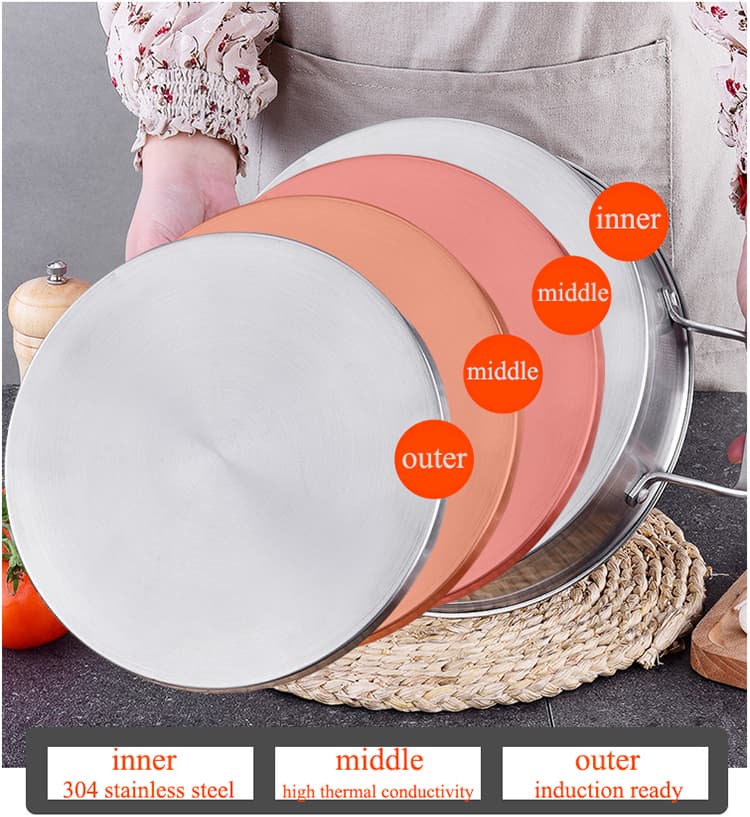
“Impact Bonded” pans have a thick disc glued to the bottom. They are cheap, but the bond is a weak point. Under high heat, the different expansion rates of the disc and the pan body can shear the bond, leading to warping or separation.
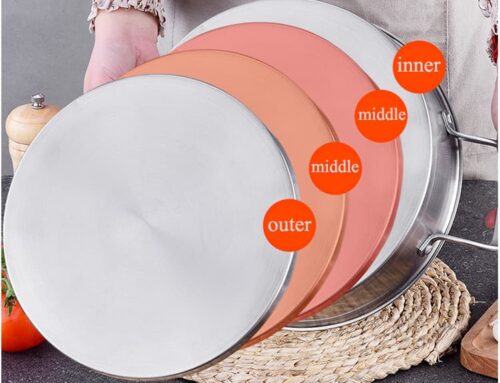
“Tri-Ply Cladding” (used in premium AT Cooker cookware) fuses stainless steel, aluminum, and stainless steel into a single, cohesive sheet that forms the entire pan. This unified structure distributes heat laterally up the sidewalls, relieving stress on the base and offering superior tri-ply vs impact bonded durability.
3. The “Spinner” Effect: How a Micro-Warped Base Destroys Magnetic Efficiency
A warped pan doesn’t sit flat. It becomes a “Spinner”—a pan that spins like a top on the glass.
This gap (even just 1-2mm) destroys efficiency. The magnetic field weakens exponentially with distance. A spinner pan cooks unevenly, wastes energy, and can trigger the induction unit’s safety sensors to shut down, interrupting service.
4. Deglazing Danger: The Risk of Pouring Cold Liquids into Superheated Stainless Steel
Deglazing is a standard culinary technique: searing meat, then pouring in cold wine or stock. This creates an extreme thermal shock event.
For thermal shock resistant pans, this is routine. For lesser pans, it’s a death sentence. The sudden contraction of the metal can snap a warped base into a permanent concave shape instantly. Our 304-grade steel is engineered with high tensile strength to withstand these rapid temperature swings.
5. Material Thickness Standards: Why 2.5mm is the Minimum for Commercial Durability
In the home kitchen, 0.8mm thick pans are common. In a commercial induction kitchen, anything under 2.0mm is disposable.
We adhere to a 2.5mm minimum thickness standard for our commercial lines. This extra mass acts as a thermal buffer, absorbing the initial shock of the induction field and distributing it evenly before the metal has a chance to deform.
5-year Warranty | 2-year Free Exchangeable | 1-year Free Return
6. The “Bi-Metal” Expansion Conflict: How Aluminum Cores and Steel Shells React Differently
Induction pans are usually bi-metal: magnetic steel for the heat, aluminum for conduction. Aluminum expands twice as fast as steel.
If these layers aren’t bonded perfectly, the internal fight for space causes the pan to twist. Our “High-Pressure Impact Bonding” process uses 1600 tons of force to fuse these layers at a molecular level, forcing them to expand and contract as a single unit.
7. Proper Cooling Protocols: Why Dumping Hot Pans Directly into Wash Sinks Ruins Investments
The fastest way to warp a pan is to take it from the burner (200°C) and plunge it into the sink (20°C). This violent contraction can warp even the thickest steel.
Commercial kitchen equipment maintenance 101: Let the pan cool naturally on a rack until it is warm to the touch before washing. This simple protocol extends the life of your cookware by years.
8. Understanding Pre-Tensioned Concavity: How Manufacturers Engineer Against Expansion
Did you know a good pan isn’t perfectly flat? It has a slight upward curve (concavity) in the center.
This is engineered. When the metal heats up and expands, it flattens out to become perfectly level with the induction glass. Cheap pans start flat and expand downwards, becoming “spinners.” Our engineering anticipates this expansion for perfect contact when hot.
9. Sensor Connectivity: Why Even 1mm of Warping Triggers “No Pan” Error Codes
Induction sensors measure the feedback from the coil. If a pan warps away from the glass by just 1mm, the feedback signal changes.
The cooker thinks the pan has been removed and triggers an “E0” or “No Pan” error. A warp-resistant base ensures the pan stays within the sensor’s detection zone, preventing frustrating shut-offs during service.
10. The “Tuo Di” Phenomenon: Analyzing the Delamination Risk of Capsule Bottoms
“Tuo Di” (Bottom Falling Off) is a catastrophic failure where the aluminum disc separates from the steel body. This happens when moisture gets into the seam and turns to steam explosively during heating.
AT Cooker uses a fully encapsulated “Capsule Bottom” design that wraps the aluminum core in steel, eliminating exposed seams. This airtight seal prevents moisture ingress and delamination, even in high-heat commercial dishwashers.
11. Dry Burn Tolerance: How Steel Grade Stability Affects Shape Retention During Accidents
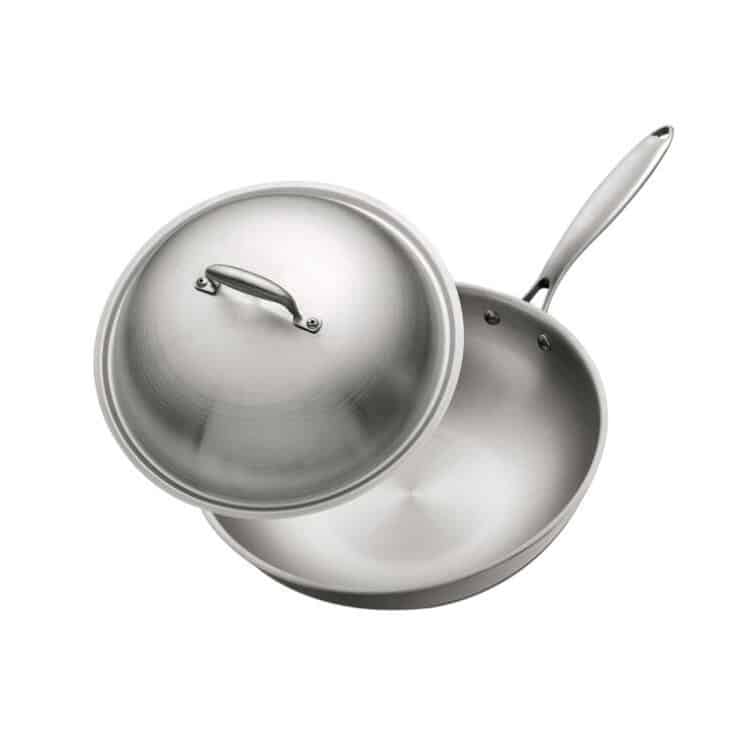
Accidents happen. A pan is left on high heat dry. This “Dry Burn” can reach temperatures over 400°C.
Low-grade steel softens and sags at these temperatures. Our heavy duty stainless steel cookware durability tests ensure that our pans maintain their structural shape even after accidental dry burns, saving the investment from a single mistake.
12. The Impact of Handle Welding Stress Points on Overall Pan Body Geometry
Believe it or not, heavy handles can cause warping. If the weld points are weak, the weight of the handle pulls on the sidewall, distorting the base.
We use heavy-duty, multi-point welded or riveted handles with large backing plates. This distributes the mechanical stress across a wide area of the pan wall, ensuring the base remains perfectly round and flat.
5-year Warranty | 2-year Free Exchangeable | 1-year Free Return
Final Thoughts: Buy Nice or Buy Twice
Saving money on cheap pans for an expensive induction system is false economy. A warped pan ruins the efficiency of the cooker and slows down your line. Invest in induction ready cookware construction from AT Cooker that matches the power of your equipment.
Equip Your Kitchen with Durability
Stop replacing warped pans. Contact us for a quote on our commercial-grade, thermal-shock resistant cookware sets.