Durability Assessment: Will Dropping a 50kg Stock Pot Crack Your Commercial Induction Glass?
5-year Warranty | 2-year Free Exchangeable | 1-year Free Return
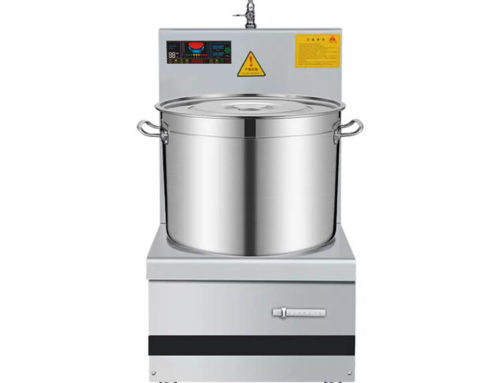
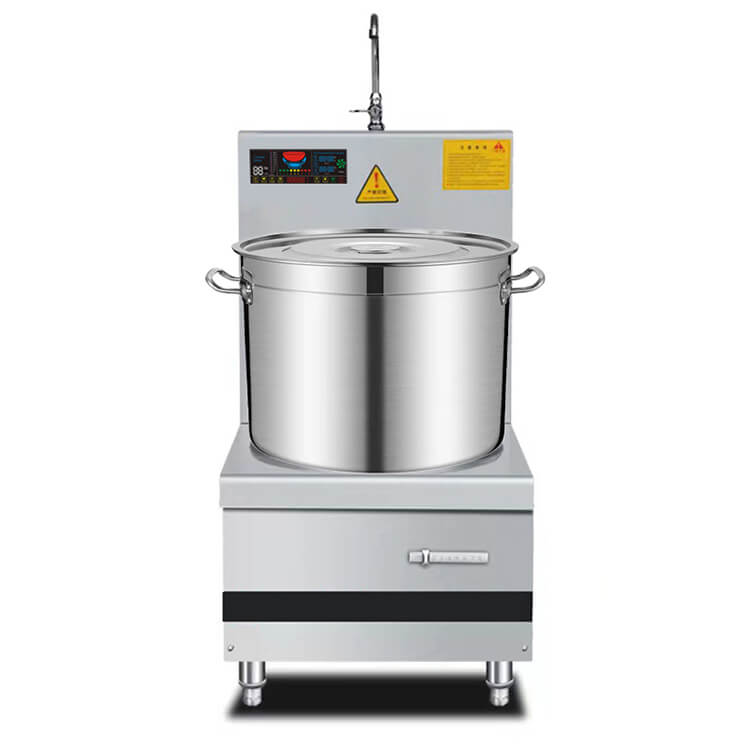
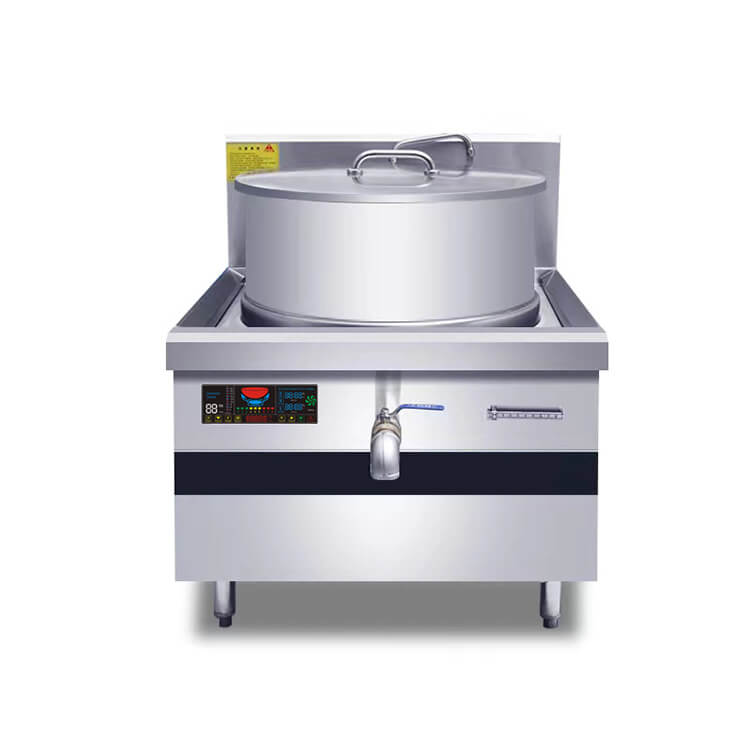
AT Cooker Executive Insight: The nightmare scenario for any chef is shattering a glass cooktop in the middle of service. When handling a 98L stock pot filled with boiling liquid (weighing over 100kg), the structural integrity of the cooking surface is a matter of safety, not just convenience. At AT Cooker, we field one question constantly: “Is the glass strong enough?” In this durability assessment, we break down the engineering behind commercial induction glass durability, analyzing impact resistance, load capacity, and the specific materials used in our ATT-ABT S Single Burner Induction Soup Cooker.
Glass in a commercial kitchen seems counter-intuitive. Kitchens are zones of heavy metal, hard impacts, and rough handling. However, the “glass” used in commercial induction is not glass at all—it is a sophisticated glass-ceramic composite designed to withstand extreme thermal and physical stress.
Despite this, cracks can happen if the wrong equipment is chosen or protocols are ignored. A commercial stock pot burner load capacity must be matched to the volume of food being cooked. The ATT-ABT S features a 98L net capacity, meaning it routinely supports static loads of 120kg+. To handle this, we don’t just rely on the glass; we rely on a comprehensive support system.
This article explores the physics of glass-ceramic strength and how to ensure your equipment lasts for a decade, not a month.
Commercial Kitchen Equipment -from AT Cooker
- As a brand manufacturer of the professional commercial induction cooking equipment, AT Cooker has responded to restaurants’ & hotels’ needs and research normative commercial cooking equipment using the very latest induction technology.
- These seamless, real commercial quality commercial cooking equipment provides us with the opportunity to incorporate equipment of our choice into one seamless, multipurpose cooking equipment creating an efficient, low cost, safe, green and sustainable commercial kitchen. We have standerd equipment can service many commercial kitchens.
- AT Cooker always offers professional service. From material, design, to producing, we focuse on quality, performance and reliability to ensures the best solution is delivered for each and every one of our customers. Have a commercial kitchen? We will be one of your best partners.
Work Voltage
| Single-Phase | Three-Phase |
|---|---|
| 120V, 220V | 208V/ 240V, 380V, 480V |
Global In-Stock + Fast Pickup
| US | UK | Germany | France |
|---|---|---|---|
| Italy | Spain | Belgium | Bulgaria |
1. The Critical Difference Between Standard Tempered Glass and Commercial Grade Glass-Ceramic
Many first-time buyers confuse residential “tempered glass” with commercial “glass-ceramic.” Tempered glass is designed for windows; if it gets too hot, it shatters. It has poor thermal shock resistance.
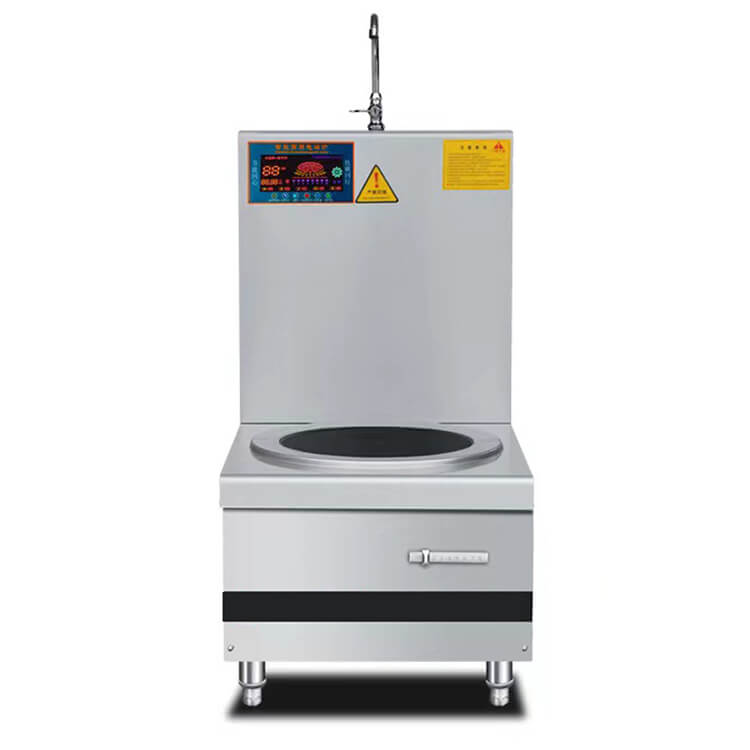
Commercial induction glass durability relies on Glass-Ceramic (like Schott Ceran or premium Chinese equivalents like Kanger). This material has a near-zero coefficient of thermal expansion. You can heat it to 700°C and pour ice water on it without it cracking. The AT Cooker ATT-ABT S uses high-quality microcrystalline glass engineered specifically for the punishing environment of a commercial kitchen.
2. Why 6mm Thickness is the Non-Negotiable Standard for Heavy-Duty Stock Pot Burners
Thickness equals strength. Residential units use 4mm glass. For a heavy duty induction glass ceramic strength rating capable of supporting a 98L stock pot, 4mm is insufficient.
We use 6mm thick microcrystalline glass. This extra 2mm increases the flexural strength exponentially, allowing the unit to support static loads of over 100kg without bowing or snapping under the weight of a full soup run.
3. The Protective Role of Raised Stainless Steel Rims in Absorbing Side Impacts
The weakest point of any glass plate is the edge. If you slide a heavy metal pot into the side of the glass, it can chip or crack. This is “Impact Fracture.”
The ATT-ABT S features a 304# stainless steel body with a raised protective rim. This rim sits slightly higher than the glass edge or flush with it, ensuring that when a chef drags a heavy pot across the unit, the steel takes the hit, not the glass edge.
4. Static Load vs. Impact Force: Understanding the Physical Limits of Ceramic Plates
Glass-ceramic is incredibly strong under Static Load (weight pressing down). It can hold hundreds of kilograms if placed gently. The danger is Impact Force (dropping).
⚠️ Impact Physics
Dropping a 50kg pot from just 5cm generates a momentary impact force of several tons. While our 6mm glass is tough, no glass is unbreakable. We engineer the chassis to absorb shock, but proper handling is still required.
5. How Flat-Bottom Stock Pots Distribute Force to Prevent Point-Load Fractures
If a pot has a dented or warped bottom, all 100kg of weight concentrates on a single point on the glass. This “Point Load” creates massive stress.
We recommend using heavy-gauge, flat-bottom stainless steel pots (often 430 or 409 magnetic steel). A flat bottom distributes the weight evenly across the entire surface area of the glass, reducing the pressure per square inch (PSI) to safe levels.
5-year Warranty | 2-year Free Exchangeable | 1-year Free Return
6. The “Thermal Shock” Factor: Resistance to Cold Water Spills on Hot Surfaces
In a busy kitchen, cold water often spills onto a hot stove. On tempered glass, this temperature difference causes immediate shattering.
Microcrystalline glass has virtually zero thermal expansion. You can spill ice water onto the ATT-ABT S surface while it is running at full 15KW power without any risk of preventing cracked induction cooktops. This thermal resilience is critical for soup stations where spills are guaranteed.
7. Identifying the Weakest Point: Why Edge Hits Are More Dangerous Than Center Drops
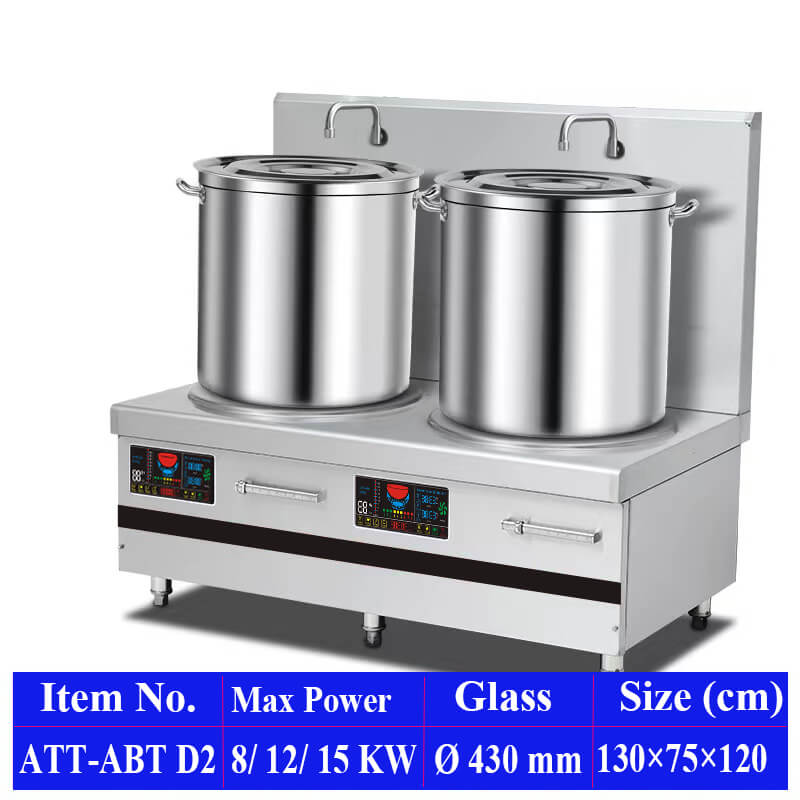
The center of the glass plate is supported by the induction coil and structural beams. It is the strongest point. The corners and edges are where tension is highest.
Our design recesses the glass slightly or uses a flush-mount steel bezel to shield these vulnerable edges. By protecting the perimeter, we eliminate 90% of accidental breakage risks caused by pots banging against the side.
8. The Importance of “Soft Landing” Protocols for Chefs Handling 50kg+ Liquid Loads
Equipment is only as durable as the user. Kitchen equipment safety standards should include training on “Soft Landings.”
Chefs should never drop a full stock pot. They should slide it onto the unit or lower one edge first. While the AT Cooker unit is built to take abuse, treating it like an anvil will eventually find the limit of the material.
9. Assessing the Cushioning Effect of Silicone Seals and Internal Mounting Buffers beneath the Glass
Glass should never touch metal directly. Thermal expansion differences would cause it to snap. We use high-temperature industrial silicone and flexible mounting buffers between the glass and the stainless steel frame.
This “Floating Mount” allows the glass to expand and contract microscopically without stress. It also acts as a shock absorber, dampening the impact when a heavy pot is placed down hard.
10. Cost Analysis: The Feasibility of Replacing Modular Glass Tops vs. Entire Units
Accidents happen. If a forklift hits your stove and breaks the glass, do you need a new machine?
The ATT-APST S is designed with modularity in mind. The glass-ceramic plate can be replaced by a technician without scrapping the induction engine or chassis. This repairability protects your long-term investment.
11. The “1kg Steel Ball Drop Test” Standard in Premium Chinese Manufacturing Quality Control
How do we verify impact resistance? We use the “Steel Ball Drop Test.” A 1kg solid steel ball is dropped from a height of 50cm directly onto the center of the glass.
Only glass batches that survive this impact without chipping or cracking are approved for our heavy duty induction cooker assembly line. This ensures every unit shipped meets a baseline of extreme durability.
12. Understanding “Black Crystal” Grades: Distinguishing High-Temp Endurance Levels from Cosmetic Gloss
Not all black glass is the same. Some are purely cosmetic. AT Cooker uses Grade A “Black Crystal” designed for 800°C endurance.
This high-grade material resists scratching from sliding pots and does not become brittle over time due to heat cycling, maintaining its strength for years of commercial service.
| Feature | Standard Glass | AT Cooker Microcrystalline |
|---|---|---|
| Thickness | 4mm | 6mm |
| Thermal Shock | Low (Can Shatter) | High (800°C Safe) |
| Load Capacity | <50kg | >120kg |
| Edge Protection | Exposed | Steel Rim Guard |
5-year Warranty | 2-year Free Exchangeable | 1-year Free Return
Final Thoughts from AT Cooker
Will dropping a 50kg pot crack the glass? If you drop it from chest height onto the edge? Possibly. But under normal, heavy-duty commercial use, the AT Cooker ATT-ABT S is built to endure.
We stock these durable units in the USA, Germany, France, UK, Belgium, Italy, Spain, and Bulgaria. Don’t fear the glass. Trust the engineering. Visit our About Us page to learn more about our quality control.