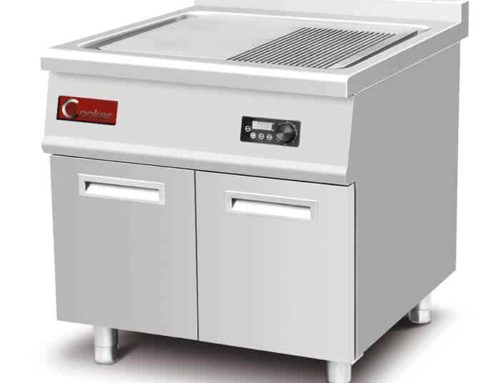
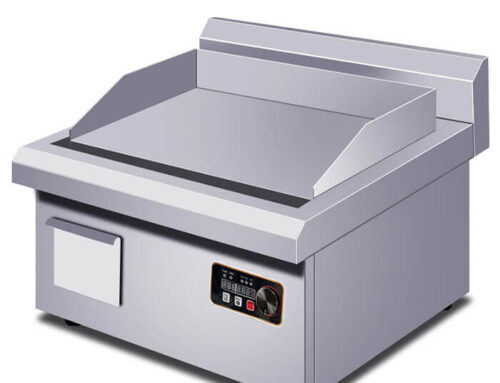
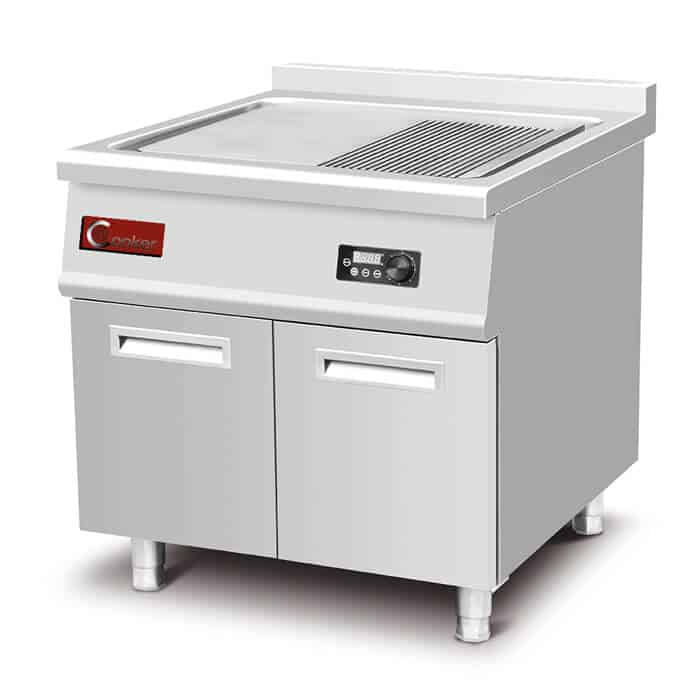
400°F Lockdown: 11 Commercial Griddle Insights on Consistent Searing
5-year Warranty | 2-year Free Exchangeable | 1-year Free Return
AT Cooker Executive Insight: The difference between a juicy, caramelized burger and a gray, boiled patty is temperature control. In high-volume QSR and chain restaurants, maintaining a consistent searing temperature is the biggest challenge. Traditional gas griddles suffer from massive heat swings, leading to inconsistent product quality during rush hours. The solution is digital precision. By upgrading to the AT Cooker Commercial Induction Griddle, you lock in 400°F with surgical accuracy. This guide reveals 11 critical insights into why induction is the future of grilling.
Every chef knows the frustration: You load the grill with cold steaks, and the temperature crashes. You wait for the gas burners to catch up, but it’s too late—the meat is steaming instead of searing. This “Recovery Lag” is a physical limitation of gas thermostats, which react slowly to surface cooling.
Induction technology changes the game. By placing sensors directly under the plate and sampling temperature 120 times per second, AT Cooker griddles react instantly to thermal load. This ensures the Maillard reaction consistency you need to serve perfect food, every single time.
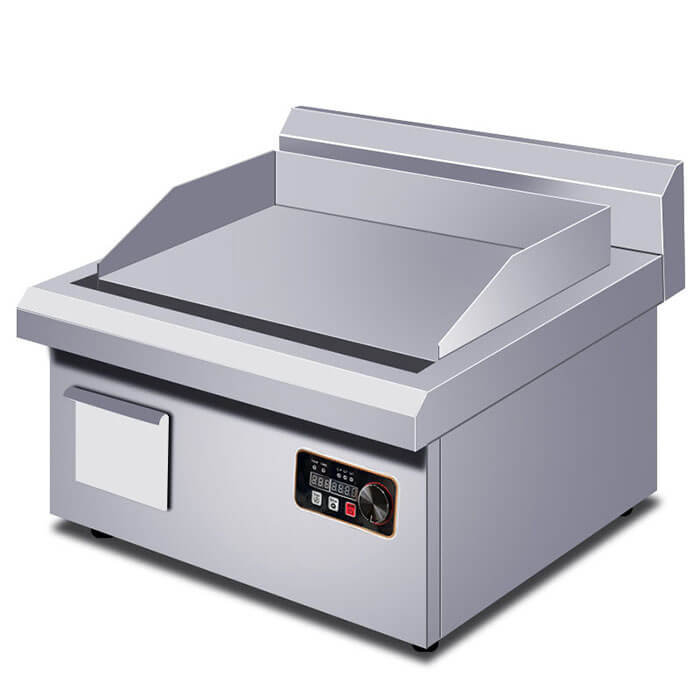
Commercial Kitchen Equipment -from AT Cooker
- As a brand manufacturer of the professional commercial induction cooking equipment, AT Cooker has responded to restaurants’ & hotels’ needs and research normative commercial cooking equipment using the very latest induction technology.
- These seamless, real commercial quality commercial cooking equipment provides us with the opportunity to incorporate equipment of our choice into one seamless, multipurpose cooking equipment creating an efficient, low cost, safe, green and sustainable commercial kitchen. We have standerd equipment can service many commercial kitchens.
- AT Cooker always offers professional service. From material, design, to producing, we focuse on quality, performance and reliability to ensures the best solution is delivered for each and every one of our customers. Have a commercial kitchen? We will be one of your best partners.
Work Voltage
| Single-Phase | Three-Phase |
|---|---|
| 120V, 220V | 208V/ 240V, 380V, 480V |
Global In-Stock + Fast Pickup
| US | UK | Germany | France |
|---|---|---|---|
| Italy | Spain | Belgium | Bulgaria |
1. Gas vs. Induction Thermostats: Why Accuracy Matters
Gas thermostats are mechanical devices. They rely on a metal probe expanding to close a gas valve. This system is slow and imprecise, often allowing surface temperatures to swing by ±30°F (approx ±15°C). This means your “400°F” setting could actually be 370°F or 430°F.
Induction uses digital NTC sensors placed directly under the glass-ceramic plate. These sensors sample the temperature 120 times per second. This real-time feedback loop allows the inverter to adjust power instantly, holding the consistent searing temperature within a tight ±2°F tolerance.
2. 120 Samples Per Second: How Digital Sensing Prevents Temperature Drift
Imagine a chef checking the meat every second versus every minute. That is the difference between induction and gas control.
Because the AT Cooker induction sensor reads the pan temperature continuously, it detects the slightest drop the moment a cold burger hits the plate. The system reacts before the temperature can drift out of the searing zone, ensuring consistent results.
3. The Maillard Reaction: Why 400°F is the Magic Number for Flavor
The Maillard reaction—the browning that creates flavor—happens most effectively above 300°F (150°C) and peaks around 400°F (200°C). If the temperature drops below this, meat steams and turns gray.
By locking the temperature at 400°F, induction griddles guarantee that the Maillard reaction begins immediately upon contact. This seals the surface, trapping juices inside and creating the crust that customers crave.
4. Tolerance Comparison: ±2°F Precision vs Gas Variability
In a side-by-side test, gas griddles show significant variance. A cold load can drop the plate temperature by 50°F, taking minutes to recover.
The AT Cooker Induction Griddle maintains its set point with extreme rigidity. The ±2°F tolerance means that whether you are cooking one patty or twenty, the heat energy available to each is identical.
5. Eliminating Recovery Lag: The 50th Burger Matches the 1st
During a lunch rush, consistency usually drops. The grill gets “tired” as it loses heat faster than gas burners can replace it.
Induction has “Zero Lag.” The power delivery is instant. This means the 50th burger of the shift hits a plate that is just as hot as the 1st burger, ensuring peak hour performance never dips.
5-year Warranty | 2-year Free Exchangeable | 1-year Free Return
6. The “Cold Corner” Problem: Why Gas Griddles Waste Valuable Space
Gas burners are often H-shaped or linear tubes. The areas between the burners and the corners of the plate receive less heat. This creates “dead zones” where food cooks slowly.
Induction coils can be arranged to cover the entire underside of the plate. This surface heat retention uniformity means you can use 100% of the griddle surface, cooking edge-to-edge without fear of undercooked food.
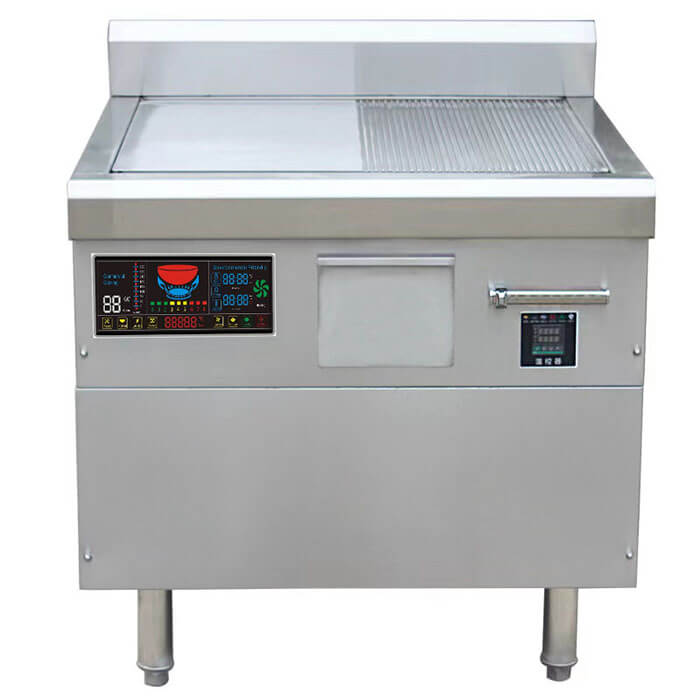
7. Maximizing Throughput: Using Every Inch of the Plate
Because there are no cold corners, you can fit more product on an induction griddle of the same size. A 36-inch induction griddle often has the effective capacity of a 48-inch gas griddle.
This efficiency allows you to produce more food in a smaller footprint, which is critical for cramped QSR kitchens or food trucks.
8. Digital Control Precision: Specific Temps for Specific Proteins
Different proteins require different searing temperatures. Fish might need 350°F; steak needs 450°F.
Digital controls allow chefs to dial in the exact number. This repeatability is a key factor in avoiding gray meat and ensuring that delicate items aren’t scorched and tough items aren’t served raw.
9. High-Density Coils vs. Tube Burners: Preventing “Wavy” Heat Patterns
If you put a piece of paper on a gas griddle, you can often see the scorch marks of the burners underneath—a “wavy” pattern of hot and warm.
AT Cooker uses high-density copper coils that create a uniform magnetic field. This field heats the plate material evenly, eliminating the hot/cold waves that cause uneven browning on large items like pancakes or tortillas.
10. Power Injection Algorithms: Countering Frozen Food Heat Loss
Our control chips feature specific algorithms for “Power Injection.” When the sensor detects a sharp temperature drop (indicating frozen food was added), it boosts power beyond the normal maintenance level.
This surge of energy counteracts the latent cold of frozen patties instantly, ensuring the surface temperature rebounds before the meat begins to thaw and stew.
11. Asian “Hollow Coil” Designs: Ensuring Center-to-Edge Uniformity
Advanced “Hollow Coil” winding techniques allow us to shape the magnetic field. By adjusting the spacing of the copper wires, we can push more energy to the edges of the coil.
This compensates for natural heat loss at the perimeter of the plate, resulting in a perfectly flat thermal profile across the entire cooking zone.
5-year Warranty | 2-year Free Exchangeable | 1-year Free Return
Final Thoughts from AT Cooker
Consistency is the hallmark of a great restaurant. By locking down your temperature at 400°F with the AT Cooker Commercial Induction Griddle, you ensure that every customer gets a perfectly seared meal, every time.
With stock ready for immediate delivery in the USA, Germany, France, UK, Belgium, Italy, Spain, and Bulgaria, we can help you upgrade your grill line today. Visit our About Us page to learn more about our precision cooking solutions.