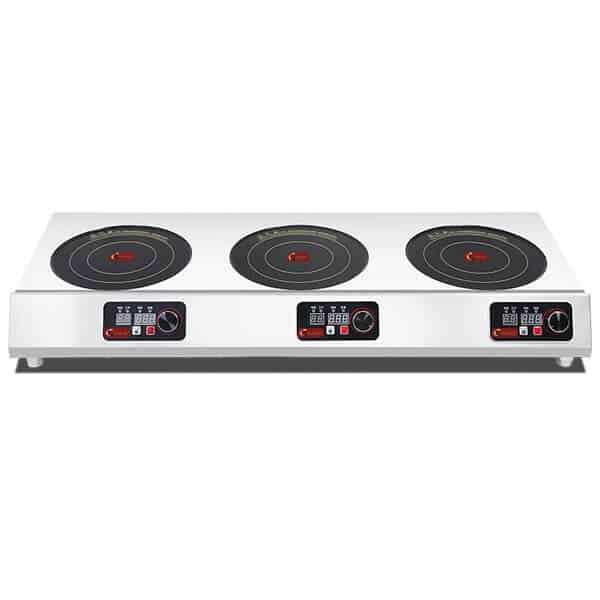
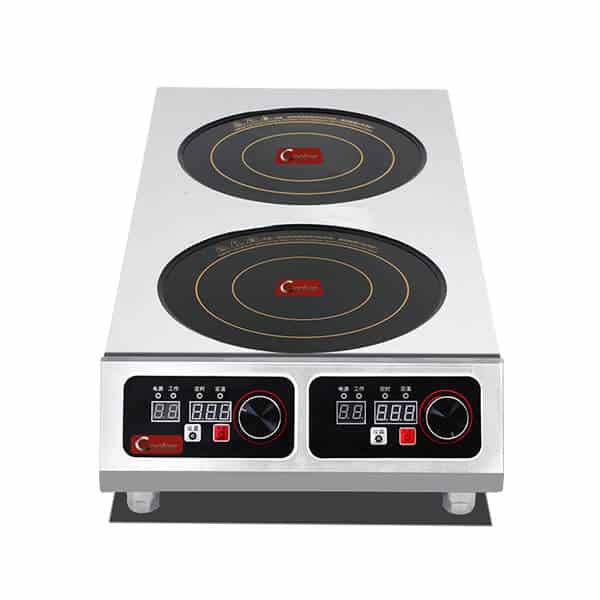
Zero Lag Sautéing: Does Commercial Induction Heat Resume Instantly After the Toss?
5-year Warranty | 2-year Free Exchangeable | 1-year Free Return
AT Cooker Executive Insight: Sautéing is a rhythm. The flick of the wrist, the toss of the ingredients, and the sear of the pan. For chefs considering the switch to electric, the biggest fear is “Lag.” Will the pan lose heat when I lift it? Will I have to wait for it to reconnect? At AT Cooker, we engineer our commercial induction heat recovery systems with “Miao Hui” (Instant Return) technology. This ensures that the moment your pan touches the glass, the power is there. In this guide, we debunk the myth of lag and explore how induction sauté technique has surpassed gas.
In a fine dining kitchen, consistency is king. When searing scallops or sautéing vegetables, maintaining the Maillard reaction (browning) is non-negotiable. Traditional gas burners provide a constant thermal envelope—the flame is always there, even when the pan is in the air. Early generation induction units struggled with this; lifting the pan broke the circuit, and resetting it took seconds.
Those seconds killed the sear. Today, however, professional induction cooktop lag is a solved problem. Using advanced sensor algorithms and memory chips, AT Cooker Commercial Induction Cooktops bridge the gap between lift and landing, providing a seamless cooking experience that mimics the continuity of fire without the waste.
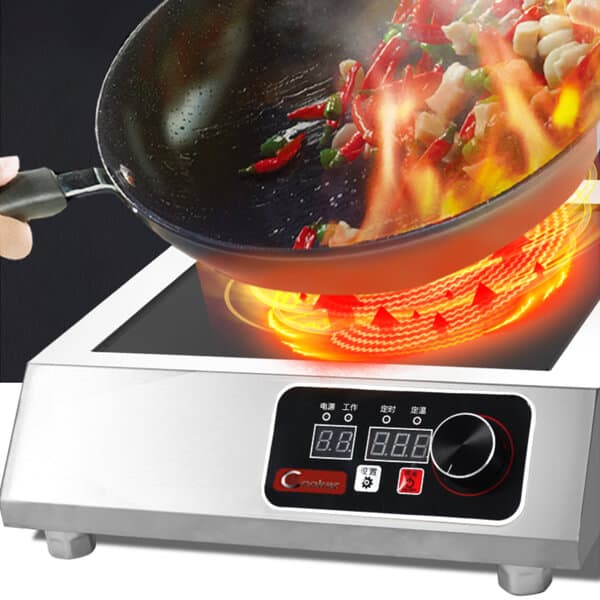
Commercial Kitchen Equipment -from AT Cooker
- As a brand manufacturer of the professional commercial induction cooking equipment, AT Cooker has responded to restaurants’ & hotels’ needs and research normative commercial cooking equipment using the very latest induction technology.
- These seamless, real commercial quality commercial cooking equipment provides us with the opportunity to incorporate equipment of our choice into one seamless, multipurpose cooking equipment creating an efficient, low cost, safe, green and sustainable commercial kitchen. We have standerd equipment can service many commercial kitchens.
- AT Cooker always offers professional service. From material, design, to producing, we focuse on quality, performance and reliability to ensures the best solution is delivered for each and every one of our customers. Have a commercial kitchen? We will be one of your best partners.
Work Voltage
| Single-Phase | Three-Phase |
|---|---|
| 120V, 220V | 208V/ 240V, 380V, 480V |
Global In-Stock + Fast Pickup
| US | UK | Germany | France |
|---|---|---|---|
| Italy | Spain | Belgium | Bulgaria |
1. Understanding the “Pan Detection Lag”: Why Home Units Fail the Sauté Test
If you have ever tried to sauté on a home induction burner, you know the frustration. You lift the pan to flip the vegetables, and the machine screams “Beep! Beep! Error!” When you put it back down, it takes 3-5 seconds to start heating again. This is “Pan Detection Lag.”
For a home cook, it is annoying. For a professional chef during a rush, it is a dealbreaker. This lag kills the momentum of the cooking process, allowing the pan temperature to drop below the searing point. Commercial units are built differently. They prioritize connectivity over strict energy-saving timeouts.
2. The Physics of Magnetic Re-Coupling: How Fast is “Instant” in Commercial Units?
When you lift a pan, the magnetic circuit is broken. To resume heating, the inverter must sense the metal, calculate the load, and re-energize the coil. On cheap units, this “handshake” takes time.
The AT Cooker commercial series uses high-speed processors that check for the pan 50 times per second. This means the re-coupling process happens in milliseconds. To the chef, it feels like the heat never left. The oil continues to sizzle the moment the pan touches the glass.
3. Preserving the Maillard Reaction: Preventing Temperature Drops During Air Time
The Maillard reaction (browning) stops if the surface temperature drops below 140°C. When you toss food in the air, it cools rapidly. You need the pan to be blazing hot when the food lands to regain that heat.
If the induction unit lags, the pan cools down while sitting on the glass waiting for power. Zero-lag technology ensures that the commercial induction heat recovery is immediate, pumping energy into the pan instantly to maintain the sear.
4. Digital Memory Features: How Commercial Units “Remember” Power Levels Mid-Toss
Home units often reset to “Level 0” or “Default” if the pan is removed for too long. Professional units have “Short-Term Memory.”
Smart Memory
If you are cooking at Power Level 9 and lift the pan to toss, the AT Cooker unit holds “Level 9” in its active memory for a preset duration (e.g., 60 seconds). When the pan returns, it doesn’t ramp up from zero; it hits Level 9 instantly.
5. Gas vs. Induction: Comparing Thermal Inertia in Stainless Steel vs. Cast Iron Pans
Gas chefs rely on the thermal inertia of heavy cast iron grates to keep the heat going. Induction relies on the pan itself. Because induction heats the pan directly, the response is faster.
While a gas flame is always “on,” the efficiency of heat transfer is low (40%). An induction unit recovering at 95% efficiency puts more energy into the pan in 2 seconds than a gas burner does in 5 seconds, effectively beating gas at its own game.
5-year Warranty | 2-year Free Exchangeable | 1-year Free Return
6. The “Vertical Magnetic Zone”: How High Can You Lift Before Connection Breaks?
A common misconception is that you must touch the glass. In reality, the magnetic field extends vertically. Depending on the pot size and coil quality, you can often lift the pan 10-20mm and still receive power.
This “Hover Zone” allows for micro-movements and sliding techniques without breaking the connection, creating a smoother experience for fine dining kitchen equipment users.
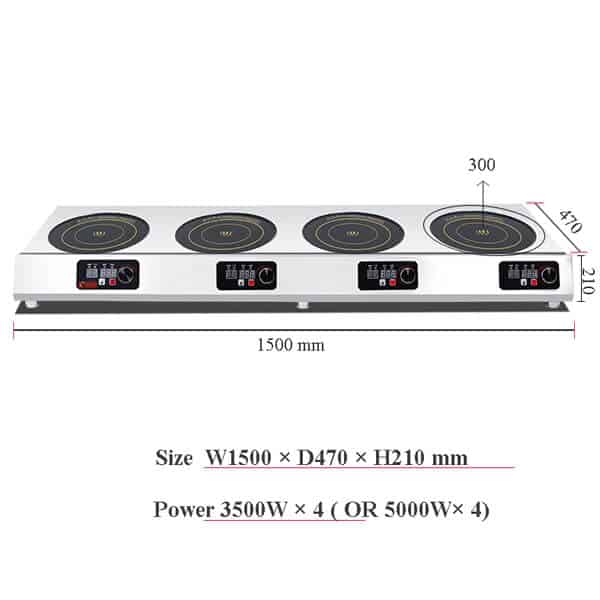
7. Soft-Start Logic: Balancing Component Protection with Immediate Heat Delivery
Engineers have to balance speed with safety. Dumping 5000 Watts instantly can stress components. The “Soft-Start” logic in AT Cooker units is tuned for performance.
It ramps up power in milliseconds—fast enough to be imperceptible to the chef, but controlled enough to protect the IGBTs from voltage spikes. This balance is what defines professional induction cooktop lag management.
8. Minimizing Error Codes: Customizing Sensor Sensitivity for Aggressive Techniques
Nothing disrupts service like an “E0” error code flashing every time you move the pan. Commercial units allow for sensitivity adjustments.
We program our sauté stations to be tolerant. They understand that a pan moving rapidly across the sensor is not a “missing pan,” but an active chef. This reduction in false alarms keeps the kitchen quiet and focused.
9. The “Smart Delay” Algorithm: How Factory Chips Distinguish Tossing from Pan Removal
How does the machine know if you are tossing or cleaning up? The algorithm analyzes the pattern of connection.
If the connection breaks and reconnects rhythmically (tossing), the machine stays primed. If the connection breaks for >5 seconds, it enters standby. This “Smart Delay” is crucial for induction sauté technique.
10. Miao Hui Technology: Achieving Millisecond Power Restoration to Mimic Continuous Flame
“Miao Hui” (Second Return) is the industry term for instant recovery. It is the benchmark for Asian wok cooking where heat must be continuous.
AT Cooker’s proprietary control boards are optimized for this. By keeping the magnetic circuit in a “pre-charged” state during the brief disconnect of a toss, we achieve a resumption speed that rivals a continuous gas flame.
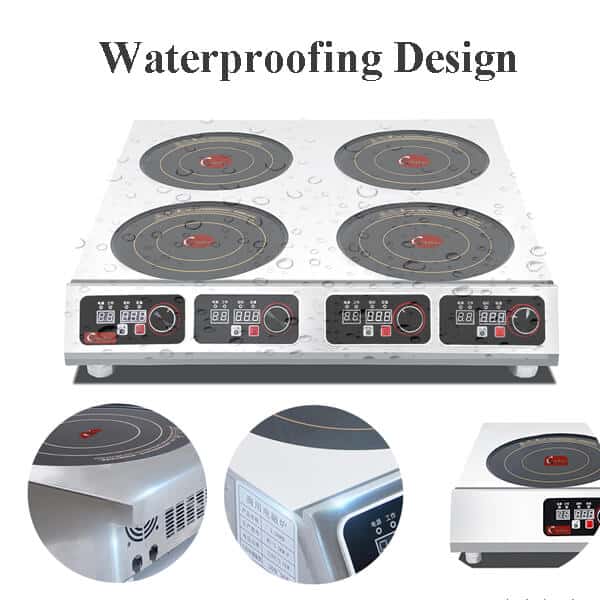
11. Chef Adaptation: Adjusting the “Slide-Toss” Technique for Uninterrupted Connectivity
While technology has advanced, technique adapts too. Chefs using induction often adopt a “Slide-Toss” motion, keeping the front lip of the pan close to the glass while lifting the back.
This maximizes magnetic coupling while still allowing the food to be aerated. It is more ergonomic and guarantees 100% power delivery.
12. Impact on Sauce Emulsion: Why Constant Heat is Critical for Delicate Reductions
When making a delicate emulsion (like a Beurre Blanc), temperature fluctuation breaks the sauce. Gas is good for this, but induction is better.
The constant, steady heat of induction—unaffected by drafts or pressure drops—ensures the sauce holds its temperature perfectly, even when you lift the pan to swirl it. The instant recovery prevents the cooling that leads to separation.
| Performance | Standard Induction | AT Cooker Commercial |
|---|---|---|
| Lift Reaction | Error / Shut Off | Standby / Memory |
| Resume Speed | 2-3 Seconds | Milliseconds |
| Sensor Type | Basic | Smart Algorithm |
| Sauté Feel | Interrupted | Continuous |
5-year Warranty | 2-year Free Exchangeable | 1-year Free Return
Final Thoughts from AT Cooker
Zero lag is not a luxury; for a professional chef, it is a necessity. The AT Cooker Commercial Induction Series delivers the responsiveness of gas with the precision of digital.
With stock ready for fast delivery in the USA, Germany, France, UK, Belgium, Italy, Spain, and Bulgaria, you can equip your line with the fastest technology on the market. Don’t wait for your pan to heat up. Visit our About Us page to learn more.