Chef Flow: Does ‘Pan Detection’ on Commercial Induction Cooktops Ruin Cooking Rhythm?
5-year Warranty | 2-year Free Exchangeable | 1-year Free Return
AT Cooker Executive Insight: For a professional chef, “Flow” is everything. It is the rhythmic dance of sautéing, tossing, and plating. Many chefs fear that switching from gas to induction will kill this flow because of “Pan Detection”—the momentary pause in heating when a pan is lifted. Does commercial induction pan detection truly ruin your rhythm? The short answer is: Not anymore. With AT Cooker “Miao Hui” technology and Smart Memory chips, we have engineered a system that feels as seamless as gas, without the excess heat.
Cooking is a sensory experience. Chefs rely on the visual cue of the flame and the tactile feedback of the pan toss. When you lift a pan off a gas burner, the flame is still there, ready to work. When you lift a pan off a standard induction plate, the magnetic connection breaks.
In older or cheaper induction units, this break resulted in annoying beeping, error codes, and a frustrating 3-second lag before heat resumed. This is unacceptable in fine dining kitchen efficiency. Modern commercial induction vs gas flow is a different story. Our heavy-duty units are designed with “Chef-Logic,” understanding that lifting the pan is part of the cooking process, not a mistake to be corrected.
In this article, we analyze the mechanics of pan detection and how our technology bridges the gap between lift and landing.
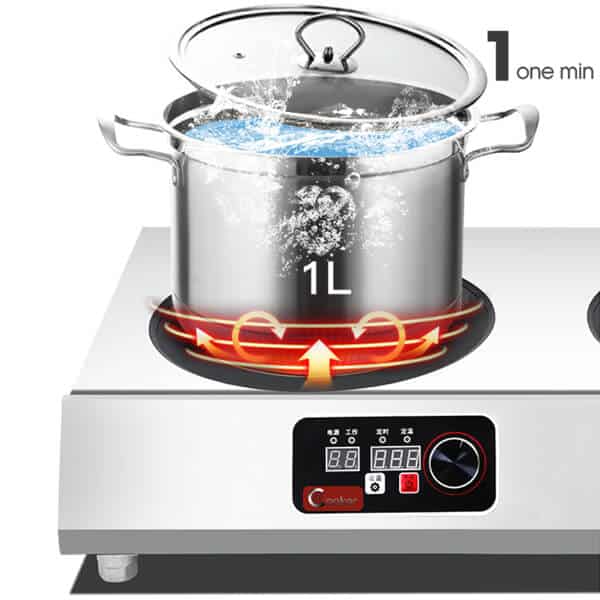
Commercial Kitchen Equipment -from AT Cooker
- As a brand manufacturer of the professional commercial induction cooking equipment, AT Cooker has responded to restaurants’ & hotels’ needs and research normative commercial cooking equipment using the very latest induction technology.
- These seamless, real commercial quality commercial cooking equipment provides us with the opportunity to incorporate equipment of our choice into one seamless, multipurpose cooking equipment creating an efficient, low cost, safe, green and sustainable commercial kitchen. We have standerd equipment can service many commercial kitchens.
- AT Cooker always offers professional service. From material, design, to producing, we focuse on quality, performance and reliability to ensures the best solution is delivered for each and every one of our customers. Have a commercial kitchen? We will be one of your best partners.
Work Voltage
| Single-Phase | Three-Phase |
|---|---|
| 120V, 220V | 208V/ 240V, 380V, 480V |
Global In-Stock + Fast Pickup
| US | UK | Germany | France |
|---|---|---|---|
| Italy | Spain | Belgium | Bulgaria |
1. The Mechanics of Pan Detection: Why the Heat Stops When You Lift
Induction cooking relies on a magnetic circuit. The copper coil under the glass sends magnetic waves into the ferrous metal of the pan. This connection is what creates heat. When you lift the pan to toss food, you physically break this circuit.
The unit’s “Pan Detection” system instantly recognizes that the load is gone. For safety and energy efficiency, it pauses the power output. The question is not why it stops, but how fast it starts again. In cheap units, this pause triggers a full reset. In professional kitchen equipment responsiveness scenarios, this is unacceptable.
2. Lag Time Reality: Comparing Entry-Level vs. Professional Grade Response Speeds
Lag time is the delay between placing the pan back down and the heat returning.
Entry-Level: 2-4 seconds. The unit has to “wake up,” verify the pan, and ramp up power.
Professional Grade: < 0.5 seconds. AT Cooker units use high-frequency polling. The moment the pan touches the glass, the heat is there. This near-zero lag is essential for maintaining the sizzle during a busy sauté shift.
3. The “Beep” Factor: How Constant Error Alerts Disrupt Chef Concentration
Imagine a kitchen where every time a chef lifts a pan, a loud “BEEP” goes off. It would be maddening. This induction cooktop chef workflow disruption is common with consumer units.
Commercial induction cooktops are programmed to expect lifting. They have a “silent grace period” (usually 60 seconds). You can lift, toss, and return the pan without the machine screaming at you. This silence is golden in a high-stress environment.
4. Technique Adaptation: Shifting from High-Lifts to Sliding Motions
While our technology minimizes lag, chefs can also adapt for even better flow. Instead of lifting the pan 6 inches off the burner (common with gas to avoid flare-ups), induction chefs use a “Slide and Tilt” motion.
By keeping the back edge of the pan close to the glass while flipping the food, you maintain a partial magnetic connection, ensuring that induction sautéing rhythm is never broken.
5-year Warranty | 2-year Free Exchangeable | 1-year Free Return
5. Thermal Inertia: Does the Pan Stay Hot Enough During the Toss?
Chefs worry that the pan cools down mid-air because the “flame” is gone. This is a misunderstanding of thermal mass. A quality 3-ply stainless steel pan holds significant heat.
During the 2 seconds it takes to toss food, the temperature drop is negligible. The bigger factor is recovery speed upon landing. With commercial induction heat recovery, the pan is blasted with energy the millisecond it returns, compensating for any air-cooling instantly.
6. The Impact on Emulsions: Preventing Sauce Breakage During Micro-Pauses
Delicate sauces like Beurre Blanc or Hollandaise can break if the temperature fluctuates wildly. Gas burners can be inconsistent due to drafts. Induction is precise.
Even with the micro-pause of a pan lift, the pan’s residual heat keeps the emulsion stable. When reconnected, the soft-start logic prevents a sudden temperature spike that might scramble the eggs or separate the fat.
7. Customizing Sensor Sensitivity: Can You Adjust the Cut-Off Timing?
Not all stations are the same. A Sauté station needs high sensitivity; a Stock Pot station does not. AT Cooker units offer adjustable parameters.
Technicians can adjust the “Pan Absent Delay” setting. For aggressive sauté stations, we can extend the “memory” time, ensuring the unit doesn’t try to shut down or error out during vigorous service.
8. Gas vs. Induction Flow: The Psychological Difference of Visible Flame
The biggest barrier to commercial induction vs gas flow is psychological. Chefs “feel” faster with a visible flame. However, stopwatch tests prove otherwise.
Induction heats oil to the smoke point 2x faster than gas. Once a chef trusts the invisible heat—and realizes they aren’t sweating as much—their flow actually improves because they aren’t fighting against the radiant heat of the stove.
9. The “Smart Memory” Feature: Resuming Exact Power Levels Instantly
If you are cooking on “Level 8” and lift the pan, a dumb unit resets to “Level 0” or “Ready.” You have to press buttons to get back to Level 8. This is a workflow killer.
Our units have Smart Memory. They remember you were at Level 8. When the pan returns, it resumes at Level 8 automatically. No button pressing required.
10. Miao Hui Technology: Millisecond Re-Coupling for Seamless Sautéing
“Miao Hui” (Second Return) is the industry term for instant recovery. It is the holy grail of induction engineering.
⚡ Miao Hui Tech
This technology keeps the magnetic circuit in a “pre-charged” state. The inverter doesn’t fully power down; it idles at a high-readiness state. The moment the sensor detects metal, full current flows instantly. This eliminates the “ramp up” lag entirely.
11. The Difference Between Standby Mode and Error Mode Logic in Control Chips
It is vital to distinguish between “Standby” (Pan Lifted) and “Error” (Pan Incompatible). Standby is a normal operating state. Error requires a reset.
Our control chips are programmed to stay in Standby for up to 60 seconds of pan absence. This accommodates plating, tossing, and adding ingredients without triggering an annoying Error Mode reset.
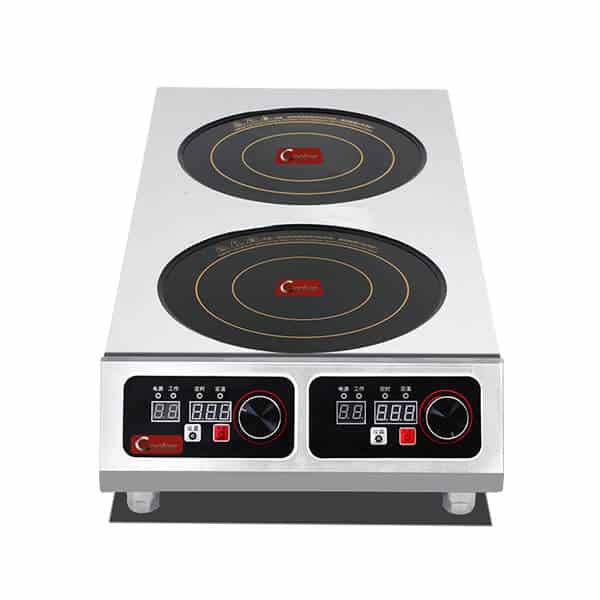
12. Retraining Muscle Memory: How Long Does It Take to Trust the Invisible Heat?
Transitioning a brigade to induction takes about 3 days. Day 1 is frustration (no flame). Day 2 is adaptation (learning the settings). Day 3 is acceptance.
Once chefs realize they can boil water in seconds and hold a simmer with digital precision—all while the kitchen stays cool—they rarely want to go back. The “Flow” is different, but it is faster.
| Workflow Factor | Gas Range | AT Cooker Induction |
|---|---|---|
| Pan Lift Effect | Flame continues | Pause & Resume (Instant) |
| Heat Waste | High (Heats Air) | Low (Heats Pan) |
| Recovery Time | Slow | Instant |
| Chef Comfort | Low (Hot) | High (Cool) |
5-year Warranty | 2-year Free Exchangeable | 1-year Free Return
Final Thoughts from AT Cooker
Does pan detection ruin the cooking rhythm? Only if you use the wrong equipment. The AT Cooker Commercial Induction Series is built for the professional flow, ensuring that your sauté technique is supported, not hindered.
With stock ready for delivery in the USA, Germany, France, UK, Belgium, Italy, Spain, and Bulgaria, you can upgrade your line with confidence. Visit our About Us page to learn more about our chef-centric engineering.