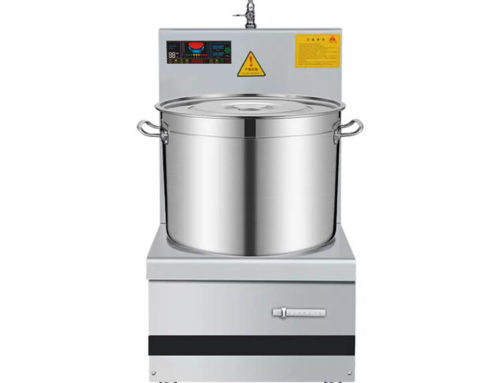
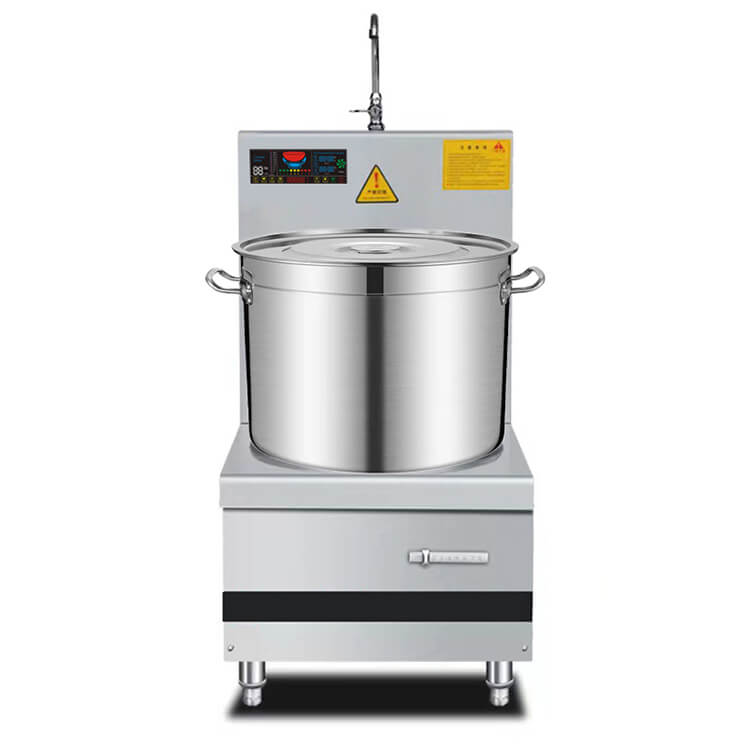
Hidden Savings: How Commercial Induction Stock Pot Burners Drastically Reduce Restaurant AC Bills
5-year Warranty | 2-year Free Exchangeable | 1-year Free Return
AT Cooker Executive Insight: When restaurant owners audit their utility bills, they often treat the Gas bill and the Electric (HVAC) bill as separate entities. In reality, they are deeply connected. Every dollar of gas you burn creates waste heat that your air conditioner must spend electricity to remove. This “Double Tax” is silently killing your profit margins. By switching to AT Cooker Commercial Induction Stock Pot Burners, you eliminate the waste heat at the source, potentially reducing restaurant air conditioning costs by 30% or more. Here is the financial physics behind the cool kitchen revolution.
Commercial kitchens are notoriously hot. For decades, chefs accepted sweat-drenched shifts as part of the job. But this heat represents wasted money. A traditional gas stock pot burner, running for 12 hours to simmer broth, acts like a massive heater in the middle of your kitchen.
The solution is not a bigger AC unit; it is energy efficient commercial kitchen ventilation and cooking equipment. The AT Cooker Induction Soup Cooker transfers 95% of its energy directly into the pot. There are no flames heating the air, no radiant heat blasting the chef, and minimal load on your HVAC system. In this guide, we quantify the hidden savings of switching to induction.
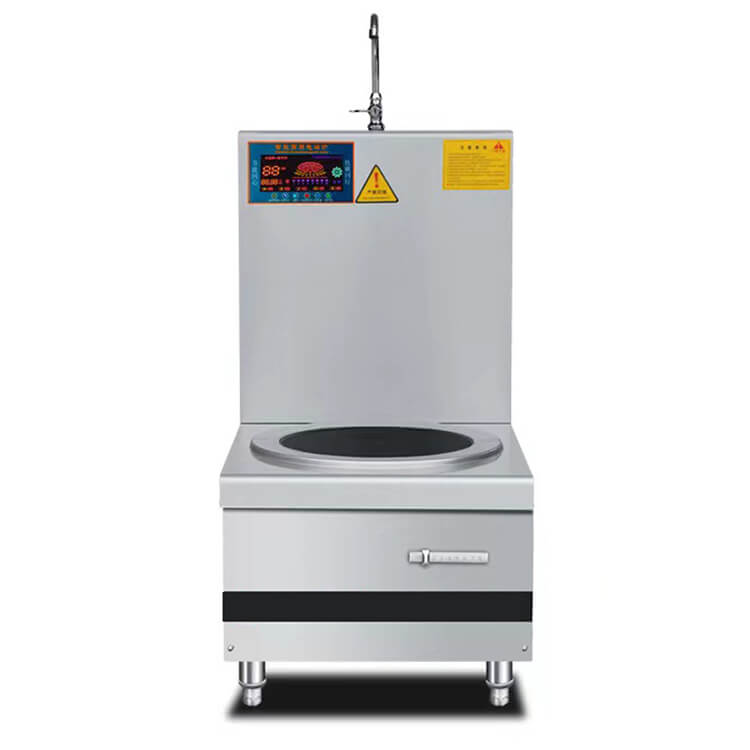
Commercial Kitchen Equipment -from AT Cooker
- As a brand manufacturer of the professional commercial induction cooking equipment, AT Cooker has responded to restaurants’ & hotels’ needs and research normative commercial cooking equipment using the very latest induction technology.
- These seamless, real commercial quality commercial cooking equipment provides us with the opportunity to incorporate equipment of our choice into one seamless, multipurpose cooking equipment creating an efficient, low cost, safe, green and sustainable commercial kitchen. We have standerd equipment can service many commercial kitchens.
- AT Cooker always offers professional service. From material, design, to producing, we focuse on quality, performance and reliability to ensures the best solution is delivered for each and every one of our customers. Have a commercial kitchen? We will be one of your best partners.
Work Voltage
| Single-Phase | Three-Phase |
|---|---|
| 120V, 220V | 208V/ 240V, 380V, 480V |
Global In-Stock + Fast Pickup
| US | UK | Germany | France |
|---|---|---|---|
| Italy | Spain | Belgium | Bulgaria |
1. The Thermodynamics of Waste Heat: Why Gas Burners Turn Kitchens into Saunas
If your kitchen feels like a sauna, your wallet is leaking money. The intense heat you feel when walking past a gas stock pot burner is not “cooking power”—it is waste. A gas burner operates at roughly 40-45% thermal efficiency. This means nearly 60% of the energy you pay for is dumped directly into the kitchen air.
This creates a “Thermal Load.” Every BTU of waste heat must be removed by your air conditioning or ventilation system. In contrast, the AT Cooker Commercial Induction Stock Pot Burner puts 95% of its energy into the pot. The air remains cool, tackling the root cause of high utility bills.
2. Quantifying the BTU Load: How Much Heat Does a Gas Burner Dump into the Room?
Let’s do the math. A typical 100,000 BTU gas burner running at 40% efficiency puts 40,000 BTUs into the food and 60,000 BTUs into the room.
The Heat Penalty
60,000 BTUs is equivalent to running five residential space heaters in your kitchen simultaneously, all summer long. This is why your AC unit never shuts off.
3. Calculating the “Double Payment”: Buying Gas to Heat the Air, Then Electricity to Cool It
This is the “Double Tax” of gas equipment. First, you pay the gas company to generate the heat. Then, because that heat makes the kitchen unbearable, you pay the electric company to run the AC to remove it.
By switching to sustainable commercial cooking equipment like induction, you stop this cycle. You pay only for the energy that cooks the food, significantly reducing restaurant air conditioning costs.
4. The Impact of Induction Technology on Reducing Commercial HVAC Tonnage Requirements
When designing a new kitchen, engineers calculate “AC Tonnage” based on the equipment load. Gas kitchens require massive HVAC systems.
An induction-only kitchen produces far less ambient heat. This allows you to install smaller, cheaper HVAC units and run them at lower speeds. For existing kitchens, swapping gas for induction effectively gives your AC unit a massive break, extending its lifespan.
5. Improving Chef Productivity and Reducing Heat Exhaustion During Long Simmering Shifts
Heat kills productivity. A chef working in a 35°C (95°F) kitchen is slower, makes more mistakes, and needs more breaks than one working in a 24°C (75°F) environment.
Stock pot burners often run for 12 hours straight. With induction, the “Heat Wall” is gone. The unit itself stays cool to the touch. This ergonomic improvement reduces heat exhaustion risk and keeps your staff sharp during long shifts.
5-year Warranty | 2-year Free Exchangeable | 1-year Free Return
6. Energy Audit Analysis: Visualizing the Drop in Total Facility KW Usage
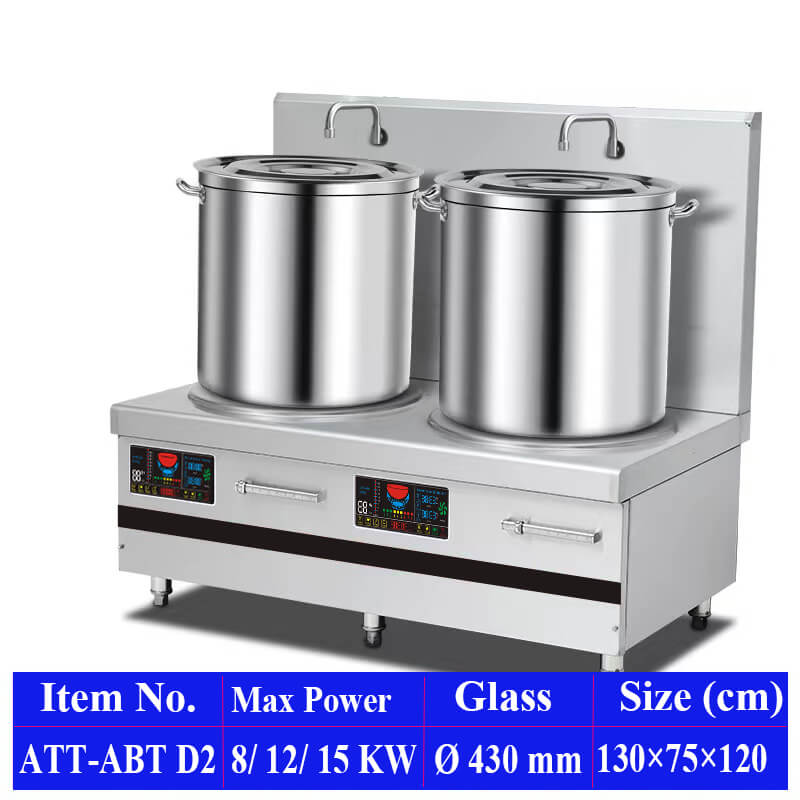
We conducted an energy audit with a client who replaced two gas stock pot burners with AT Cooker 15KW induction units. The results were stark.
While the electrical load for cooking increased slightly, the Total Facility Load dropped by 18%. The reduction in HVAC electricity consumption outweighed the cooking electricity cost, proving that induction is a net-positive energy decision.
7. The “Domino Effect”: How Cooler Ambient Temperatures Extend the Life of Nearby Refrigeration Units
Your walk-in cooler and reach-in fridges have compressors that fight ambient heat. If your kitchen is 10 degrees hotter due to gas burners, those compressors run 24/7 to keep food safe.
By lowering the ambient temperature with induction, you reduce the strain on your refrigeration equipment. This leads to fewer breakdowns, longer equipment life, and lower repair bills—a hidden saving often overlooked.
8. Optimizing Ventilation Systems: Reducing Extraction Fan Speeds for Induction Stations
Kitchen hoods are legally required to remove combustion fumes (Carbon Monoxide) from gas burners. This requires high-speed fans sucking conditioned air out of the building.
Induction produces zero combustion fumes. You are only venting steam. This often allows you to install “Demand Control Kitchen Ventilation” (DCKV) systems that slow the fans down, saving massive amounts of electricity and keeping your cool air inside.
9. Seasonal Cost Analysis: The Exaggerated Savings During Peak Summer Months
In winter, waste heat from gas might seem like “free heating.” But in summer, it is a liability. Commercial electricity rates often have “Peak Demand” charges in summer months.
Using induction during July and August prevents your kitchen from spiking into a higher tariff bracket, saving you money when electricity is most expensive.
10. Understanding Radiant Heat vs. Direct Magnetic Friction in Large Volume Cooking
Radiant heat spreads out in all directions. Magnetic friction is contained within the metal of the pot. The commercial induction soup stove heat emission profile is negligible because the energy only turns into heat once it is inside the cooking vessel.
This precision means you can stand right next to a 30KW induction burner and feel comfortable, whereas a gas burner would force you to step back.
11. The “Three-Degree Rule”: Keeping Kitchen Ambient Rise Minimal Even During Full Capacity
A well-designed induction kitchen should not be more than 3°C warmer than the dining room. This “Three-Degree Rule” is achievable with AT Cooker equipment.
Maintaining this balance keeps the kitchen pressure neutral and prevents odors from drifting into the dining area, improving the overall guest experience.

12. Measuring the “Invisible Consumption Ratio”: AC Electricity Saved vs. Induction Power Used
The “Invisible Consumption Ratio” is the metric of smart operators. For every 1 kWh of electricity used by an induction cooker, you save approximately 0.5 kWh of electricity that would have been used by the AC to fight a gas burner.
This efficiency multiplier makes induction the only logical choice for sustainable commercial cooking equipment.
| Cost Factor | Gas Kitchen | Induction Kitchen |
|---|---|---|
| Waste Heat | 60% | 5% |
| AC Load | Maximum | Reduced |
| Ventilation | High Speed | Low Speed |
| Total Utility Cost | High | Low |
5-year Warranty | 2-year Free Exchangeable | 1-year Free Return
Final Thoughts from AT Cooker
Reducing your AC bill starts with the equipment you choose. The AT Cooker Induction Stock Pot Burner is more than a stove; it is a climate control strategy for your kitchen.
With stock ready for immediate delivery in the USA, Germany, France, UK, Belgium, Italy, Spain, and Bulgaria, you can start cooling down your kitchen and your costs today. Visit our About Us page to calculate your potential savings.