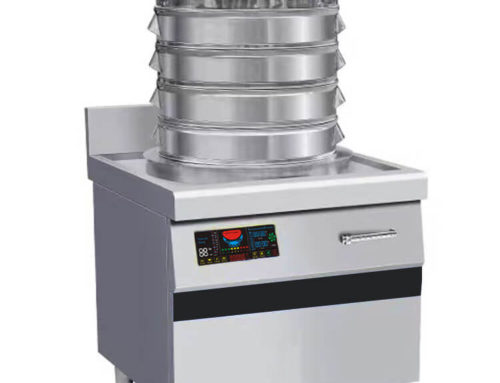
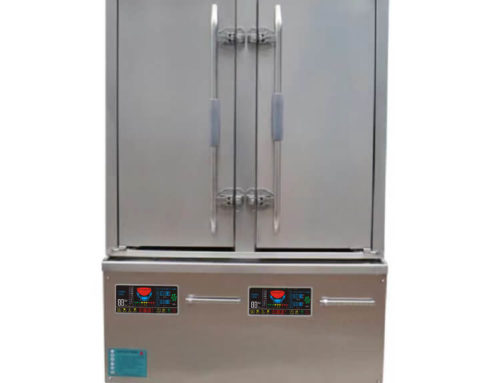
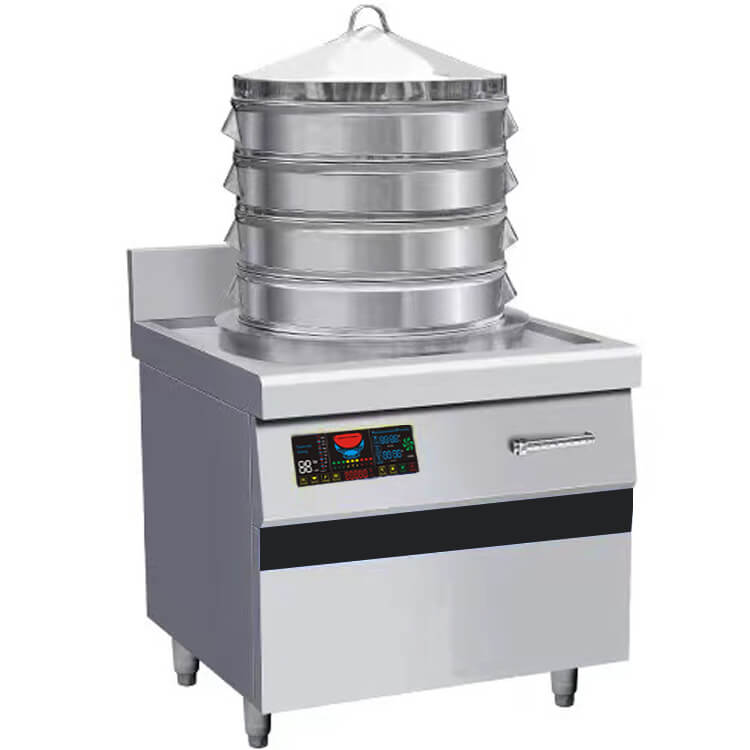
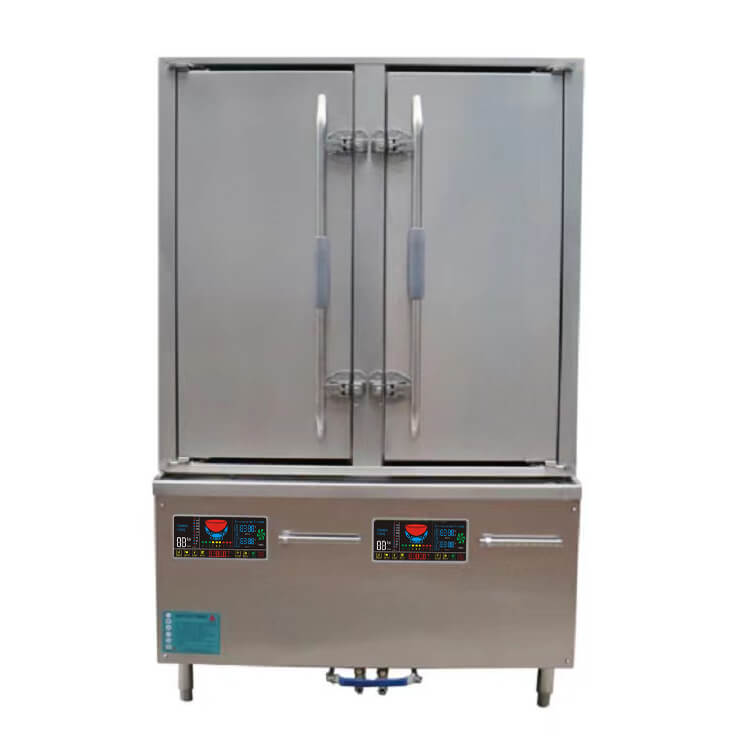
The AT Cooker ZFGT-R24 (24–48 trays, 20KW/25KW×2, 95% efficiency) requires precise installation—electrical supply, water infrastructure, space constraints, and environmental conditions all tie to its core specs. Missteps trigger safety warnings and void the 2-year warranty. Below, 14 critical requirements and limitations.
1. Dedicated Electrical Circuit (208V/240V or 380V 3-Phase)
The ZFGT-R24’s high power (20KW/25KW×2) and 3-phase design demand a dedicated circuit—sharing power causes voltage drops, triggering “Anti-Low Voltage Warning.” North America: 208V or 240V, 3-phase. Europe/Asia: 380V/400V/415V. Single-phase is incompatible—attempting to rewire burns out induction coils and voids warranty.
| Power Config | 240V Amp | 380V Amp | Wire Gauge |
|---|---|---|---|
| 20KW×2 (40KW) | ~96.2A | ~60.1A | 2AWG |
| 25KW×2 (50KW) | ~120.3A | ~75.1A | 1AWG |
Circuit protection: 100A breaker (40KW) or 125A (50KW) with GFCI. Separate 6AWG ground wire required. A Dallas school cafeteria used 3AWG wire for a 40KW unit—daily breaker trips during lunch rush; upgrading to 2AWG resolved the issue. A London restaurant connected a 380V unit to 240V—control board failed in 10 minutes, $600 replacement.
AT Cooker Warning: Only a licensed commercial electrician should handle wiring. Warranty is void if electrical work is done by an unqualified person.
2. Reliable Water Supply Line with Shut-Off Valve
The “Automatic Filling Water” feature depends on consistent water supply—interruptions trigger “Anti-Dry Heating Warning” and shut down the unit. Pipe: 1/2-inch NPT cold water line (hot water causes mineral buildup, reducing efficiency from 95% to 85% over 6 months). Pressure: 20–80 psi. Within 1.5m of unit’s rear lower inlet; longer runs need 3/4-inch pipe.
Shut-off: full-port ball valve near unit. Filtration: 5-micron sediment filter; hard water areas need a softener (unfiltered hard water requires monthly descaling vs. quarterly). Water quality limit: chlorine <5 ppm, no sulfur—both damage 304# stainless steel components.
Post-Installation Test: Run a “water fill” cycle—unit should fill its 10L internal reservoir in ≤2 minutes. Slower filling indicates pressure or pipe size issue.
3. Proper Drainage for Condensation & Wastewater
Drain pipe: 1.5-inch minimum (2-inch for starchy foods). Slope: 1/4 inch per foot. P-trap with cleanout plug prevents sewer gases. A Chicago catering company ignored slope—mold infestation, $1,200 remediation. Built-in condensation pan (5L) at base must connect to drain via 3/4-inch hose. Drain positioned to rear (not sides) to avoid blocking tray access (24–48 trays, 525×325×40mm).
| Requirement | ZFGT-R24 Spec | Common Mistake | Consequence |
|---|---|---|---|
| Electrical | 208V/240V or 380V, 3-phase, 100–125A | Single-phase power | Coil failure; warranty void |
| Water Supply | 1/2″ NPT, 20–80 psi, cold water | Hot water connection | Mineral buildup; clogs |
| Drainage | 1.5–2″ pipe, 1/4″/ft slope | Flat drain pipe | Standing water; mold |
| Rear Clearance | 30cm minimum | 15cm clearance | Overheating warnings |
| Ambient Temp | -5°C to +40°C | Unheated garage | Steam output reduced 30% |
4. Adequate Clearance for Ventilation & Access
Unit size: W120×D110×H185cm. Rear: 30cm (cooling fan airflow). Side: 60cm both sides (tray access, 24–48 pcs). Front: 90cm (door swing, loading). Vertical: 120cm to ceiling/hood. Total footprint: 240×210cm including clearances. A Boston diner placed unit 15cm from wall—weekly “Anti-Overheating Warning” alerts; moving to 30cm resolved it.
Space Constraint: Cannot be installed in kitchens with narrow aisles. For small kitchens, consider AT Cooker’s smaller 12-tray countertop steamer instead.
5. Level & Sturdy Installation Surfaces
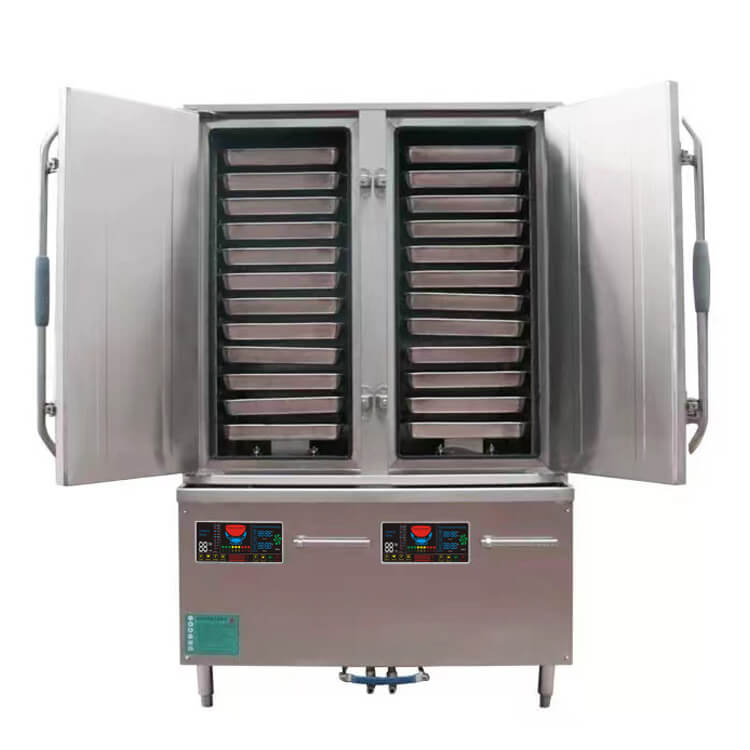
Weight: ~200kg empty, ~500kg full. Max slope: 1% (1/8 inch per foot). Use stainless steel shims (not wood/plastic). Min floor rating: 250kg/m². Concrete: ideal (10cm thick min). Wood/composite: needs steel joist reinforcement. A Seattle restaurant installed on wood without reinforcement—floor sagged after 3 months, $1,800 repair. Tile: commercial-grade ceramic/porcelain with epoxy grout.
Weight Test: Fill 10 trays with water, place evenly. Check for floor deflection or wobble—if observed, stop and reinforce surface immediately.
6. Compliance with Local Plumbing & Electrical Codes
NEC (US): THHN/THWN-2 wiring in metal conduit, labeled “Commercial Rice Steamer” at breaker, NEC Article 250 grounding. IEC 60335-2-14 (Europe): 30mA RCD required. Post-installation inspection by local authority typically required. Plumbing: grease traps often mandated; 50-gallon sufficient. Water conservation regions (CA, AU): 1.5 GPM low-flow valve. Fire: 1.5m from flammables (NFPA 96 / EN 1860-1).
Documentation: Keep inspection reports, electrical permits, and invoices for insurance. Most insurers require proof of code compliance.
7. Regular Descaling Maintenance Setup
Descaling port (rear panel) must remain unobstructed. Store food-safe solution nearby. Wastewater needs PVC or stainless steel drain pipes (acid corrodes plain plastic). A Las Vegas hotel skipped descaling for 3 months—steam generator clogged, $950 replacement.
| Water Type | Descaling Frequency | Impact of Skipping |
|---|---|---|
| Soft (<60 ppm) | Every 3 months | 10% efficiency loss |
| Hard (60–120 ppm) | Every 2 months | 25% loss; clogs |
| Very Hard (>120 ppm) | Every month | Generator failure; $800+ repair |
Limitation: ZFGT-R24 has no self-descaling feature. Installation must include a manual descaling plan (staff training, solution storage).
“Installing the ZFGT-R24 in our school cafeteria required careful code compliance and planning. Dedicated 3-phase circuit, water line, drain, and steel joists for our wooden floor ($1,000). Monthly descaling schedule (hard water). Unit has run flawlessly for 18 months.”
— Carlos, School Cafeteria Manager (Dallas, TX)
8. Voltage Compatibility for Energy Efficiency
95% efficiency depends on correct voltage. Proper (380V EU): 20KW produces 19KW usable heat. Mismatch (240V for 380V unit): efficiency drops to 65%, only 13KW usable—adds ~$300/month in electricity (8 hrs/day at $0.15/kWh). Verify with multimeter before installation; document results for warranty. Unit is factory-set, not voltage-adjustable—modifications void warranty and risk fire.
Savings: With proper voltage and 95% efficiency, ZFGT-R24 saves ~$1,800/year vs. a 45% efficient gas rice steamer (8 hrs/day use).
9. Professional Installation Recommended
DIY voids 2-year warranty. Electrician: licensed, 3-phase commercial experience. Plumber: licensed, commercial drainage. Includes: electrical connections + voltage/amperage test, water/drain setup with P-trap + leak test, unit leveling + shimming, safety feature testing (Anti-Dry Heating, Anti-Overheating, Fault Detection), staff user training. Miami restaurant: DIY install, steam generator failed at 6 months, warranty denied—$850 repair.
Authorized Installers: Contact AT Cooker for a list. They provide an “Installation Certificate” required for warranty validation.
10. Ambient Temperature & Humidity Limits
Operating range: -5°C to +40°C. Below -5°C: water line freezes. Above +40°C: cooling fan strains. Max humidity: 60% RH—higher causes condensation on control panel, shorts LED display and sensors. A Thailand resort ignored humidity limits—control panel failed after 4 months, $500 repair. Not rated for outdoor use.
Monitoring: Place a temperature/humidity gauge near the unit during the first month. If levels exceed limits, add insulation or a dehumidifier immediately.
11. Kitchen Exhaust System Integration
No dedicated hood required, but integration needed in: small kitchens (<50m², exhaust fan ≥800 CFM), multiple heat appliances (Type I grease-rated hood), healthcare facilities (strict air quality). Hood height: 72–84 inches above unit. Airflow: 100 CFM per sq ft of unit top (1.32m² = 14.2 sq ft → 1,420 CFM min). A Chicago café used 600 CFM—persistent steam buildup; upgrading to 1,500 CFM resolved it.
Limitation: No built-in exhaust fan. Installation must account for external exhaust if needed to meet local health codes.
12. Safety Features Require Proper Setup
Auto Water Refill: calibrate float switch during installation; test inlet valve with 3 full fill cycles. Dry-Run Protection: align level sensor to trigger below 2L; test by draining to 1L—unit should shut down within 30 seconds with “Anti-Dry Heating Warning.” Sensors are not user-serviceable—repairs by unauthorized personnel void warranty.
Safety Checklist: Have the technician sign off confirming all safety features work after installation. Keep for warranty and inspection records.
13. User Training Minimizes Failures
Critical topics: startup/shutdown procedures, warning interpretation (Anti-Low Voltage, Anti-Overheating), even tray loading (24–48 trays across two compartments), daily cleaning + monthly descaling. Boston catering: uneven loading bent tray rack, $300 repair. LED controls are not intuitive for untrained staff—confusing power level with temperature causes overheating or undercooking.
Training Resources: AT Cooker provides free ZFGT-R24 User Manual and video training series with step-by-step diagrams.
14. Long-Term Reliability & Correct Initial Setup
Lifespan: 7–10 years with proper care. Key factors: proper wiring/grounding (prevents control board failure), filtered soft water (reduces limescale), unobstructed clearance (cooling fan longevity), maintenance schedule adherence. Toronto hotel: correct install, 8 years without major repair. LA restaurant: cut corners, replaced after 3 years. Some mistakes (inadequate floor reinforcement, incorrect voltage) cannot be retroactively fixed—replacement costs 5× more than initial reinforcement.
Follow-Up: Schedule a 1-month post-installation inspection to catch loose wiring or slow leaks before they become major problems.
What electrical supply does the ZFGT-R24 commercial rice steamer require?
A dedicated 3-phase circuit: 208V/240V (North America) or 380V/400V/415V (Europe/Asia). Power: 20KW or 25KW per compartment. Amperage: ~96.2A at 240V or ~60.1A at 380V for the 40KW config. Wire gauge: 2AWG (40KW) or 1AWG (50KW). Must include GFCI protection and separate 6AWG ground wire. Never use single-phase power.
What water line specifications are needed for the rice steamer?
1/2-inch NPT cold water line (hot water causes mineral buildup). Pressure: 20–80 psi. Within 1.5m of the unit’s rear inlet. Include a full-port ball shut-off valve and 5-micron sediment filter. Hard water areas need a softener. Water must contain <5 ppm chlorine and no sulfur—both damage 304# stainless steel components.
What clearance distances are required around the ZFGT-R24?
Rear: 30cm (cooling fan airflow). Both sides: 60cm (tray access for 24–48 trays). Front: 90cm (door swing and loading). Vertical: 120cm to ceiling or hood. Total footprint including clearances: 240×210cm. The unit cannot be installed in kitchens with narrow aisles.
What drainage setup does the commercial rice steamer need?
1.5-inch drain pipe minimum (2-inch for starchy foods). Slope: 1/4 inch per foot for gravity flow. P-trap with cleanout plug. Built-in condensation pan (5L) connects via 3/4-inch hose. Drain positioned to rear to avoid blocking tray access. Flat pipes cause standing water and mold growth.
What ambient conditions does the ZFGT-R24 operate within?
Temperature: -5°C to +40°C. Maximum humidity: 60% relative humidity. Below -5°C freezes water lines; above +40°C strains the cooling fan. High humidity shorts the LED display and sensors. The unit is not rated for outdoor installation. Place a temperature/humidity gauge nearby during the first month.
Ensure Proper Installation of Your ZFGT-R24
Share your kitchen layout and regional code requirements—we’ll provide a custom installation checklist tailored to your space.