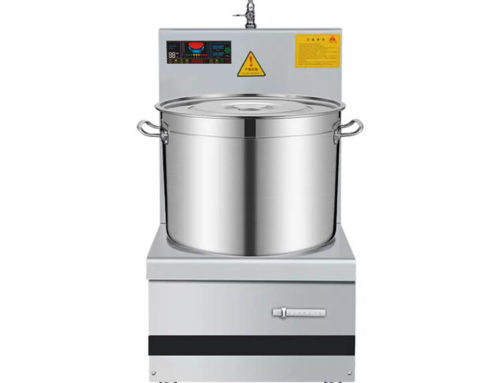
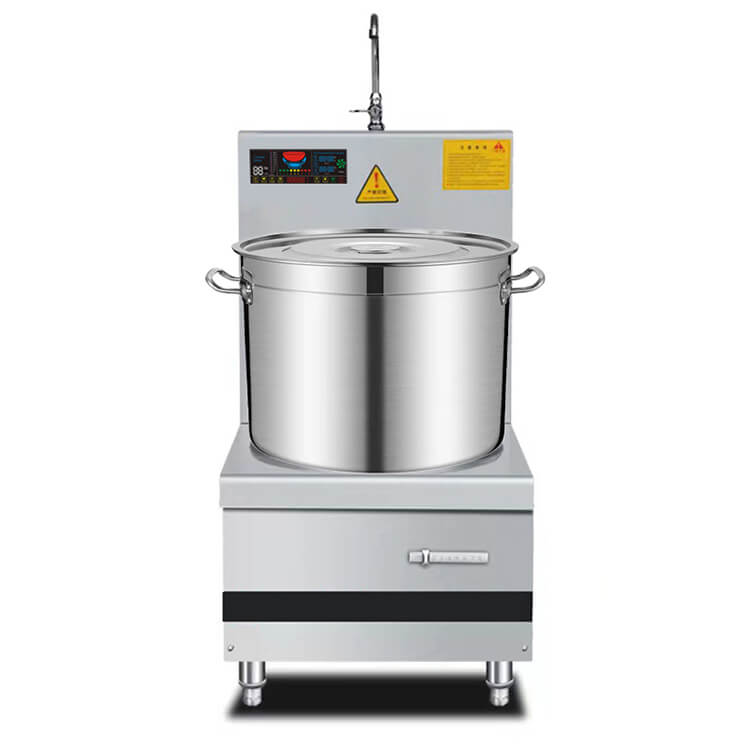
Can Your Commercial Burner Safely Support a Fully Loaded 100-Liter Stock Pot?
5-year Warranty | 2-year Free Exchangeable | 1-year Free Return
AT Cooker Executive Insight: In a busy commercial kitchen, safety starts with stability. A 100-liter pot of boiling bone broth is not just heavy; it is a potential hazard if your equipment isn’t built to handle the load. Many chefs underestimate the sheer weight of liquids and steel. At AT Cooker, we engineer our heavy duty commercial stock pot burner units, like the ATT-ABT Y, with industrial-grade chassis capable of supporting 500L capacities. Here is why structural integrity is the most important feature you never thought about.
Every commercial kitchen has a “Big Pot.” It is the workhorse for stocks, soups, and boiling water. But have you ever calculated how much that pot weighs when full? A standard 100-liter stock pot can easily weigh over 120 kilograms (265 lbs). Placing that kind of mass on a flimsy, residential-grade stove is a recipe for disaster.
The legs buckle. The grates crack. Or worse, the entire unit tips over when a chef leans in to stir a thick stew. This is why commercial kitchen safety standards mandate specific load-bearing requirements for large volume cooking. A heavy duty commercial stock pot burner must be more than just a heat source; it must be a structural foundation.
In this engineering breakdown, we will examine the physics of heavy loads and why the Induction Soup Cooker ATT-ABT Y is built like a tank to keep your kitchen safe.
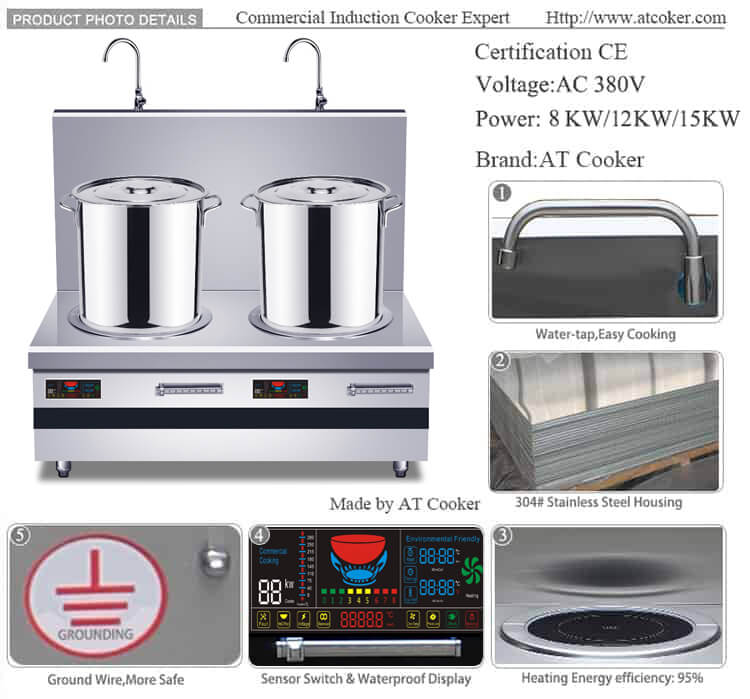
Commercial Kitchen Equipment -from AT Cooker
- As a brand manufacturer of the professional commercial induction cooking equipment, AT Cooker has responded to restaurants’ & hotels’ needs and research normative commercial cooking equipment using the very latest induction technology.
- These seamless, real commercial quality commercial cooking equipment provides us with the opportunity to incorporate equipment of our choice into one seamless, multipurpose cooking equipment creating an efficient, low cost, safe, green and sustainable commercial kitchen. We have standerd equipment can service many commercial kitchens.
- AT Cooker always offers professional service. From material, design, to producing, we focuse on quality, performance and reliability to ensures the best solution is delivered for each and every one of our customers. Have a commercial kitchen? We will be one of your best partners.
Work Voltage
| Single-Phase | Three-Phase |
|---|---|
| 120V, 220V | 208V/ 240V, 380V, 480V |
Global In-Stock + Fast Pickup
| US | UK | Germany | France |
|---|---|---|---|
| Italy | Spain | Belgium | Bulgaria |
1. The Physics of Heavy Loads: Calculating Total Weight of Water, Ingredients, and Steel
Stability starts with math. To understand if your burner can handle the job, you must calculate the static load. Water weighs 1kg per liter. A 100 liter soup cooker capacity means 100kg of water weight immediately. Add 20-30kg for the heavy gauge stainless steel pot itself, plus another 30kg for bones, meat, and vegetables in a dense stock.
You are looking at a total static load of 150kg to 160kg. That is the weight of two grown men standing on your stove. If the frame isn’t engineered for this, the legs will splay, the top will bow, and the pot will become unstable. The ATT-ABT Y is rated for loads exceeding 350kg, giving you a safety factor of 2x.
2. Analyzing Chassis Construction: Why 2.0mm Thick Stainless Steel is the Industry Minimum
In the world of commercial kitchen equipment, “stainless steel” is a vague term. Budget burners often use 0.8mm or 1.0mm thick skins over a rusting iron frame. This is cosmetic, not structural.
For true heavy duty commercial stock pot burner applications, AT Cooker uses 2.0mm thick 304 stainless steel for the main chassis. This thickness provides the necessary rigidity to resist buckling under heavy vertical loads. It ensures that the unit remains square and level, even after years of supporting massive cauldrons.
3. The Role of Internal “Cross-Bracing” Reinforcement in Preventing Frame Deformation
A metal box is strong until you twist it. Stirring a thick stew creates torque (twisting force). To combat this, our units feature internal diagonal cross-bracing.
Think of it like the trusses on a bridge. These internal stainless steel beams distribute the weight from the center of the unit out to the legs. This prevents the top plate from sagging in the middle, which is the most common failure point in cheaper industrial induction range load bearing designs.
4. Glass-Ceramic Strength: Understanding the Load Limits of 6mm vs 4mm Black Crystal Plates
The glass-ceramic plate is the interface between the heavy pot and the induction coil. Standard consumer cooktops use 4mm glass, which can crack under the impact of a 100L pot being dropped even 1cm.
Glass Engineering
We use 6mm High-Strength Microcrystalline Glass from German or Japanese suppliers (like Schott or NEG equivalents). This glass is rated to withstand thermal shocks of 800℃ and physical impacts that would shatter lesser glass. It is the shield that protects the 30KW coil underneath.
5. Low Center of Gravity: Why “Low Boy” Designs Offer Superior Stability for Tall Pots
A 100-liter stock pot is tall. If you place it on a standard 800mm high range, the top of the pot is at chest level. This is ergonomically dangerous and mechanically unstable. The center of gravity is too high.
Low boy soup stove safety relies on keeping the pot close to the floor. The ATT-ABT Y stands at a reduced height (typically 500-600mm for low-boy configurations), lowering the center of gravity. This makes it virtually impossible to tip over, even if accidentally bumped by a cart.
6. Adjustable Heavy-Duty Feet: Distributing 150kg+ Loads Evenly Across Uneven Floors
Kitchen floors are sloped for drainage. A rigid 4-legged stove will inevitably wobble on 3 legs, creating a dangerous “rocking” motion when stirring.
Our units come with heavy-duty, stainless steel bullet feet with 50mm of thread adjustment. This allows you to level the unit perfectly on any floor. More importantly, the feet have a wide diameter to distribute the 150kg load over a larger area, preventing damage to your floor tiles.
5-year Warranty | 2-year Free Exchangeable | 1-year Free Return
7. Dynamic vs. Static Load: What Happens When Chefs Vigorously Stir Thick Stews?
Static load is the weight of the pot sitting still. Dynamic load is the force applied when a chef leans their body weight into a paddle to stir a thick chili or curry. The lateral force can be significant.
A weak frame will flex or “rack” (twist) under this motion. Our fully welded frame is rigid. The stainless steel structural integrity ensures that the energy of stirring goes into mixing the food, not deforming the stove.
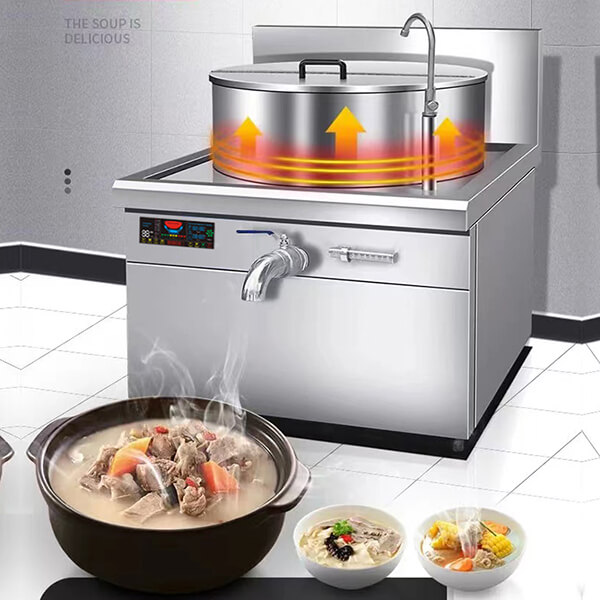
8. Welding vs. Fasteners: Why Full-Seam Welding Prevents Structural Loosening Over Time
Vibration is the enemy of screws. In a busy kitchen, equipment vibrates from fans, motors, and use. Over time, screws and bolts loosen. A bolted frame will eventually get “rickety.”
We use TIG (Tungsten Inert Gas) welding to fuse the stainless steel joints permanently. There are no screws to come loose in the structural frame. This creates a monolithic unit that retains its strength for decades, far surpassing the lifespan of flat-pack equipment.
9. The Impact of Thermal Stress: Ensuring Frame Rigidity at High Operating Temperatures
Metal expands when hot. A 30KW induction burner creates intense heat. If the frame design doesn’t account for thermal expansion, welds can crack and glass can shatter.
The AT Cooker design includes expansion gaps and heat sinks that allow the materials to breathe without stressing the structural joints. The “Cool Chassis” technology ensures that while the pot is 100°C, the frame remains stable.
10. Pot Diameter Compatibility: Ensuring the Base Fits the Burner Ring for Maximum Stability
Stability is also about fit. A 100L pot usually has a diameter of 50-60cm. If the induction coil diameter is too small (e.g., 30cm), the pot will be unstable and heat unevenly.
The ATT-ABT Y series offers oversized coil options matched to large stock pots. This ensures the pot sits flat and the magnetic field is distributed evenly across the entire base, preventing hot spots that can warp the pot bottom.
11. Jing-Zi (Grid) Structural Design: The Chinese Manufacturing Standard for Heavy-Duty Chassis
In heavy industrial manufacturing, we use the “Jing-Zi” (井字) structure. This refers to a grid pattern of reinforcement beams under the top plate, resembling the Chinese character for “well” or a hashtag (#).
This grid supports the glass ceramic plate from underneath, ensuring that if a chef accidentally drops a heavy pot, the impact is absorbed by the steel grid, not just the glass.
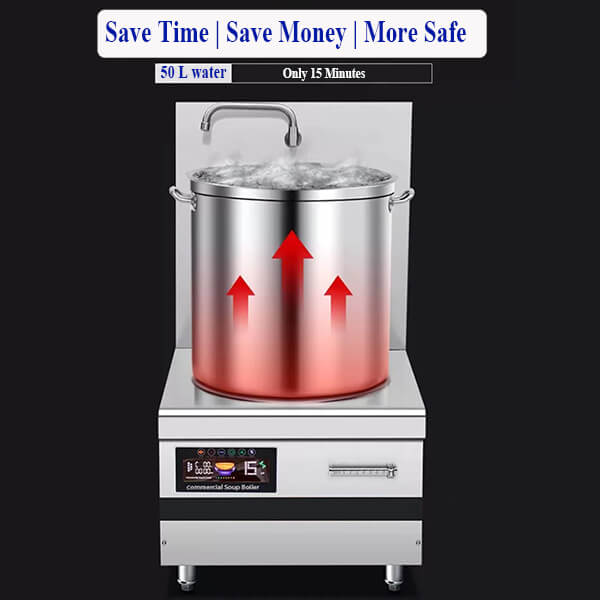
12. Factory Testing Protocols: Why Manufacturers Test at 3x the Rated Capacity
We don’t trust math alone; we trust testing. Before any heavy-duty model leaves our factory, it undergoes a Static Load Test. For a unit rated for 100L (100kg), we stack 300kg of concrete blocks on the chassis.
We measure deflection (bending) with laser precision. Only units that show zero permanent deformation pass QC. This 3x Safety Factor ensures that in the real world, your 100L pot is an easy load for our equipment.
| Specification | Standard Stove | AT Cooker Heavy Duty |
|---|---|---|
| Steel Thickness | 0.8mm – 1.0mm | 2.0mm+ (304 SS) |
| Assembly | Screws / Rivets | Full TIG Welding |
| Load Capacity | ~80kg | 350kg+ |
| Glass Support | Perimeter Only | “Jing-Zi” Grid Support |
5-year Warranty | 2-year Free Exchangeable | 1-year Free Return
Final Thoughts from AT Cooker
Can our burner support a 100-liter pot? Yes, and it can support two more on top of that. Safety and stability are the core of our engineering philosophy. When you are dealing with scalding hot liquids in a commercial environment, over-engineering is the only acceptable standard.
With stock available in the USA, Germany, France, UK, Belgium, Italy, Spain, and Bulgaria, AT Cooker can deliver this stability to your kitchen door. Don’t risk a spill. Invest in a foundation you can trust. Visit our About Us page for more details.