Stability Matters: Ensuring Commercial Stock Pot Burners Can Handle Thick Stews Without Wobbling
5-year Warranty | 2-year Free Exchangeable | 1-year Free Return
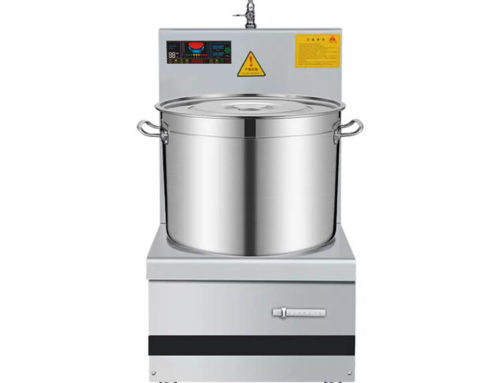
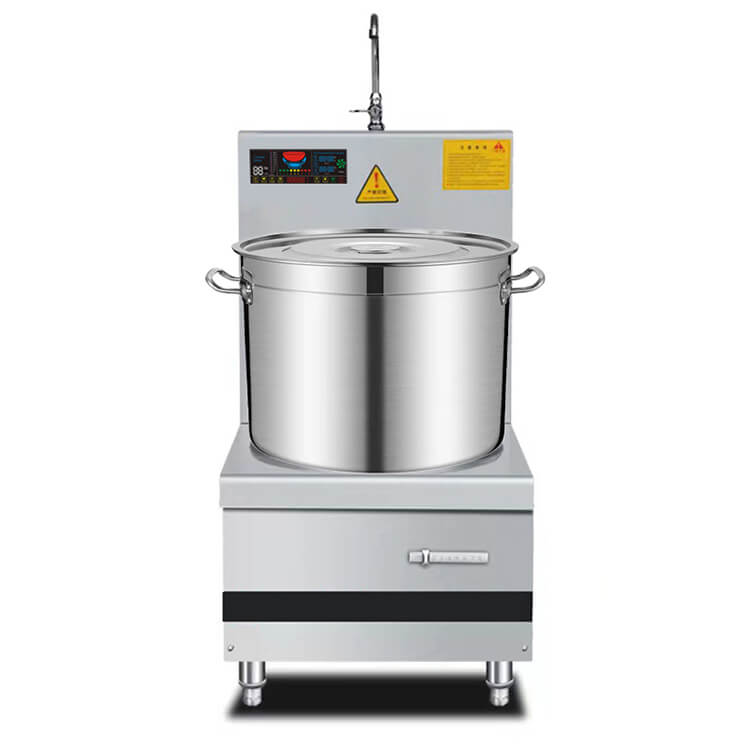
AT Cooker Executive Insight: In a commercial kitchen, a wobbling pot is not just an annoyance; it is a liability. When you are boiling 150 liters of scalding bone broth or stirring a viscous curry, the stability of your stove is the only thing standing between safety and disaster. At AT Cooker, we engineer our heavy duty commercial stock pot burner units with reinforced chassis and low centers of gravity to ensure that even the heaviest, thickest stews stay grounded. Here is why structural integrity is non-negotiable.
There is a terrifying moment that every chef fears: you are vigorously stirring a massive pot of stew, the spoon hits a thick patch of roux, and the entire stove shifts. The liquid sloshes dangerously close to the rim. In that split second, the quality of your equipment’s engineering is tested.
Unlike standard ranges, an industrial soup cooker must handle immense static and dynamic loads. A 200-liter pot of water weighs 200 kilograms. Add ingredients and the downward force of stirring, and the stress on the frame is enormous. Cheap, screw-assembled units simply cannot handle this torque over time. They loosen, they wobble, and eventually, they fail.
At AT Cooker, we treat our stock pot burners like structural foundations. In this guide, we will explore the physics of stability, the importance of commercial kitchen structural integrity, and why our 304 stainless steel welded frames are the safest choice for high-volume kitchens.
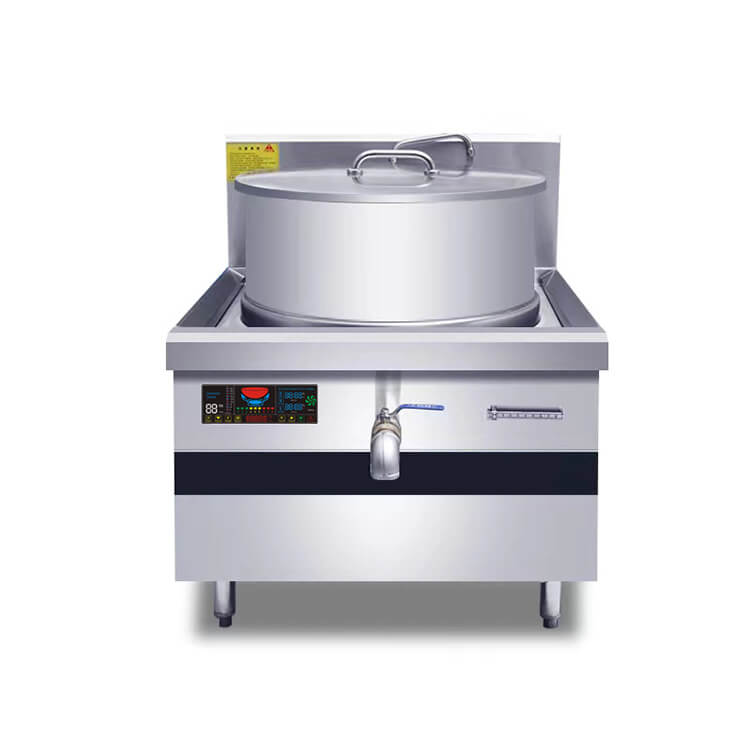
Commercial Kitchen Equipment -from AT Cooker
- As a brand manufacturer of the professional commercial induction cooking equipment, AT Cooker has responded to restaurants’ & hotels’ needs and research normative commercial cooking equipment using the very latest induction technology.
- These seamless, real commercial quality commercial cooking equipment provides us with the opportunity to incorporate equipment of our choice into one seamless, multipurpose cooking equipment creating an efficient, low cost, safe, green and sustainable commercial kitchen. We have standerd equipment can service many commercial kitchens.
- AT Cooker always offers professional service. From material, design, to producing, we focuse on quality, performance and reliability to ensures the best solution is delivered for each and every one of our customers. Have a commercial kitchen? We will be one of your best partners.
Work Voltage
| Single-Phase | Three-Phase |
|---|---|
| 120V, 220V | 208V/ 240V, 380V, 480V |
Global In-Stock + Fast Pickup
| US | UK | Germany | France |
|---|---|---|---|
| Italy | Spain | Belgium | Bulgaria |
1. The Physics of Viscosity: Why Thick Stews Demand Higher Equipment Stability
Cooking water is easy. Cooking a thick, starch-heavy stew or a reduction sauce is a physical battle. As liquids thicken, their viscosity increases, meaning they resist movement. When a chef stirs a pot of curry or gumbo, the force isn’t just absorbed by the liquid; it is transferred laterally into the stove itself.
If the heavy duty commercial stock pot burner has a weak frame or poor floor grip, this lateral force will cause the unit to shift, wobble, or even tip. For commercial safety, the friction between the unit and the floor must exceed the force applied by the chef. This is why lightweight aluminum frames are banned in many industrial specifications.
2. Examining Load-Bearing Capacity: Can the Unit Support 100kg+ Stock Pots?
Let’s do the math. A 100-liter stock pot filled with water weighs 100kg (220 lbs). Add the weight of the steel pot (approx. 15kg) and bones/meat (another 20kg), and you are looking at a static load of 135kg (approx. 300 lbs).
️♂️ AT Cooker Load Specs
The AT Cooker Stock Pot Burner is engineered to support dynamic loads exceeding 350kg. This large pot induction stove weight capacity is achieved through a reinforced skeletal structure that distributes weight directly to the legs, preventing the chassis from bowing under pressure.
3. Low Center of Gravity Design: Why “Low Boy” Burners Resist Tipping Forces
Height is the enemy of stability. A standard range is 900mm high. Lifting a 50kg pot onto that height is dangerous and raises the center of gravity (CoG). The “Low Boy” design, typically 500mm-600mm high, keeps the mass close to the ground.
This low profile drastically reduces the “tipping moment.” Even if a pot is bumped forcefully from the side, the low CoG ensures the unit slides rather than topples, a critical feature for preventing stove tipping in busy kitchens.
4. Adjustable Bullet Feet vs. Locking Casters: Choosing the Best Anchor for Heavy Stirring
Mobility is great for cleaning, but bad for stirring. Locking casters often have a slight “play” or wiggle even when locked. For maximum stew stirring safety, we recommend heavy-duty adjustable stainless steel bullet feet.
These feet grip the floor with a wider surface area and have zero play. They allow you to level the unit perfectly, turning the stove into an immovable object during service.
5. The Importance of Reinforced Stainless Steel Frame Thickness (2.0mm+)
In the commercial market, you will find cheap burners using 0.8mm or 1.0mm stainless steel skins over a mild steel angle iron frame. Over time, the mild steel rusts, and the thin skin buckles.
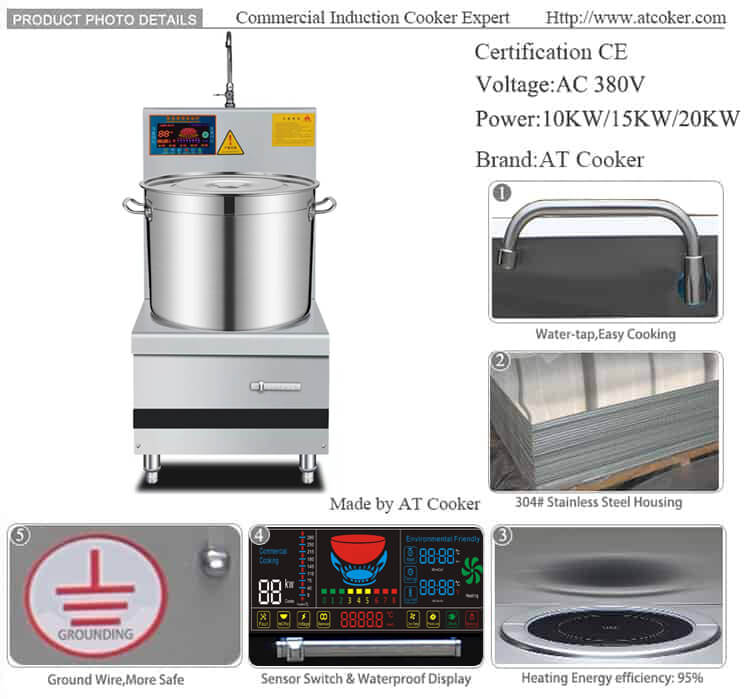
AT Cooker uses a unibody construction with 2.0mm thick 304 stainless steel. This gauge provides structural rigidity without relying on a hidden, rusting internal frame. It resists twisting forces during heavy stirring and supports the weight of full cauldrons without deformation.
5-year Warranty | 2-year Free Exchangeable | 1-year Free Return
6. Floor Leveling: The First Line of Defense Against Equipment Wobble on Uneven Tiles
Commercial kitchen floors are sloped for drainage. A stove with fixed legs will inevitably wobble on three legs. This wobble amplifies the motion of stirring liquids, creating a dangerous resonance.
Our units feature legs with 50mm of threaded adjustment. Proper installation involves using a spirit level to ensure the cooktop is perfectly flat. This eliminates the wobble at the source and ensures the weight is evenly distributed across all four load points.
7. Flat Glass-Ceramic Stability: Friction Advantages Over Slippery Metal Gas Grates
Cast iron gas grates are slippery, especially when greasy. A heavy pot can slide off if bumped. Induction uses a flat, high-friction glass-ceramic plate.
When a heavy pot sits on the glass, the surface area contact is massive. This friction coefficient keeps the pot planted firmly in place, even during vigorous mixing. For commercial kitchen safety equipment, this passive stability feature is a significant upgrade over gas grates.
8. Preventing “Walking”: How Vibration from Vigorous Boiling Affects Lightweight Units
Have you ever seen a washing machine “walk” across the floor? The same physics applies to lightweight stoves when a large pot is at a rolling boil. The vibration can cause the unit to creep across wet tiles.
Mass is the solution. The industrial soup cooker range from AT Cooker is built heavy. The sheer weight of the unit, combined with rubberized foot pads, dampens vibration and prevents walking, ensuring the gas line (or electrical cord) is never strained.
9. Ergonomics of Stirring: How Stove Height Affects Downward Force Application and Stability
If a stove is too high, a chef has to stir with their elbows up, pushing outward. This destabilizes the pot. If the stove is the correct “Low Boy” height, the chef can stir with straight arms, applying force downward.
Downward force increases friction and stability. Our ergonomic design (approx 500-600mm height) puts the pot rim at hip level, allowing chefs to use their body weight to stabilize the stir without straining their backs.
10. Structural Integrity: The Rigidity Difference Between Full-Seam Welding and Screws
Screws vibrate loose. Welds do not. In the high-vibration environment of a commercial kitchen, a screw-assembled chassis is a ticking time bomb of instability.
We utilize full-seam TIG welding for our chassis. This creates a monolithic structure where the legs, frame, and top plate act as a single piece of steel. This commercial kitchen structural integrity ensures that even after 5 years of heavy use, the unit remains as rigid as day one.
11. Factory “Static Load Testing”: Why Manufacturers Stack Concrete Blocks on Chassis Beams
We don’t guess; we test. Before a model is approved for production, it undergoes Static Load Testing. We stack concrete blocks onto the chassis well beyond the rated capacity (often up to 500kg) and measure deflection with laser calipers.
Only designs that show zero permanent deformation pass. This ensures that when you drop a 100-liter pot of water onto the unit, the frame won’t buckle.
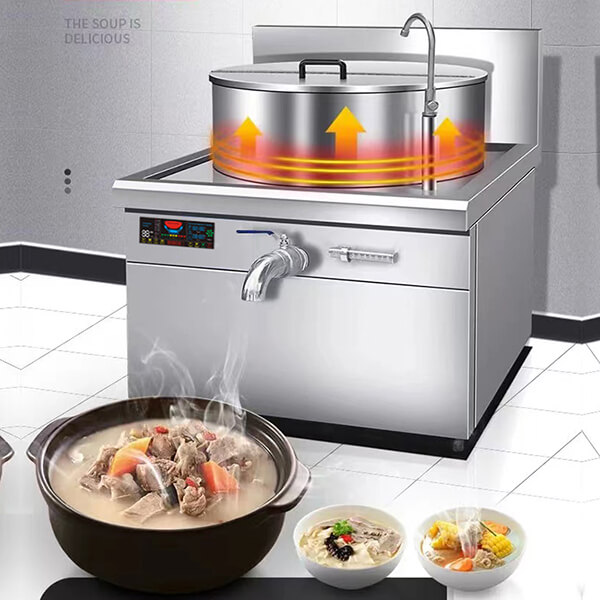
12. The “Triangle Stability” Principle: Internal Cross-Bracing Designs in Heavy-Duty Chassis
Look underneath an AT Cooker unit. You won’t just see four legs; you will see triangular cross-bracing. In engineering, triangles are the strongest shape.
By bracing the legs against the frame with diagonal supports, we eliminate “racking” (the tendency of a square frame to collapse into a parallelogram). This lateral stiffness is critical for resisting the side-to-side forces of mixing thick stews.
5-year Warranty | 2-year Free Exchangeable | 1-year Free Return
Final Thoughts from AT Cooker
Stability isn’t a feature; it’s a necessity. When dealing with hundreds of liters of boiling liquid, you cannot afford to compromise on structural engineering. The AT Cooker Stock Pot Burner series is built to be the bedrock of your kitchen—immovable, reliable, and safe.
We stock these heavy-duty units in the USA, Germany, France, UK, Belgium, Italy, Spain, and Bulgaria for immediate delivery. Don’t risk your staff’s safety with wobbly equipment. Upgrade to the stability of AT Cooker today.