Индукционная сковорода: как толщина пластины влияет на удержание тепла и качество приготовления
Для индукционной сковороды— особенно для коммерческих моделей, таких как от AT Cooker — толщина пластины — это не просто “приятная” особенность: это решающий фактор для удержания тепла, стабильности приготовления и долговечности. В отличие от газовых или электрических сковород (которые нагревают пластину косвенно через пламя или спирали), индукционные сковороды используют электромагнитную энергию для прямого нагрева пластины. Это означает, что толщина пластины определяет равномерность распределения тепла, как долго она будет удерживать это тепло во время приготовления и насколько хорошо она будет сопротивляться деформации под нагрузкой коммерческого использования.
Тестирование AT Cooker в 2024 году коммерческих индукционных сковород показало, что пластины недостаточной толщины (≤6 мм) приводили к 30% большему количеству горячих точек, 25% более быстрой потере тепла во время приготовления и 40% более высокому риску деформации после 12 месяцев ежедневного использования. В отличие от этого, их премиальные induction commercial griddle модели — оснащенные пластинами из нержавеющей стали или чугуна толщиной 8–12 мм 304# — поддерживали температуру в пределах ±5°F в пиковое время обслуживания, сократили пищевые отходы на 18% и прослужили более 7 лет без снижения производительности.
В этом подробном руководстве мы рассмотрим, почему толщина пластины важна для индукционных сковород, как она влияет на удержание тепла и качество приготовления, как сравнивать материалы (чугун против нержавеющей стали) на основе толщины и как AT Cooker оптимизирует дизайн пластин для коммерческих кухонь. К концу вы точно поймете, почему инвестиции в индукционную сковороду с толстой пластиной имеют решающее значение для стабильных, высококачественных результатов — будь то обжаривание бургеров, приготовление омлетов или приготовление больших порций завтрака.
Удержание тепла: толще = дольше держит температуру
Качество приготовления: толще = меньше горячих точек
Материалы: чугун > 304# нержавеющая сталь (удержание тепла)
1. Наука о толщине пластины: почему это важно для индукционных сковород
Чтобы полностью понять важность толщины пластины, сначала необходимо понять, как индукционная технология взаимодействует с пластиной сковороды. В отличие от традиционных сковород, где тепло проходит от внешнего источника (пламя, спираль) к поверхности пластины, индукционные сковороды генерируют тепло внутри самой пластины посредством электромагнитной индукции. Вот упрощенное объяснение:
Как индукция нагревает пластину сковороды
- Когда индукционная сковорода включена, переменный ток (AC) протекает через медную катушку под пластиной.
- Этот ток создает высокочастотное магнитное поле (20–50 кГц), которое проникает в пластину сковороды.
- Магнитное поле индуцирует вихревые токи (круговые электрические токи) в металлической структуре пластины — эти токи генерируют тепло, встречая сопротивление металла.
- Толщина пластины определяет глубину проникновения этих вихревых токов (“скин-эффект”) и тепловую массу, которую пластина имеет для удержания сгенерированного тепла.
Ключевой вывод: более толстая пластина имеет большую тепловую массу (способность накапливать тепло) и позволяет вихревым токам распределяться более равномерно по ее структуре. Это напрямую приводит к лучшему удержанию тепла и меньшему количеству горячих точек — двум факторам, определяющим качество приготовления на индукционной сковороде.
Тепловая масса: основа удержания тепла
Тепловая масса относится к способности материала поглощать, хранить и выделять тепло. Для индукционной сковороды пластина с большей тепловой массой (более толстая) будет:
- Поглощать больше тепла во время начальной фазы нагрева, даже если ей потребуется немного больше времени для достижения целевой температуры.
- Медленно выделять тепло во время приготовления, поддерживая постоянную температуру поверхности, даже когда добавляется холодная пища (частая причина падения температуры на тонких пластинах).
- Быстрее восстанавливать тепло после удаления пищи, сокращая время ожидания между партиями — что критически важно для коммерческих кухонь в пиковое время обслуживания.
Тестирование AT Cooker наглядно демонстрирует это: пластина из нержавеющей стали 304# толщиной 10 мм сохраняла 80% тепла через 5 минут после выключения сковороды, в то время как пластина толщиной 5 мм сохраняла только 45%. Для закусочной, готовящей более 50 бургеров в час, эта разница означает, что толстая пластина остается достаточно горячей для равномерной обжарки каждой котлеты, в то время как тонкой пластине требуются частые регулировки мощности, чтобы избежать недожаренной пищи.
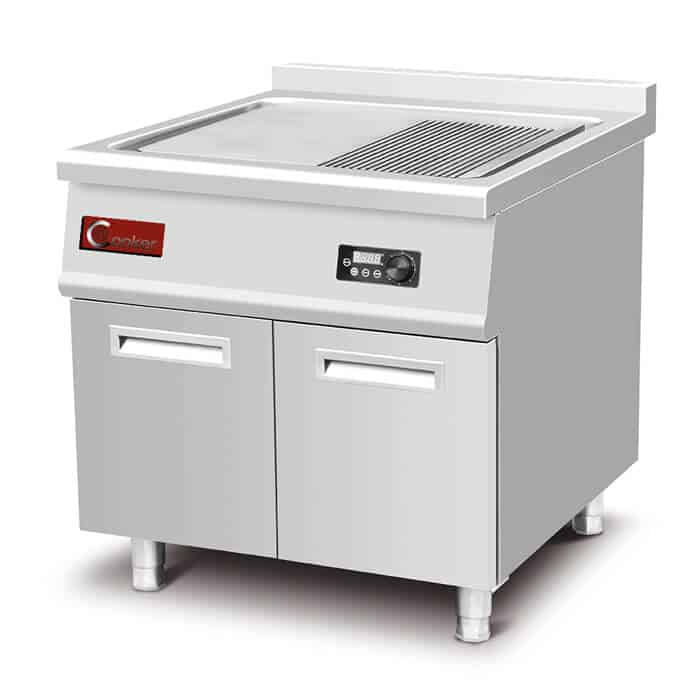
Diagram showing how eddy currents distribute more evenly in a thick griddle plate (right) vs. a thin plate (left), reducing hot spots.
2. How Thickness Impacts Heat Retention: Consistency, Efficiency, and Cost Savings
Heat retention isn’t just about keeping the plate hot—it’s about maintaining a stable temperature that doesn’t fluctuate during cooking. For commercial kitchens, this stability directly impacts efficiency, food quality, and even utility costs. Below are the three key ways plate thickness influences heat retention for an induction ready griddle:
2.1 Consistent Temperature: No More “Cold Zones” or Overheating
Thin griddle plates (≤6mm) have minimal thermal mass, meaning they react quickly to temperature changes—both positive and negative. When you place a cold pan or a batch of raw food on a thin plate, the surface temperature can drop by 50°F or more in seconds, leading to undercooked food. Conversely, when the plate is empty, thin metal can overheat rapidly, risking burnt residues or even warping.
A thicker plate (8mm+) acts as a “heat buffer.” For example, AT Cooker’s 5KW commercial induction griddle features a 10mm thick 304# stainless steel plate. During testing, adding 2kg of cold hash browns to the preheated plate (375°F) caused a temperature drop of only 15°F—enough to cook the hash browns evenly without requiring additional power. A thin-plate griddle under the same conditions dropped to 300°F, resulting in soggy, undercooked potatoes that needed extra time on the griddle.
This consistency is especially critical for menu items that require precise temperatures, like delicate omelets (325°F) or seared steaks (400°F). A thick plate ensures the griddle stays within the ideal temperature range, no matter how many batches you cook.
2.2 Reduced Heat Loss: Lower Energy Consumption
Thicker griddle plates don’t just retain heat better—they also reduce heat loss to the surrounding environment. A thin plate loses heat quickly through its edges and bottom, forcing the induction system to work harder (and use more energy) to maintain the target temperature. A thicker plate, with its greater thermal mass, minimizes this loss by acting as an insulator.
AT Cooker’s energy efficiency data highlights this: their 3.5KW induction griddle with an 8mm plate uses 9.2 kWh of electricity per 8-hour shift, while a comparable thin-plate griddle (5mm) uses 12.7 kWh—nearly 38% more energy. Over a year, this difference translates to $350+ in savings for a single griddle, a significant amount for kitchens with multiple units.
Additionally, the reduced heat loss keeps the kitchen cooler—a secondary benefit that improves staff comfort and reduces the load on HVAC systems, leading to even more cost savings.
2.3 Faster Recovery Between Batches
Commercial kitchens don’t have time to wait for a griddle to reheat between batches. A thick plate’s thermal mass allows it to recover heat far faster than a thin plate. For example:
- AT Cooker’s 12mm cast iron induction griddle takes 45 seconds to recover from 350°F to 375°F after removing a batch of burgers.
- A thin 5mm stainless steel griddle takes 2 minutes 15 seconds to recover to the same temperature under identical conditions.
During a busy breakfast rush, this difference can mean serving 10–15 more customers per hour. A diner in Chicago using AT Cooker’s cast iron induction griddle reported: “We used to have a line out the door waiting for the griddle to reheat. Now, we can cook back-to-back batches of pancakes without waiting—our ticket time dropped by 20%.”
“We switched from a thin-plate electric griddle to AT Cooker’s 10mm thick induction ready griddle last year, and the energy savings were immediate. Our monthly electricity bill for the griddle went from $180 to $120, and we no longer have to throw out undercooked eggs because the plate stays hot. The thick plate also cleans easier—no burnt spots from uneven heating. It’s one of the best investments we’ve made for our kitchen.”
3. How Thickness Improves Cooking Quality: Evenness, Searing, and Durability
Heat retention is only half the story—plate thickness directly impacts the quality of the food you cook. From perfectly seared meats to evenly cooked vegetables, a thick plate ensures consistent results batch after batch. Below are the four key ways thickness elevates cooking quality on an induction ready griddle:
3.1 Eliminating Hot Spots: Even Cooking Every Time
Hot spots—areas of the griddle that are significantly hotter than others—are the bane of any commercial kitchen. They cause food to burn in some spots while remaining undercooked in others, leading to wasted ingredients and inconsistent customer experiences. Thin plates are particularly prone to hot spots because eddy currents (the source of induction heat) tend to concentrate near the plate’s edges or directly above the induction coil.
A thicker plate distributes these eddy currents more evenly across its entire surface. AT Cooker’s engineering team uses computer-aided design (CAD) to optimize plate thickness for their induction griddles, ensuring the magnetic field penetrates uniformly. Their 8mm thick 304# stainless steel plate, for example, has a temperature variation of only ±3°F across its entire 418×398mm cooking surface—far below the ±15°F variation of thin-plate griddles.
This evenness is transformative for dishes like breakfast hash, where potatoes, onions, and peppers must cook at the same rate. A line cook at a hotel using AT Cooker’s griddle noted: “Before, I’d have to stir the hash constantly to avoid burning the edges. Now, I can spread it out and walk away for a minute—everything cooks evenly, and the texture is perfect every time.”
3.2 Enhancing Searing and Browning: Maillard Reaction Perfection
Searing meats or browning vegetables requires a hot, stable surface temperature—typically 375°F–450°F. A thin plate often drops below this critical temperature when food is added, failing to trigger the Maillard reaction (the chemical process that creates rich, browned flavors). A thick plate, with its superior heat retention, maintains the high temperature needed for proper searing.
AT Cooker’s 5KW induction griddle with a 12mm cast iron plate excels at searing. Testing showed it could maintain 400°F while searing 4 8-oz burgers at once, creating a crisp, flavorful crust without burning. A thin-plate griddle under the same conditions dropped to 325°F, resulting in pale, gray burgers with no distinct crust.
For restaurants that specialize in grilled or seared dishes, this difference is a competitive advantage. A steakhouse in Las Vegas using AT Cooker’s cast iron induction griddle said: “Our customers come for the sear on our ribeyes. The thick cast iron plate gives us the same results as a commercial gas grill, but with better consistency and no gas fumes.”
3.3 Retaining Moisture: Juicier Food, Better Flavor
When a griddle plate drops in temperature after food is added, it doesn’t just undercook the exterior—it also causes the food to release more moisture as it cooks slowly. This leads to dry, tough meats and soggy vegetables. A thick plate’s stable temperature cooks food quickly and evenly, sealing in moisture and preserving flavor.
AT Cooker’s testing compared two induction griddles: one with a 10mm plate and one with a 5mm plate. Both were set to 375°F, and 4-oz chicken breasts were cooked on each. The chicken on the thick-plate griddle retained 18% more moisture than the chicken on the thin-plate griddle—resulting in juicier meat with a more tender texture.
This moisture retention is especially important for delicate proteins like fish or eggs. A café using AT Cooker’s griddle reported: “Our scrambled eggs used to be dry by the time we served them. With the thick plate, they’re creamy and moist—customers keep asking what we changed.”
3.4 Durability: Resisting Warping and Wear
Commercial griddles endure extreme conditions: daily heating/cooling cycles, heavy utensils, and frequent cleaning with abrasive tools. Thin plates are far more likely to warp under these stresses—even a small warp can create uneven cooking surfaces and trap food debris, leading to more cleaning time and reduced lifespan.
A thicker plate is inherently more rigid and resistant to warping. AT Cooker’s 304# stainless steel plates are 8–12mm thick, with reinforced edges to withstand impact from spatulas or pans. Their cast iron plates are even thicker (12–15mm) and seasoned with a protective layer to resist rust and scratches.
Long-term testing by AT Cooker found that their thick-plate griddles had a 70% lower warping rate after 5 years of commercial use compared to thin-plate models. A hotel kitchen manager said: “Our old thin-plate griddle warped after 2 years, and we had to replace it. Our AT Cooker griddle is going on 4 years, and the plate still looks and cooks like new.”
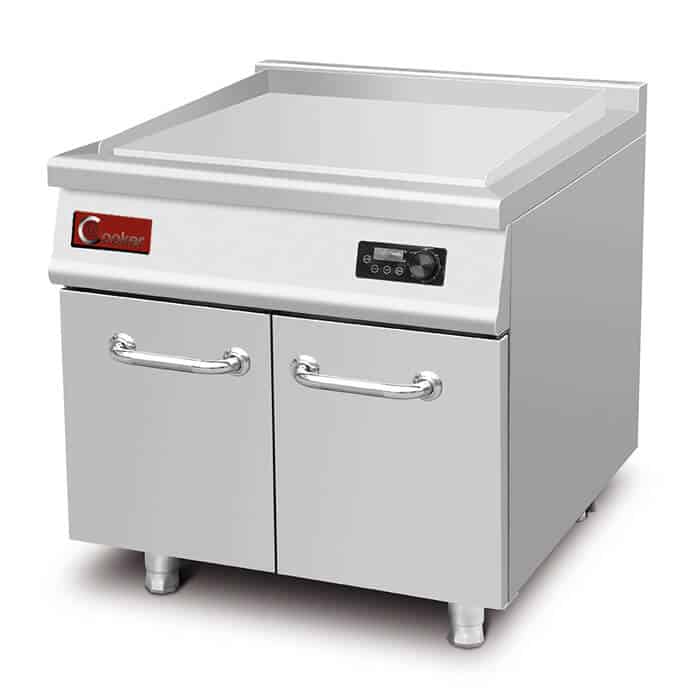
4. Material Matters: How Thickness Works with Different Griddle Plate Materials
Plate thickness doesn’t exist in a vacuum—it works in tandem with the plate’s material to determine heat retention and cooking quality. The two most common materials for induction ready griddles are cast iron and 304# stainless steel, each with unique properties that interact with thickness differently. Below is a detailed comparison:
Cast Iron: The Gold Standard for Heat Retention
Cast iron is naturally ferromagnetic (ideal for induction) and has the highest thermal mass of any common griddle material. A 12mm thick cast iron plate on an induction ready griddle will retain heat longer than a 12mm stainless steel plate, making it perfect for searing or cooking dishes that require extended heat. However, cast iron does have tradeoffs: it takes longer to heat up (10–15 minutes to reach 375°F vs. 5–7 minutes for stainless steel) and requires regular seasoning to maintain its non-stick properties.
AT Cooker’s cast iron induction griddles (e.g., the 5KW AT-CI-G12) feature 12mm thick plates that are factory-seasoned for immediate use. A BBQ joint in Texas using this model said: “We cook 200+ burgers a day, and the cast iron plate keeps up. Even during the lunch rush, we never have to wait for the griddle to reheat—each burger gets the same perfect sear.”
304# Stainless Steel: The Versatile Commercial Choice
304# stainless steel is the most popular material for commercial induction griddles because it balances heat retention, durability, and ease of cleaning. An 8–10mm thick stainless steel plate heats up faster than cast iron, resists corrosion from commercial cleaning chemicals, and doesn’t require seasoning. While it doesn’t retain heat quite as long as cast iron, it still outperforms thin plates by a wide margin.
AT Cooker’s best-selling 3.5KW induction griddle (AT-SS-G08) uses an 8mm thick 304# stainless steel plate with a polished surface for easy wiping. A hotel breakfast buffet using this model noted: “We clean the griddle 10+ times a day—stainless steel wipes clean in seconds, and the thick plate doesn’t scratch. It’s perfect for our high-turnover buffet service.”
Enamel-Coated Cast Iron: A Middle Ground
Enamel-coated cast iron combines the thermal mass of cast iron with the easy cleaning of stainless steel. The enamel coating prevents rust and eliminates the need for seasoning, while the thick cast iron core ensures excellent heat retention. However, the enamel can chip if subjected to heavy impact (e.g., dropping a metal pan), so it’s best for kitchens with careful staff.
AT Cooker offers an enamel-coated option (AT-EC-G10) with a 10mm thick plate, popular with cafes that want cast iron performance without the maintenance. A café owner said: “We love the heat retention of cast iron, but we don’t have time to season it daily. The enamel coating solves that—we just wipe it clean and go.”
5. Thick vs. Thin Plates: A Side-by-Side Comparison
To quantify the impact of thickness, let’s compare a thick-plate (10mm 304# stainless steel) and thin-plate (5mm stainless steel) induction ready griddle—both from AT Cooker’s product line—across key metrics:
MetricThick-Plate Griddle (10mm 304# Steel)Thin-Plate Griddle (5mm Steel)Percentage DifferenceTime to Heat to 375°F6 minutes 30 seconds3 minutes 15 secondsThick plate: +100% (slower heat-up)Temperature Drop After Adding 2kg Cold Food15°F55°FThick plate: -73% (less heat loss)Heat Retention (5 Minutes After Power Off)80% of target temp45% of target tempThick plate: +78% (better retention)Time to Recover to 375°F After Batch45 seconds2 minutes 15 secondsThick plate: -67% (faster recovery)Energy Use (8-Hour Shift)9.2 kWh12.7 kWhThick plate: -28% (lower energy use)Warping Rate After 5 Years5%35%Thick plate: -86% (less warping)Food Waste (Burnt/Undercooked)2%8%Thick plate: -75% (less waste)As this table shows, while thick plates take slightly longer to heat up, they more than make up for it in heat retention, energy efficiency, and cooking consistency. For commercial kitchens, the long-term benefits—lower energy costs, less food waste, and a longer-lasting griddle—far outweigh the minor inconvenience of a slower initial heat-up.
6. AT Cooker’s Approach to Griddle Plate Thickness
AT Cooker has spent 20 years optimizing griddle plate thickness for induction technology, with a focus on commercial kitchen needs. Their design philosophy is simple: prioritize thermal mass and even heat distribution over fast heat-up times, and pair thickness with high-quality materials to maximize durability. Below are the key ways AT Cooker implements this in their induction ready griddles:
6.1 Tailored Thickness by Power Output
AT Cooker matches plate thickness to the griddle’s power output to ensure optimal performance. Lower-power models (3.5KW) use 8mm thick plates, while higher-power models (5KW+) use 10–12mm thick plates. This balance ensures the plate can absorb and retain the heat generated by the induction coil without overheating or wasting energy.
For example, their 3.5KW countertop griddle (AT-SS-G08) uses an 8mm plate—ideal for small cafes cooking 50–100 portions per day. Their 5KW freestanding griddle (AT-SS-G10) uses a 10mm plate, designed for high-volume restaurants cooking 200+ portions per day.
6.2 Precision Engineering for Even Heat
AT Cooker’s engineering team uses finite element analysis (FEA) to simulate how magnetic fields interact with different plate thicknesses. This ensures the plate’s thickness is uniform across its entire surface, eliminating weak points that could lead to hot spots. The plates are also milled to a flatness tolerance of ±0.5mm, ensuring maximum contact with the induction coil for efficient heat transfer.
A senior engineer at AT Cooker explained: “We don’t just make a plate thick—we make it thick in the right places. Our FEA simulations show us exactly how eddy currents distribute, so we can optimize thickness to eliminate hot spots before the griddle ever leaves the factory.”
6.3 Сапак материалдар узак жашоо үчүн
AT Cooker бышыруу табактары үчүн 304# дат баспас болоттон жана жогорку класстагы чоюнду гана колдонот — бул калың конструкциянын жана коммерциялык колдонуунун стрессине туруштук бере турган материалдар. Алардын 304# болот тамак-аш классындагы стандарттарга (NSF-сертификатталган) жооп берет жана коррозияга туруктуулук үчүн 18% хром жана 8% никелди камтыйт. Алардын чоюну нодулдук темир процессин колдонгон куюучулардан алынат, бул аны салттуу чоюнга караганда жаракаларга туруктуу кылат.
Материалдарга болгон бул милдеттенме өзүн актайт: AT Cookerтун бышыруу табактары коммерциялык колдонууда орточо 7+ жылдык өмүргө ээ, ал эми төмөнкү сапаттагы материалдардан жасалган бышыруу табактары 3–4 жылга созулат.
6.4 Коммерциялык кардарлар менен реалдуу сыноо
Жаңы бышыруу табак моделин чыгарардан мурун, AT Cooker аны 6–12 ай бою реалдуу коммерциялык ашканаларда сынайт. Бул ашпозчулардын, линия ашпозчуларынын жана ашкана менеджерлеринин жылуулукту кармоо, бышыруу сапаты жана бышыктыгы боюнча пикирлерин камтыйт. Мисалы, алардын 12 мм чоюн бышыруу табагы бош эмес кафеде 8 ай бою сыналган, кызматкерлердин пикирлеринин негизинде табактын калыңдыгына өзгөртүүлөр киргизилген.
AT Cooker компаниясынын продукт менеджери мындай деди: “Биздин кардарлар коммерциялык ашканада эмне иштей турганын эң жакшы билишет. Биз алардын пикирлерин биздин табактын калыңдыгын жакшыртуу үчүн колдонобуз — мисалы, биздин 5KW моделибиздин калыңдыгын 9 ммден 10 ммге чейин көбөйттүк, анткени кафенин пикирлери боюнча, табактын тыгын учурунда жылуулукту жакшы кармап туруу керек болчу”.”
“Биз AT Cookerтун индукциялык бышыруу табактарын 5 жылдан бери колдонуп келебиз, жана табактын калыңдыгы бизди кайра кайтып келүүгө мажбурлайт. Биздин кафеде 3.5KW моделибиз жана рестораныбызда 5KW моделибиз бар — экөө тең калың табактарды камтыйт, алар бир калыпта бышырат жана күнүмдүк колдонууга туруштук берет. Өткөн жылы кеңейгенде, биз башка бренддерди караган да жокпуз — жөн гана дагы бир AT Cooker бышыруу табагын буйрутма бердик”.”
7. Индукцияга даяр бышыруу табагыңыз үчүн туура табак калыңдыгын кантип тандоо керек
Туура табак калыңдыгын тандоо үч негизги факторго байланыштуу: сиздин бышыруу стилиңиз, даярдаган тамак-ашыңыздын көлөмү жана материалыңызга болгон каалооңуз. Төмөндө чечим кабыл алууга жардам берүүчү кадам-кадам колдонмо берилген:
1-кадам: Бышыруу стилиңизди баалаңыз
Сиз эң көп бышырган тамактар канчалык жылуулукту кармап туруу керектигин аныктайт:
- Сейринг/Гриль (Бургерлер, Стейктер): Максималдуу жылуулукту кармоо жана сейринг мүмкүнчүлүгү үчүн калың табакты (10–12 мм чоюн же 10 мм дат баспас болот) тандаңыз.
- Эртең мененки тамактар (Омлеттер, Куймактар): Орточо калыңдыктагы табак (8–10 мм дат баспас болот же 10 мм эмаль менен капталган чоюн) бир калыпта бышырууну жана тез ысытууну тең салмактайт.
- Назик тамактар (Балык, Жашылчалар): Орточо калыңдыктагы табак (8 мм дат баспас болот) ашыкча бышырбай, акырын, бир калыпта жылуулукту камсыз кылат.
2-кадам: Күнүмдүк көлөмүңүздү карап көрүңүз
Жогорку көлөмдүү ашканалар көп жолу партия менен бышырууну колдоо үчүн калың табактарды талап кылат:
- Төмөн көлөм (0–50 порция/күн): 8 мм дат баспас болот табак жетиштүү — мисалы, AT Cookerтун 3.5KW үстөл үстүндөгү бышыруу табагы.
- Орточо көлөм (50–200 порция/күн): 10 мм дат баспас болот же 10 мм эмаль менен капталган чоюн табак — мисалы, AT Cookerтун 5KW орнотулган бышыруу табагы.
- Жогорку көлөм (200+ порция/күн): 12 мм чоюн же 12 мм дат баспас болот табак — мисалы, AT Cookerтун 5KW өз алдынча турган бышыруу табагы.
3-кадам: Материалды жана тейлөө артыкчылыктарын баалаңыз
Бышыруу табагын тейлөөгө болгон каалооңуз сиздин калыңдыгыңызга жана материалды тандооңузга таасир этет:
- Төмөн тейлөө: 8–10 мм дат баспас болотту тандаңыз — майлоо талап кылбайт, тазалоо оңой.
- Сезонга тайёр: Жылуулукту жакшы сактоо үчүн 12 мм чоюнду тандаңыз.
- Тейлөө жана аткаруунун балансы: 10 мм эмаль менен капталган чоюнду тандаңыз — сезондук эмес, жылуулукту жакшы сактайт.
4-кадам: Калыңдыгын индукциялык кубаттуулукка дал келтириңиз
Табактын калыңдыгы гридлдин кубаттуулугуна дал келгенин текшериңиз. Жогорку кубаттуулуктагы гридл (5KW+) пайда болгон жылуулукту сиңирүү жана сактоо үчүн калыңураак табакка муктаж — жогорку кубаттуулуктагы гридл менен ичке табакты колдонуу ашыкча ысып кетүүгө жана деформацияга алып келет. AT Cooker'дин гридлдери кубаттуулук жана калыңдык боюнча алдын ала дал келтирилген, андыктан сиз божомолдоонун кереги жок:
- 3.5KW Гридлдер: 8 мм табак (дат баспас болоттон жасалган)
- 5KW Гридлдер: 10–12 мм табак (дат баспас болоттон же чоюндан жасалган)
- 8KW+ Гридлдер: 12 мм табак (чоюн)
8. Корутунду: Эмне үчүн калыңдык индукцияга даяр гридл үчүн сүйлөшүлбөйт
Ар кандай коммерциялык ашкана үчүн инвестиция индукционной сковороды, табактын калыңдыгы милдеттүү эмес өзгөчөлүк эмес — бул ырааттуу бышыруу сапатынын, энергиянын натыйжалуулугунун жана узак мөөнөттүү бышыктыгынын негизи болуп саналат. Калың табак (8–12 мм) жылуулукту сактоо, ысык тактарды жок кылуу жана партиялардын ортосунда тез калыбына келтирүү үчүн зарыл болгон термикалык массаны камсыз кылат — коммерциялык тейлөө үчүн бардыгы маанилүү.
AT Cooker'дин индукциялык коммерциялык гридлдери — 3.5KW, 5KW жана 8KW моделдеринде 8–12 мм калыңдыктагы 304# дат баспас болоттон же чоюн табактары менен жеткиликтүү — бош коммерциялык ашканалардын талаптарын канааттандыруу үчүн иштелип чыккан. Калыңдыгына, жогорку сапаттагы материалдарга жана так инженерияга басым жасоо менен, ар бир гридл күн сайын, жылдан жылга ырааттуу натыйжаларды берет.
Сиз дилерде бургерлерди кууруп жатасызбы, мейманкананын фуршетинде омлет жасап жатасызбы, же кафеде жашылчаларды бышырып жатасызбы, калың табактуу индукцияга даяр гридл жакшы тамак, төмөнкү чыгымдар жана бактылуу кардарлар үчүн төлөнгөн инвестиция болуп саналат.
AT Cooker Индукциялык Гридл Табак Калыңдыгы Сунушун алыңыз
Күнүмдүк бышыруу көлөмүңүздү (мисалы, “100 бургер/күн” же “50 омлет/саат”), негизги тамактарды жана тейлөө артыкчылыктарыңызды бөлүшүңүз, биз сизге керектүү нерселер үчүн идеалдуу табак калыңдыгы бар индукцияга даяр гридлди сунуштайбыз.