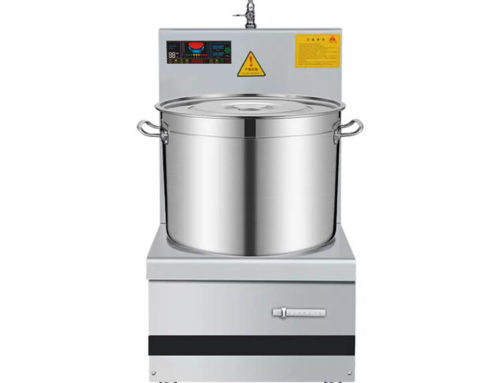
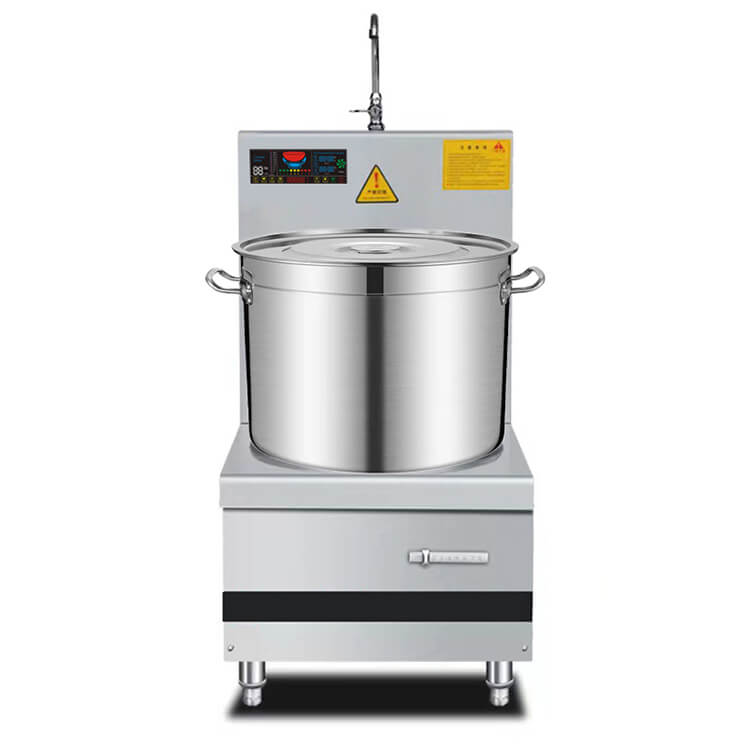
Maximizing Soup Yield: How Low Evaporation on Commercial Induction Increases Portions Per Pot
5-year Warranty | 2-year Free Exchangeable | 1-year Free Return
AT Cooker Executive Insight: In the business of soup and stock production, evaporation is money leaving the pot. Every liter of water that turns into steam is a liter of soup you cannot sell. Traditional gas burners boil too aggressively, leading to massive volume loss. The solution to increasing commercial soup yield is precision. By upgrading to the AT Cooker ATT-ABT S Commercial Induction Stock Pot Burner, you can control the simmer so precisely that evaporation is cut by up to 80%, transforming “steam” back into “profit.”
For a central kitchen or a busy noodle house, yield is everything. You start with 100 liters of water and expensive ingredients. If you finish with 70 liters due to uncontrolled boiling, your cost per portion skyrockets. This “Angel’s Share” of evaporation is accepted as normal in gas kitchens, but it is actually a sign of inefficiency.
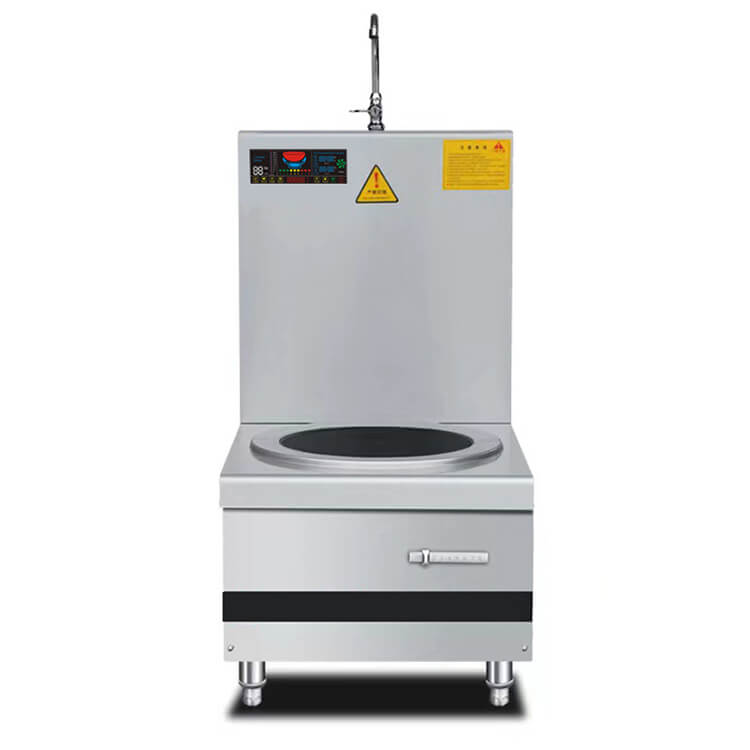
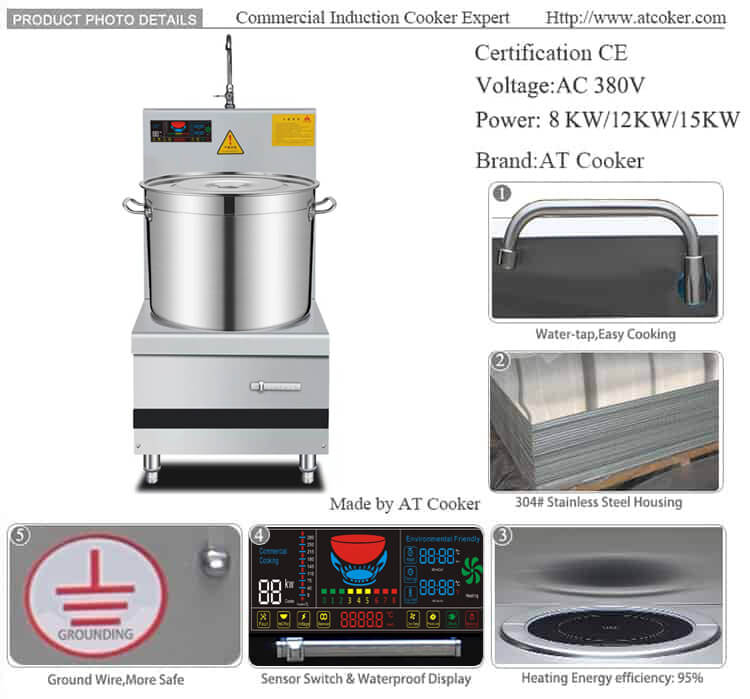
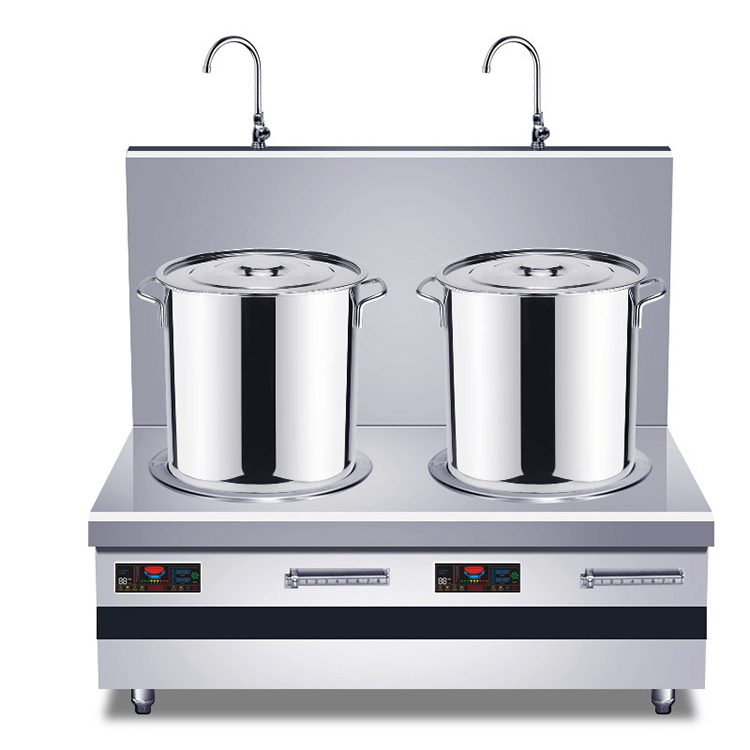
Modern stock pot burner efficiency is measured not just in energy saved, but in liquid retained. The Induction Soup Cooker (Single Burner) ATT-ABT S utilizes digital power levels to maintain the liquid at exactly 95°C—hot enough to extract flavor, cool enough to prevent violent steam generation. This capability maximizes your batch output without diluting quality.
In this yield analysis, we break down the physics of evaporation and the financial impact of switching to induction.
Commercial Kitchen Equipment -from AT Cooker
- As a brand manufacturer of the professional commercial induction cooking equipment, AT Cooker has responded to restaurants’ & hotels’ needs and research normative commercial cooking equipment using the very latest induction technology.
- These seamless, real commercial quality commercial cooking equipment provides us with the opportunity to incorporate equipment of our choice into one seamless, multipurpose cooking equipment creating an efficient, low cost, safe, green and sustainable commercial kitchen. We have standerd equipment can service many commercial kitchens.
- AT Cooker always offers professional service. From material, design, to producing, we focuse on quality, performance and reliability to ensures the best solution is delivered for each and every one of our customers. Have a commercial kitchen? We will be one of your best partners.
Work Voltage
| Single-Phase | Three-Phase |
|---|---|
| 120V, 220V | 208V/ 240V, 380V, 480V |
Global In-Stock + Fast Pickup
| US | UK | Germany | France |
|---|---|---|---|
| Italy | Spain | Belgium | Bulgaria |
1. The Physics of Evaporation: Why Gas Burners Boil Away Your Profits
When you simmer a 100L pot of stock on a gas burner, the heat is uncontrolled. The flame creates a convection current that is often too vigorous, breaking the surface tension of the liquid and releasing massive amounts of steam.
This steam is profit leaving your pot. A gas burner can evaporate up to 15-20% of your liquid volume over an 8-hour shift. Commercial induction evaporation rate is significantly lower because the heat is uniform and precise. The liquid stays just below the breaking point, preserving volume.
2. Precise Temperature Holding: Maintaining 95°C Without Crossing into Steam Generation
The key to low evaporation is keeping the liquid at 95°C—hot enough to extract flavor from bones, but cool enough to not boil. Gas burners struggle to hold this specific temperature; they drift up to 100°C, causing a rolling boil.
The AT Cooker ATT-ABT S features digital temperature control. You can lock in “Level 2” or “Level 3” to maintain a steady 95°C. This prevents the phase change from liquid to gas (steam), keeping your stock in the pot where it belongs.
3. Calculating the Volume Loss Difference: 8-Hour Simmer on Gas vs Induction
Let’s do the math on a 100L batch simmering for 8 hours.
Evaporation Loss Test
Gas Burner: 15% loss = 15 Liters gone. Remaining: 85L.
Induction (Precision): 3% loss = 3 Liters gone. Remaining: 97L.
That 12-liter difference creates approximately 35-40 extra servings of soup from the exact same ingredients. This is pure profit margin improvement.
4. Flavor Consistency: Preventing Excessive Salinity Concentration Due to Over-Reduction
When water evaporates, salt stays behind. A stock that reduces by 20% becomes salty and intense. This inconsistency ruins recipes.
By minimizing evaporation with precision simmering equipment, you ensure that the soup you serve at 8:00 PM tastes the same as the soup served at 11:00 AM. You don’t need to dilute it with water to fix the flavor.
5. Labor Efficiency: Eliminating the Need for Frequent Water Top-Ups
Chefs on gas ranges have to “babysit” the stock, adding water every hour to compensate for evaporation. This distracts them from other tasks.
With the AT Cooker unit, you can “Set and Forget.” The low evaporation rate means the water level stays stable for hours. The automatic water filling feature (if equipped) acts as a secondary failsafe, further reducing restaurant food waste and labor hours.
5-year Warranty | 2-year Free Exchangeable | 1-year Free Return
6. The “Latent Heat” Penalty: Energy Wasted Converting Valuable Broth into Exhaust Steam
It takes 5 times more energy to turn boiling water into steam than it does to heat cold water to boiling. Every cloud of steam rising from your pot represents a massive amount of wasted electricity or gas.
By preventing the phase change (staying at 95°C), you save this “Latent Heat” energy penalty. This makes induction simmering drastically cheaper than gas boiling.
7. HVAC Impact: Reducing Kitchen Humidity Load by Minimizing Steam Escape
Steam is humidity. High humidity forces your air conditioning to work harder. In a kitchen with 4 boiling gas pots, the AC bill is astronomical.
By keeping the liquid just below the boiling point, induction releases almost no steam into the room. This dry, cool environment reduces the load on your HVAC system, further commercial kitchen cost control.
8. Broth Clarity: How Gentle Thermal Currents Prevent Protein Emulsification
Violent boiling emulsifies fat, making stock cloudy. Clear broth requires a still surface.
Induction provides a gentle, uniform thermal current across the whole bottom of the pot. There are no “hot spots” causing violent bubbling. This ensures fats float to the top for easy skimming, leaving the broth underneath crystal clear.
9. Lid Dynamics: How Induction Stability Maximizes the Condensation Return Cycle
When you put a lid on an induction pot set to “Simmer,” the steam condenses on the lid and drips back in. This creates a closed loop.
On gas, the heat fluctuates, often causing the pot to boil over even with the lid on, forcing chefs to leave it off. The stability of induction allows you to cook with the lid on safely, achieving near-zero evaporation.
10. Profit Analysis: Converting Retained Liquid Volume into Extra Billable Bowls
If you sell soup for $5.00 a bowl, and you save 12 liters (35 portions) per batch, that is $175.00 in extra revenue per day.
Over a year, that is over $60,000 in found revenue. The equipment pays for itself in weeks based on yield increase alone. This is the ultimate soup production profit margin strategy.
11. The “Wei Huo” Advantage: Utilizing Micro-Currents to Suspend Evaporation for “Old Fire Soups”
In Chinese cooking, “Wei Huo” (Micro Fire) is the secret to clear soup. It requires a heat source so low it barely maintains temperature.
The ATT-ABT S can operate at extremely low wattage (e.g., 800W) continuously. This maintains the thermal mass without adding enough energy to cause a phase change to steam, perfecting the “Wei Huo” technique.
12. Standardizing “Chu Pin Lv”: Central Kitchen Protocols for Guaranteed Liquid Yield Rates
For central kitchens shipping soup to satellite locations, yield consistency is vital. You need to know that 100L of water + 50kg of bones = 95L of soup, every time.
Induction provides this standardization. Gas varies with line pressure and air drafts. Induction is digital. By locking in the settings, you lock in your yield rate (“Chu Pin Lv”), making inventory planning precise.
| Performance Metric | Gas Burner | AT Cooker Induction |
|---|---|---|
| Evaporation Rate | 15-20% | 3-5% |
| Simmer Control | Difficult | Precise |
| Flavor Profile | Salty/Reduced | Consistent |
| Profit Yield | Standard | +15% Higher |
5-year Warranty | 2-year Free Exchangeable | 1-year Free Return
Final Thoughts from AT Cooker
Evaporation is not a fact of life; it’s a symptom of bad equipment. By upgrading to the AT Cooker Induction Stock Pot Burner, you stop boiling away your profits. You get more soup, better flavor, and lower bills.
With stock ready for immediate delivery in the USA, Germany, France, UK, Belgium, Italy, Spain, and Bulgaria, we can help you maximize your yield today. Visit our About Us page to learn more about our precision cooking solutions.