Do Reinforced Legs Prevent Collapsing Under Massive Soup Weight? The Engineering Behind 500L Safety
5-year Warranty | 2-year Free Exchangeable | 1-year Free Return
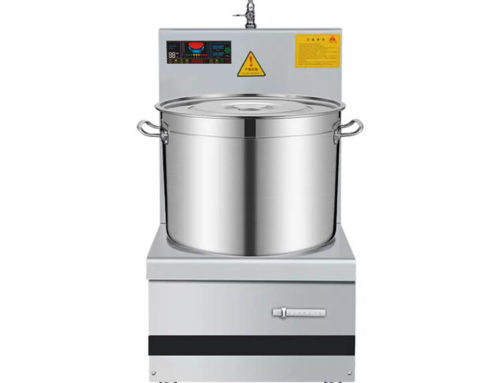
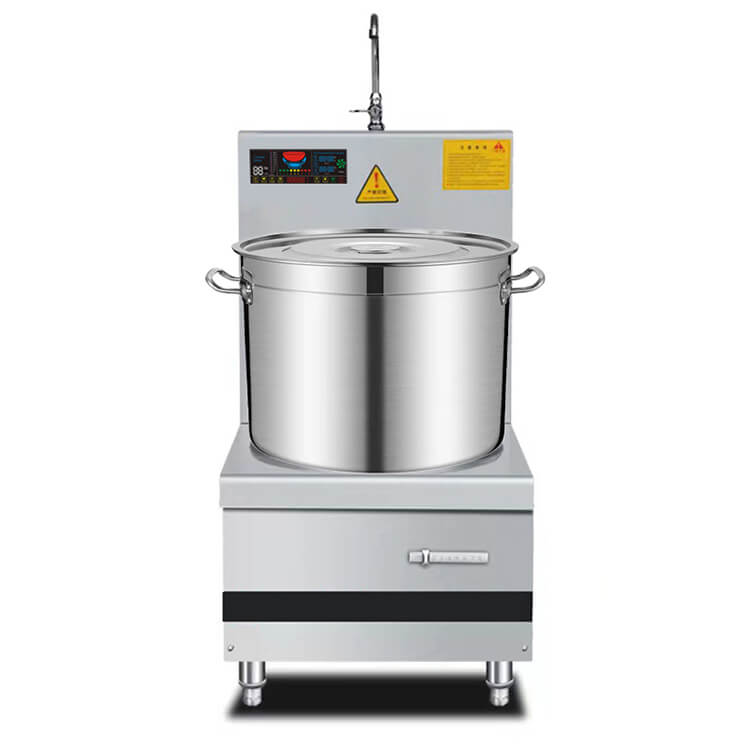
AT Cooker Insight: A 500L stock pot filled with liquid weighs over half a ton. For many chefs, the fear of equipment collapse is real—especially after seeing cheap, hollow-leg gas burners buckle under load. The difference lies in structural engineering. Here, we analyze how the AT Cooker Model ATT-ABT Y uses reinforced square tubing and cross-bracing to handle static loads exceeding 600kg, preventing catastrophic kitchen accidents.
When you are cooking 500 Liters of soup, you are not just a chef; you are managing a heavy industrial load. Water weighs 1kg per liter. Add bones, meat, and the stainless steel barrel itself, and your “kitchen appliance” is suddenly supporting the weight of a grand piano. Standard kitchen legs, often designed for light prep tables, simply cannot handle this stress vector.
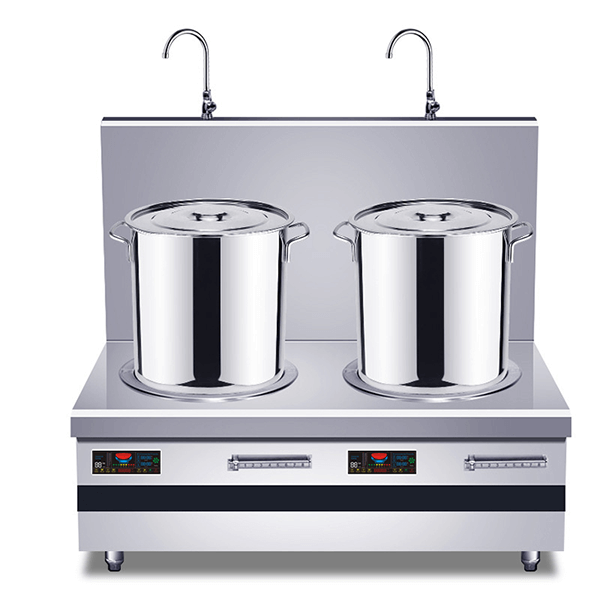
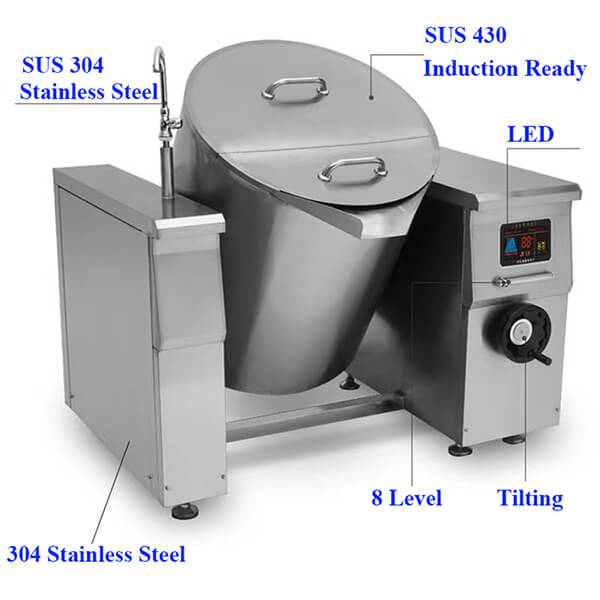
Leg collapse is a terrifying failure mode. It doesn’t just break the machine; it spills hundreds of liters of scalding liquid across the kitchen floor. At AT Cooker, we treat our heavy duty commercial stock pot ranges like structural platforms. With the Induction Soup Cooker (One-piece) ATT-ABT Y, we moved beyond standard tubular legs to a reinforced, integrated chassis design.
In this engineering breakdown, we will explain why reinforced legs are non-negotiable for large-volume cooking and how our design prevents the dreaded “buckle and tip” scenario.
Commercial Kitchen Equipment -from AT Cooker
- As a brand manufacturer of the professional commercial induction cooking equipment, AT Cooker has responded to restaurants’ & hotels’ needs and research normative commercial cooking equipment using the very latest induction technology.
- These seamless, real commercial quality commercial cooking equipment provides us with the opportunity to incorporate equipment of our choice into one seamless, multipurpose cooking equipment creating an efficient, low cost, safe, green and sustainable commercial kitchen. We have standerd equipment can service many commercial kitchens.
- AT Cooker always offers professional service. From material, design, to producing, we focuse on quality, performance and reliability to ensures the best solution is delivered for each and every one of our customers. Have a commercial kitchen? We will be one of your best partners.
Work Voltage
| Single-Phase | Three-Phase |
|---|---|
| 120V, 220V | 208V/ 240V, 380V, 480V |
Global In-Stock + Fast Pickup
| US | UK | Germany | France |
|---|---|---|---|
| Italy | Spain | Belgium | Bulgaria |
1. The Math of Static Loads: Calculating the Risk of Collapse
Understanding weight is the first step in safety. A 500L barrel of water weighs 500kg. The stainless steel vessel itself adds another 80-100kg. In total, you are placing a static load of ~600kg on four legs. That is 150kg per leg.
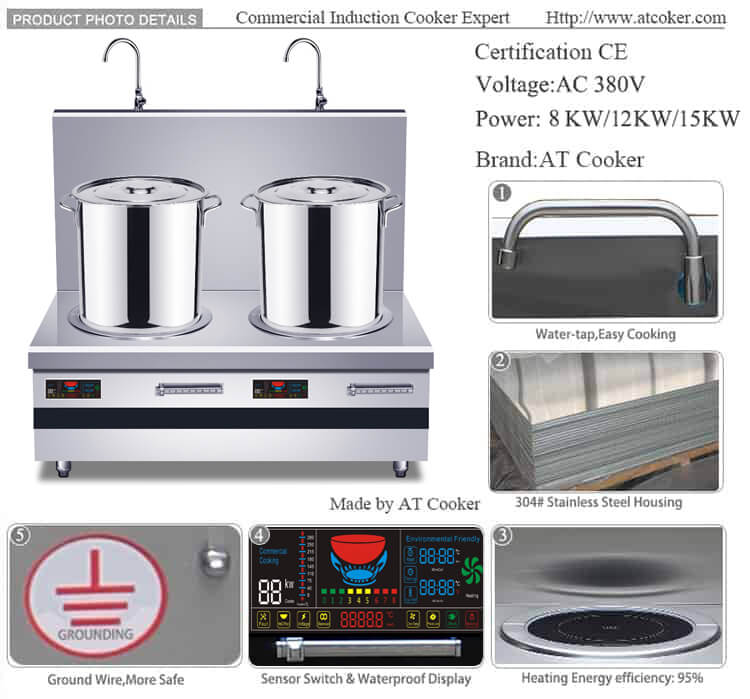
Cheap tubular legs, often made of thin-walled 201 stainless steel or even mild steel, are rated for vertical compression but are notoriously weak against shear forces. If a chef bumps into the unit or drags it across the floor, the legs can buckle. The ATT-ABT Y uses reinforced, thick-gauge 304# stainless steel legs designed with a safety factor of 3x, meaning they can support loads far exceeding the pot’s capacity.
2. Why Square Tubing Beats Round Tubing for Heavy Loads
Shape matters in engineering. Round tubes are common because they are cheap to manufacture, but square tubing offers superior structural rigidity for static frames. Square tubes resist bending and torsion better than round tubes of the same diameter.
At AT Cooker, our heavy-duty chassis utilizes square-profile stainless steel structural members. This geometry provides a flat surface for welding cross-braces, creating a “box frame” that is infinitely more stable than independent round legs screwed into a thin sheet metal base.
3. The Importance of Cross-Bracing in Preventing Sway
Legs alone are not enough. Without cross-bracing (horizontal bars connecting the legs), tall legs act like levers. A 500kg load at the top makes the unit top-heavy. Any lateral movement (like stirring vigorous soup) creates sway.
Our reinforced structure includes low-center-of-gravity cross-bracing. This triangulation locks the legs together, ensuring that lateral forces are distributed across the entire frame rather than snapping a single leg weld. This is the difference between a wobbly table and a solid platform.
4. Adjustable Bullet Feet: The Unsung Heroes of Stability
Commercial kitchen floors are rarely perfectly level. A 600kg pot on an uneven floor puts 300kg on two legs and zero on the others, causing dangerous instability.
The ATT-ABT Y features heavy-duty, adjustable stainless steel bullet feet. These allow you to level the unit perfectly, ensuring the massive weight is distributed exactly evenly (25% per leg). Furthermore, our feet are flanged, spreading the point load over a wider area to protect your flooring from cracking.
5-year Warranty | 2-year Free Exchangeable | 1-year Free Return
5. Weld Integrity: 304 Stainless vs. Mild Steel
A leg is only as strong as its weld. Mild steel legs (often painted) rust over time, especially in humid soup kitchens. Rust eats away at the weld joints, leading to sudden, catastrophic failure years down the line.
We use 304# stainless steel exclusively. It is corrosion-resistant, meaning the structural integrity of the leg welds remains 100% effective even after 10 years of exposure to steam, salt, and cleaning chemicals. We don’t just tack-weld; we use full-penetration structural welds for maximum safety.
6. The “One-Piece” Chassis: Eliminating Weak Points
Modular equipment often bolts legs onto a separate body. Over time, bolts vibrate loose. The “One-Piece” design of the ATT-ABT Y means the legs are integrated into the main chassis frame. There are no bolts to loosen. The entire unit is a single, rigid monocoque structure designed to handle the dynamic stresses of boiling 500L of liquid.
7. Comparison: AT Cooker Reinforced Legs vs. Standard Gas Legs
Visualizing the difference helps understand the value.
| Feature | Standard Gas Burner Legs | AT Cooker Reinforced Legs |
|---|---|---|
| Material | Galvanized / Mild Steel | 304 Stainless Steel |
| Structure | Round Tube / Angle Iron | Square Box Tube |
| Connection | Bolted / Tack Welded | Fully Welded Chassis |
| Load Capacity | ~100-200kg | 1000kg+ (Safety Factor) |
8. Dynamic Loads: What Happens When You Stir?
Static weight is one thing; dynamic weight is another. When a chef vigorously stirs 500L of thick stew, they generate rhythmic lateral forces. On weak legs, this causes the unit to “walk” or wobble.
Our reinforced cross-bracing acts as a dampener, absorbing these lateral forces. The sheer mass of the ATT-ABT Y (itself a heavy-duty machine) combined with the wide stance of the legs anchors it to the floor, providing a rock-solid workstation for your staff.
9. Why “Barrels Can’t Be Moved” Enhances Stability
The product feature “Barrels can’t be moved” is a safety feature. By fixing the barrel into the chassis, we lower the center of gravity. In removable pot systems, the heavy pot sits on top of the burner, creating a high center of gravity that is prone to tipping.
In our integrated design, the weight sits inside the frame, closer to the ground. This architectural stability makes it nearly impossible to tip over, even if accidentally bumped by a cart.
10. 3D Radiation Shielding and Structural Safety
It’s not just about physical weight; it’s about component safety. The reinforced legs also house the grounding and shielding components. The 3D three-dimensional radiation shielding design relies on the continuity of the stainless steel frame to function effectively, protecting the electronics from the massive magnetic field required to heat 500L of water.
5-year Warranty | 2-year Free Exchangeable | 1-year Free Return
11. Preventing Floor Damage with Wide-Base Feet
A narrow leg point-loads the floor, which can crack tiles under 600kg of pressure. Cracked tiles trap bacteria and cause water pooling. Our reinforced legs terminate in wide-diameter feet, spreading the PSI (Pounds per Square Inch) load to a safe level, preserving your expensive kitchen flooring.
Final Thoughts from AT Cooker
Do reinforced legs prevent collapsing? Yes, but only if they are engineered correctly. A “reinforced” sticker isn’t enough. You need 304 stainless steel, square tubing, cross-bracing, and a unified chassis design.
The ATT-ABT Y is built like a tank because we know what’s at stake. Don’t risk your staff’s safety with flimsy equipment. Invest in structural engineering that holds up under pressure. For specs on leg dimensions or load ratings, visit our About Us page today.