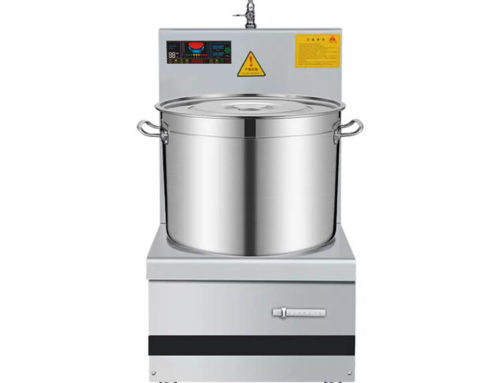
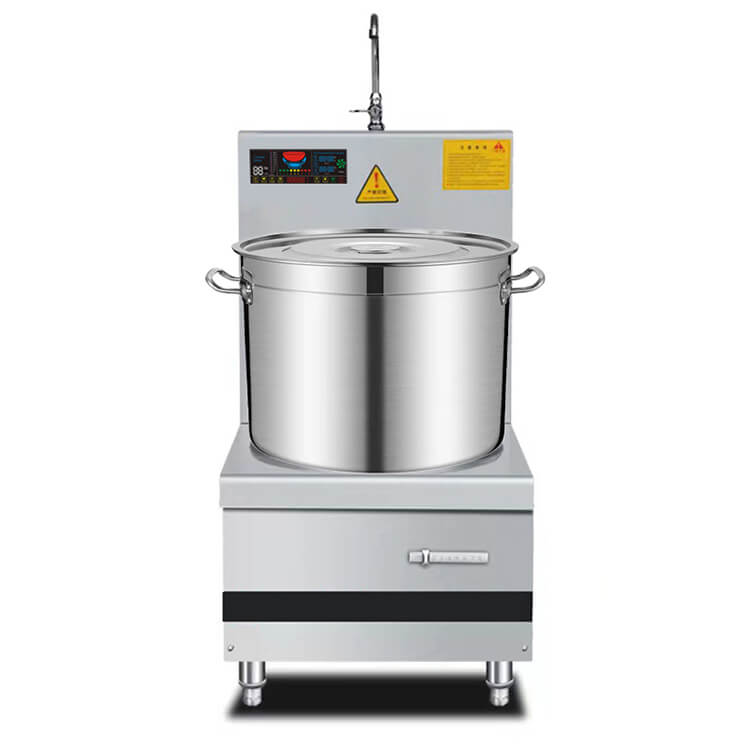
Will Heavy 150kg Stock Pots Crack the Ceramic Glass? A Deep Dive into Industrial Soup Cooker Durability
5-year Warranty | 2-year Free Exchangeable | 1-year Free Return
AT Cooker Insight: One of the most common fears when switching from gas to induction in heavy-duty kitchens is durability. Chefs worry: “If I drop a 500L pot full of bone broth onto glass, won’t it shatter?” It is a valid concern for residential units, but not for industrial engineering. Here, we explain how the AT Cooker Model ATT-ABT Y uses structural stainless steel chassis technology to bypass the glass load, allowing you to cook thousands of liters safely.
In the world of commercial food processing and large-scale catering, “heavy” is an understatement. A standard 150L soup pot, when filled with water and bones, can weigh well over 160kg. A 500L barrel can exceed half a ton. For chefs accustomed to cast-iron gas grates, placing this immense weight onto a sheet of “glass” feels counter-intuitive, if not downright dangerous.
However, the material science behind heavy duty commercial induction soup cookers has evolved. The concern about cracking ceramic glass stems from a misunderstanding of how industrial units are constructed versus their tabletop counterparts. With the Induction Soup Cooker (One-piece) ATT-ABT Y, we have engineered a solution where the glass transmits energy, but the steel supports the weight.
In this comprehensive guide, we will dismantle the myths surrounding ceramic glass durability and show you why our integrated design is safer and stronger than traditional setups.
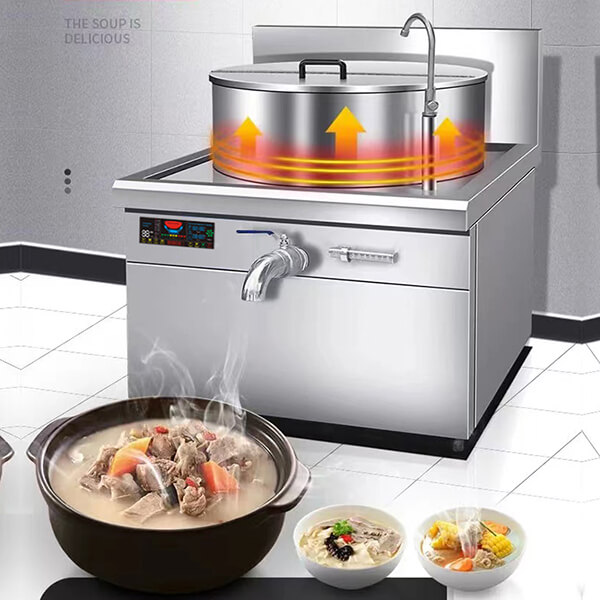
Commercial Kitchen Equipment -from AT Cooker
- As a brand manufacturer of the professional commercial induction cooking equipment, AT Cooker has responded to restaurants’ & hotels’ needs and research normative commercial cooking equipment using the very latest induction technology.
- These seamless, real commercial quality commercial cooking equipment provides us with the opportunity to incorporate equipment of our choice into one seamless, multipurpose cooking equipment creating an efficient, low cost, safe, green and sustainable commercial kitchen. We have standerd equipment can service many commercial kitchens.
- AT Cooker always offers professional service. From material, design, to producing, we focuse on quality, performance and reliability to ensures the best solution is delivered for each and every one of our customers. Have a commercial kitchen? We will be one of your best partners.
Work Voltage
| Single-Phase | Three-Phase |
|---|---|
| 120V, 220V | 208V/ 240V, 380V, 480V |
Global In-Stock + Fast Pickup
| US | UK | Germany | France |
|---|---|---|---|
| Italy | Spain | Belgium | Bulgaria |
1. The Physics of Ceramic Glass: What Makes Microcrystalline Glass Tough?
First, let’s dispel a myth: the “glass” on an induction cooker isn’t the same material as your windows. The ATT-ABT Y uses high-quality microcrystalline glass (often referred to as glass-ceramic). This material is engineered for extreme thermal shock resistance and high compressive strength.
However, glass-ceramic has a limit. While it can withstand temperatures of 700°C+, its tensile strength is lower than steel. Point loading—like dropping a heavy pot edge-first—can cause fractures. This is why for standard tabletop units, there is a strict weight limit (usually 50-80kg). But for a 150kg or 500kg soup station, relying solely on the glass is physically impossible. That’s where design innovation comes in.
2. Static vs. Dynamic Loads: Understanding the 150kg Impact
A pot sitting still (static load) is very different from a pot being dropped (dynamic load). A 500L barrel of soup weighs roughly 500kg. Even the strongest glass-ceramic panel cannot withstand a dynamic impact of that magnitude if the pot slips from a chef’s hands.
In traditional “flat top” induction designs, the user must lift the pot and place it gently on the glass. This introduces human error. One slip, and the glass cracks. To solve this, we moved away from the “place-on-top” design entirely for our heavy-duty series.
3. The “One-Piece” Advantage: Why Integrated Barrels Eliminate Glass Risk
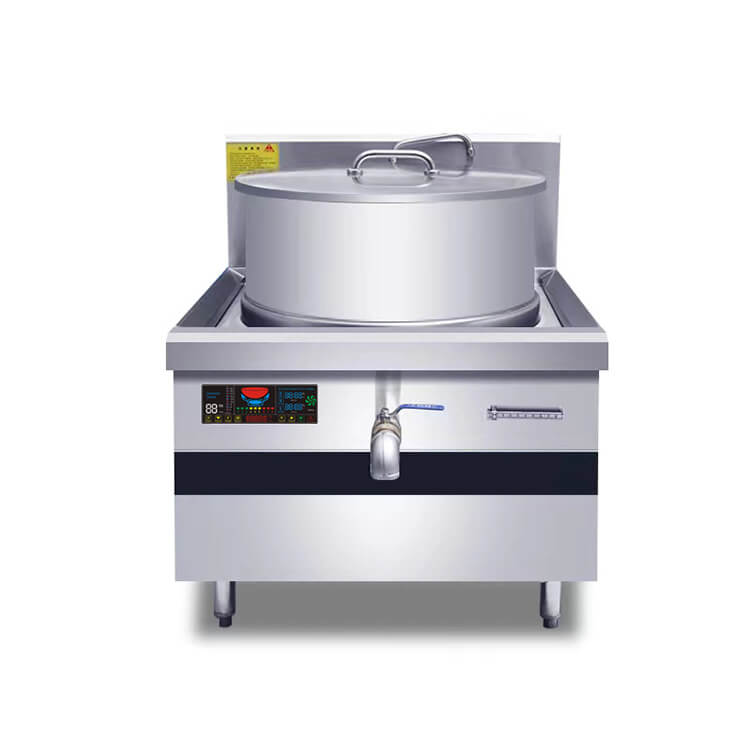
The AT Cooker model ATT-ABT Y is defined as an “Induction Soup Cooker (One-piece)”. This is the critical answer to your question. In this design, the soup barrel is integrated directly into the stainless steel chassis.
The weight of the 150kg or 500kg liquid load does not rest on the glass. Instead, the stainless steel rim of the barrel rests on the reinforced 304 stainless steel frame of the machine body. The microcrystalline glass plate is positioned underneath the barrel to transmit magnetic energy, but it is structurally decoupled from the weight bearing.
️ Structural Weight Distribution
Load Path: Soup Weight ➔ Barrel Rim ➔ Stainless Steel Chassis ➔ Floor Legs.
Glass Role: Purely for energy transmission and protecting the coil. It carries near-zero weight.
Result: Impossible to crack the glass via weight overload because the glass isn’t holding the pot.
5-year Warranty | 2-year Free Exchangeable | 1-year Free Return
4. Thermal Shock Resistance: Can It Handle Cold Water on Hot Glass?
Another cause of cracking is thermal shock—splashing ice-cold water on a hot surface. High-quality microcrystalline glass has a near-zero thermal expansion coefficient. This means you can pour 0°C water onto a 300°C glass panel, and it will not shatter.
The ATT-ABT Y uses premium glass rated for ambient temperatures from -5℃ to +40℃ and operating temperatures up to 180℃ (cooking temp). Combined with the integrated design which shields the glass from direct splashes, the risk of thermal failure is effectively zero.
5. Structural Support: It’s Not Just the Glass, It’s the Frame
The body of the ATT-ABT Y is constructed from thick-gauge 304# stainless steel. This is crucial for commercial environments. Unlike cheaper 201 or 430 steel, 304 steel is non-magnetic and highly corrosion-resistant.
More importantly, the frame is reinforced with internal ribbing to handle the 500kg+ load of a full 500L service. This rigidity ensures that the unit does not flex or warp under load, which could otherwise put torsion stress on internal components.
6. Comparing Integrated Soup Cookers to Traditional Flat-Tops
Why choose an integrated unit over a flat induction hob + separate stock pot? The safety difference is massive.
| Feature | Flat Induction Hob + Pot | Integrated ATT-ABT Y (One-piece) |
|---|---|---|
| Weight Support | Glass Surface (Risky >100kg) | Steel Chassis (Safe for 500kg+) |
| Impact Risk | High (Dropping pot cracks glass) | Zero (Pot is fixed) |
| Draining | Manual Lifting / Tilting | Built-in Faucet Drain |
| Efficiency | Gap between pot and glass | Optimized Gap (90-95% Efficiency) |
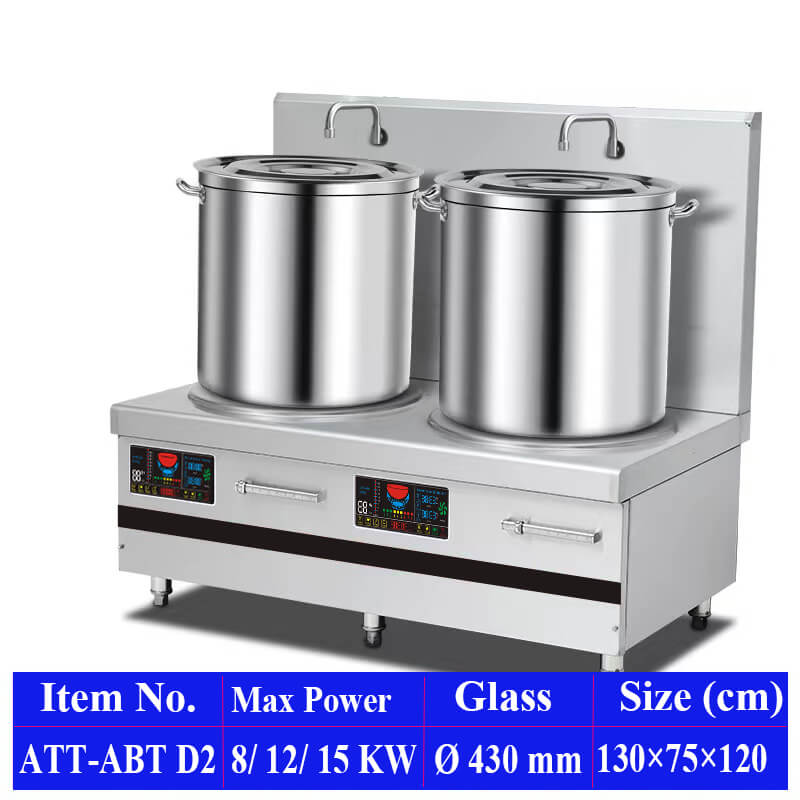
7. Preventing Operator Error: Best Practices for Heavy Pot Handling
In busy kitchens, accidents happen. A wet floor, a tired chef, a slip of the hand. With a removable pot system, these accidents jeopardize the equipment. By using the AT Cooker integrated design (“Barrels can’t be moved”), you eliminate the handling variable entirely.
The chef never has to lift a heavy pot onto the burner. They simply fill it using the Automatic filling water feature and drain it using the Faucet drain. This ergonomic improvement protects your staff from back injuries and your equipment from impact damage.
8. The Role of 304 Stainless Steel in Absorbing Weight
We chose 304 stainless steel not just for hygiene, but for its yield strength. When a 500L barrel is full, the downward force is immense. Our chassis design distributes this force down to the adjustable heavy-duty legs.
This bypasses the sensitive induction coil and glass plate entirely. The coil sits safely protected underneath the pot, generating the magnetic field through a precisely calculated air/glass gap without ever bearing the physical burden of the soup.
9. Real-World Durability: 15 Years of Heavy-Duty Soup Station Data
With 15 years of experience supplying commercial kitchens globally (from the USA to Bulgaria), we have data on longevity. Integrated units like the ATT-ABT Y have a glass failure rate of near zero because the glass is effectively removed from the “danger zone” of physical contact.
Compare this to standard flat induction cooktops used for heavy stocks, which often see glass replacements every 2-3 years due to accidental impacts or scratching.
10. Maintenance and Cleaning to Preserve Glass Integrity
Even though the glass is protected, keeping the interior clean is vital. The integrated design seals the gap between the pot and the body, preventing boil-overs from seeping into the electronics. The 3D three-dimensional radiation shielding design further protects the internal components from magnetic interference and moisture, ensuring the 20KW-30KW power system runs reliably for years.
5-year Warranty | 2-year Free Exchangeable | 1-year Free Return
11. Why AT Cooker’s Design Outlasts Standard Cooktops
Standard cooktops are built for versatility; the ATT-ABT Y is built for a specific mission: boiling massive amounts of liquid safely.
- Power: 20KW to 30KW options allow for rapid boiling of 100L-500L capacities.
- Safety: No open flames, no lifting heavy pots, no exposed glass to crack.
- Efficiency: 90-95% energy transfer saves huge amounts on utility bills compared to gas candy stoves.
Final Thoughts from AT Cooker
Will heavy 150kg stock pots crack the ceramic glass? On a standard cooktop, yes, it is a risk. On the AT Cooker ATT-ABT Y, the answer is no. By integrating the barrel into the steel chassis, we remove the weight from the glass entirely, offering you a robust, industrial solution that handles 500kg loads as easily as 5kg.
Don’t gamble with glass breakage in a high-volume kitchen. Choose the integrated design for safety and longevity. For more specs or to check our global stock availability, visit our About Us page or contact our engineering team directly.