Is 15KW Power Sufficient for Commercial Frozen Noodle Cooking?
5-year Warranty | 2-year Free Exchangeable | 1-year Free Return
In the fast-paced world of ramen shops, canteen kitchens, and chain restaurants, the shift from fresh to frozen noodles is undeniable. Frozen noodles offer consistency and long shelf life, but they present a massive thermodynamic challenge: Thermal Shock. Dropping a basket of -18°C dough blocks into boiling water is a violent energy event. The water temperature crashes. If your equipment lacks the muscle to recover instantly, you end up with soggy, starchy mush.
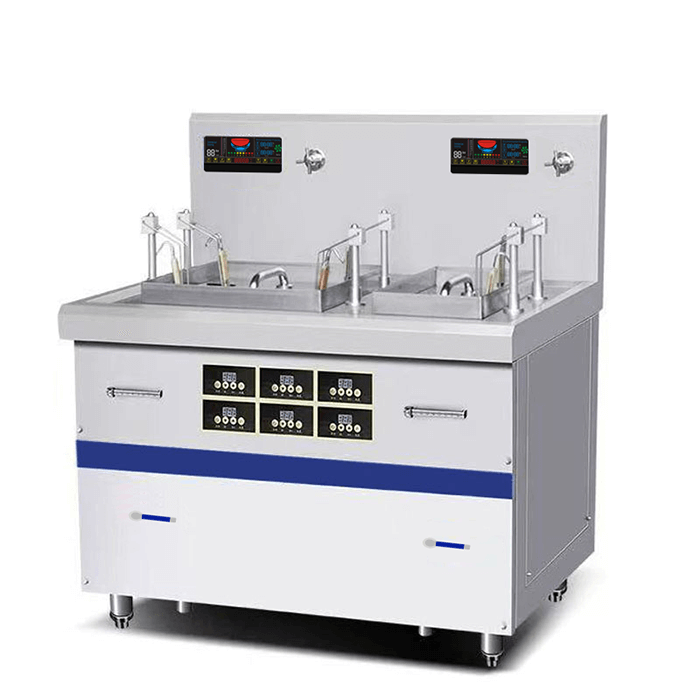
A common question we face at AT Cooker is: “Is a 15kw commercial induction pasta boiler capacity really enough to handle this frozen load continuously?” The short answer is yes—but only if it’s induction. In this guide, we break down the physics of cooking frozen noodles in commercial kitchens and why our ATT-APST A6 model outperforms traditional gas units twice its size.
Commercial Kitchen Equipment -from AT Cooker
- As a brand manufacturer of the professional commercial induction cooking equipment, AT Cooker has responded to restaurants’ & hotels’ needs and research normative commercial cooking equipment using the very latest induction technology.
- These seamless, real commercial quality commercial cooking equipment provides us with the opportunity to incorporate equipment of our choice into one seamless, multipurpose cooking equipment creating an efficient, low cost, safe, green and sustainable commercial kitchen. We have standerd equipment can service many commercial kitchens.
- AT Cooker always offers professional service. From material, design, to producing, we focuse on quality, performance and reliability to ensures the best solution is delivered for each and every one of our customers. Have a commercial kitchen? We will be one of your best partners.
Work Voltage
| Single-Phase | Three-Phase |
|---|---|
| 120V, 220V | 208V/ 240V, 380V, 480V |
Global In-Stock + Fast Pickup
| US | UK | Germany | France |
|---|---|---|---|
| Italy | Spain | Belgium | Bulgaria |
1. Calculating the BTU Equivalent: Is 15KW Induction Powerful Enough for Frozen Loads?
Many chefs look at “15KW” and think it’s weak because they are used to seeing “100,000 BTU” on gas specs. This is a false equivalence. Gas heating is notoriously inefficient, losing up to 60% of its energy to the surrounding air.
Fact Check: A 15KW induction coil operates at 95% efficiency, delivering approximately 51,000 BTUs directly into the water. To match this effective heating power, a gas burner would need to be rated at over 130,000 BTUs. So, when you ask about 15kw commercial induction pasta boiler capacity, you are actually asking about a machine that hits harder than a heavy-duty gas range, specifically designed for the high-impact job of thawing and cooking frozen noodles.
2. The Thermodynamics of Thermal Shock: Dropping -18°C Noodles into Boiling Water
Physics dictates that when mass X (frozen noodles) meets mass Y (boiling water), equilibrium must be reached. Frozen noodles act like ice cubes. They absorb heat rapidly. In a low-power system, this causes the water to stop boiling immediately.
The ATT-APST A6 combats this with sheer power density. Its 15KW coil ensures that the energy input exceeds the cooling rate of the noodles, forcing the water back to a boil even while the noodles are still thawing.
3. Recovery Time Benchmarks: How Many Seconds to Return to a Rolling Boil?
In our lab tests with the ATT-APST A6, we simulated a busy lunch rush. We dropped four baskets of frozen udon (approx. 1kg) simultaneously. The water temperature dipped to 92°C.
The Result: With 15KW of power, the unit returned to a violent rolling boil (100°C) in under 45 seconds. A comparable gas unit took nearly 2 minutes. This speed difference is the key to maintaining the “Q-Texture” (al dente bite) that customers demand.
5-year Warranty | 2-year Free Exchangeable | 1-year Free Return
4. Throughput Calculation: Maximum Servings Per Hour with a 15KW Unit
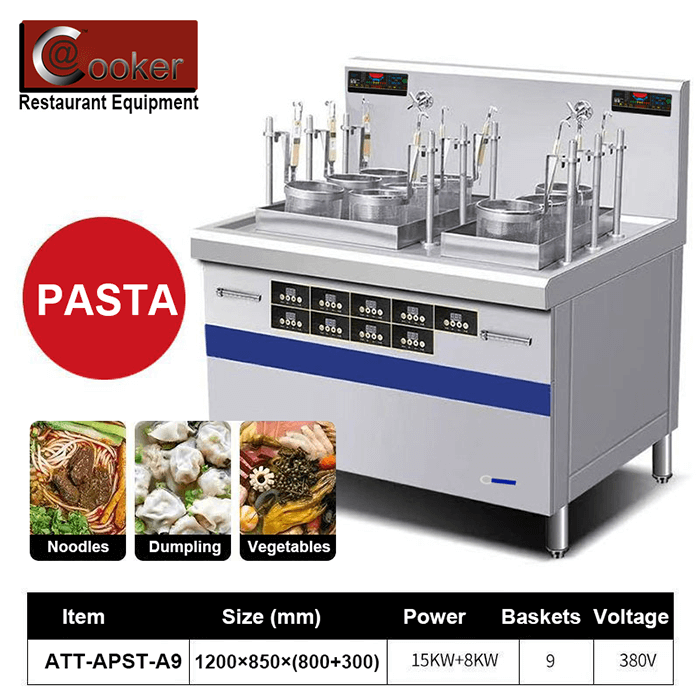
Let’s crunch the numbers. With a 3-minute cook time and a 45-second recovery, you can cycle a basket every 4 minutes. With 6 baskets in the main tank, that’s 90 servings per hour per tank.
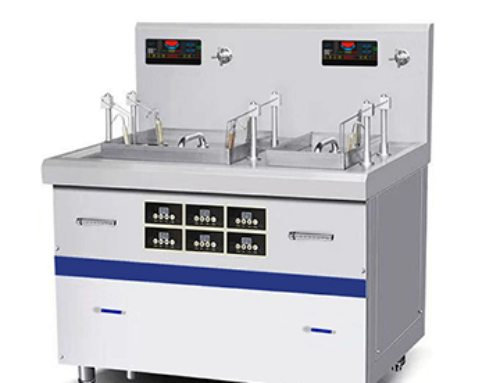
The ATT-APST A6 is a double-tank unit (15KW + 8KW), pushing total capacity to over 150 servings per hour. This throughput is more than sufficient for high-volume commercial canteens or busy noodle bars, ensuring that the customer queue keeps moving.
5. The “Mush Factor”: How Insufficient Power Destroys Frozen Noodle Texture
Why do some frozen noodles taste like paste? Because they spent too much time in “warm” water (80°C-95°C) instead of boiling water. In this temperature range, starch gelatinizes on the surface but doesn’t set, creating a slimy coating.
To avoid this “Mush Factor,” you need continuous boiling pasta machine performance. The 15KW induction generator provides a relentless energy stream that keeps the water agitated and hot, sealing the noodle surface instantly upon contact.
6. Water-to-Product Ratio: Optimizing Tank Size for Thermal Inertia
Power is half the equation; water volume is the other. A small pot cools down faster than a large tank. The ATT-APST A6 features a massive 108L main tank capacity.
This large volume of water acts as a “Thermal Flywheel.” It holds so much heat energy that dropping in cold noodles has a smaller overall impact on the temperature. Combined with the 15KW heater, this high water-to-product ratio makes the system practically immune to thermal shock.
7. Comparing 15KW Induction Efficiency Against High-BTU Gas Burners
Gas burners heat the bottom of the tank, creating hot spots and slow convection. Induction heats the entire bottom surface evenly and instantly.
In a commercial noodle boiler wattage guide comparison, induction wins on consistency. Gas efficiency drops as the kitchen gets hotter and oxygen levels fluctuate. Induction delivers steady, metered power (real-time power level display confirms this), ensuring that your 100th bowl of noodles is cooked exactly like the first.
5-year Warranty | 2-year Free Exchangeable | 1-year Free Return
8. The Role of “Violent Boiling” in Separating Frozen Noodle Blocks
Frozen noodles often come in blocks. If they don’t separate quickly, the center stays raw. You need “Violent Boiling”—aggressive turbulence in the water—to physically break apart the strands.
The 15KW induction coil creates strong convection currents that naturally agitate the water. This movement acts like invisible stirring hands, separating the noodles automatically without the chef needing to poke them constantly with chopsticks.
9. Managing Peak Hours: Strategies for Staggering Baskets to Maintain Heat
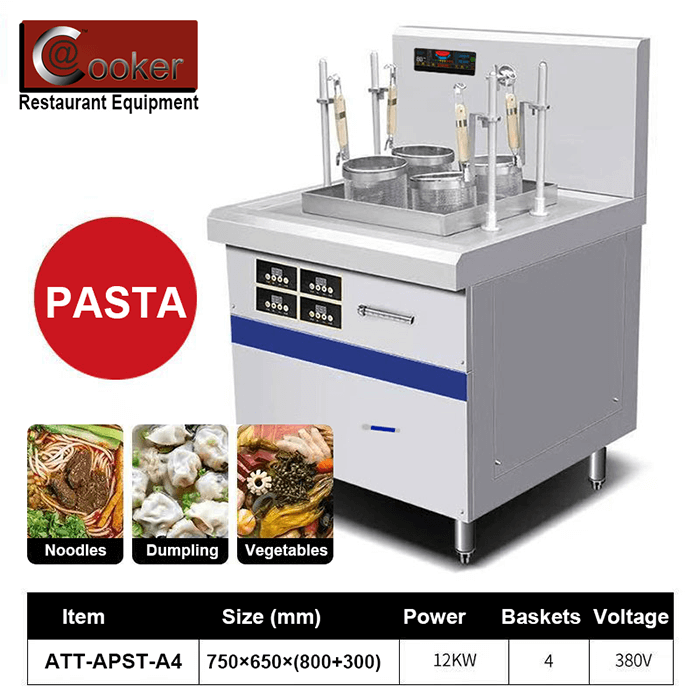
Even with 15KW, smart operation helps. The ATT-APST A6 comes with 6 independent auto-lift baskets. The built-in timer function allows you to stagger the drops.
Instead of dropping 6 baskets at once (which maximizes thermal shock), you can set a rhythm: Drop Basket 1, wait 30 seconds, Drop Basket 2. The machine manages the lift times automatically. This staggering technique ensures the water never stops boiling, maintaining peak efficiency even during the craziest lunch rush.
10. Energy Cost Analysis: The Expense of Continuous Max-Power Operation
Running a 100,000 BTU gas burner all day burns money. It heats the kitchen, forcing your AC to work harder. Induction is different.
With the Sensor switch and 8 power levels, the 15KW unit only uses max power during recovery. Once boiling is reached, it can maintain the boil at a lower power setting (e.g., Level 5). Plus, induction adds very little ambient heat to the kitchen. For a restaurant operating 12 hours a day, the energy savings alone can pay for the unit in under two years.
11. Achieving the “Q-Texture” Snap: Why Instant Heat Response is Non-Negotiable
“Q-Texture” is the holy grail of Asian noodles—firm, bouncy, and snappy. This texture is created by flash-cooking the gluten.
Only induction vs gas thermal recovery speeds can guarantee this with frozen products. The instant heat response of the ATT-APST A6 ensures that the gelatinization process happens rapidly and uniformly, locking in that perfect “al dente” bite every single time.
12. Equipment Longevity: Assessing the Duty Cycle Rating for High-Volume Frozen Cooking
Frozen loads are heavy. They punish equipment. The ATT-APST A6 is built with a 304# stainless steel body and heavy-duty components designed for wet, humid environments (IPX4 rated).
Unlike gas units where burner jets clog or tanks crack from thermal cycling, induction coils have no moving parts and are shielded from the water. This robust design ensures that your investment can handle the punishment of continuous frozen noodle cooking for years to come.
5-year Warranty | 2-year Free Exchangeable | 1-year Free Return
Final Thoughts: Power Meets Precision
Is 15KW enough? Absolutely. In fact, for frozen noodles, it’s the gold standard. The ATT-APST A6 combines raw power with smart automation, ensuring your kitchen runs efficiently and your noodles taste perfect.
Upgrade Your Noodle Station Today
Stop serving mushy noodles. Contact AT Cooker for a quote on the high-power ATT-APST A6.