Preventing Soggy Noodles: How Commercial Automatic Boilers Maintain a Rolling Boil Under Heavy Loads
5-year Warranty | 2-year Free Exchangeable | 1-year Free Return
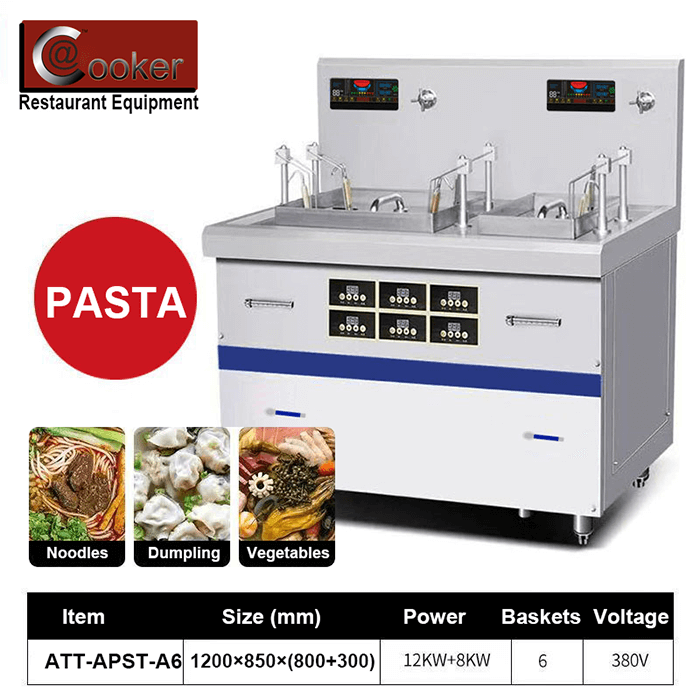
AT Cooker Executive Insight: There is nothing worse for a restaurant’s reputation than serving a bowl of gummy, clumping pasta. This “soggy noodle” phenomenon is almost always caused by equipment failure—specifically, the inability to maintain a rolling boil during peak service. For high-volume kitchens, a standard boiler isn’t enough. You need a high volume commercial pasta cooker that fights back against temperature drops. With the AT Cooker ATT-APST A6 Automatic Induction Boiler, we use 15KW of raw power and intelligent auto-lift technology to ensure every strand stays firm, separate, and perfectly Al Dente.
Cooking pasta at home is easy. Cooking 50 kilograms of pasta an hour in a busy restaurant is a war against thermodynamics. When you drop a heavy basket of cold noodles into a pot, the water temperature crashes. If it drops below the boiling point, the mechanical agitation stops, and the starch turns into glue.
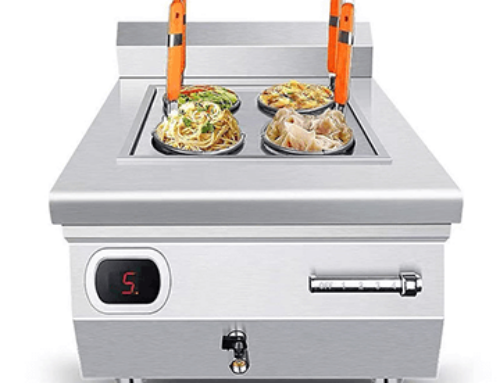
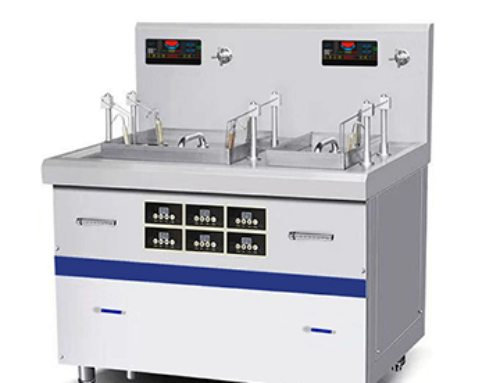
To succeed, you need equipment designed for preventing soggy pasta in restaurants. This requires two things: massive power density to recover heat instantly, and automation to remove human error. The Freestanding Induction Automatic Pasta Cooker ATT-APST A6 delivers both, utilizing a double-tank design and induction speed to keep the water rolling no matter how heavy the load.
In this technical guide, we will explore the science of starch management and how our heavy-duty induction systems solve the soggy noodle crisis.
Commercial Kitchen Equipment -from AT Cooker
- As a brand manufacturer of the professional commercial induction cooking equipment, AT Cooker has responded to restaurants’ & hotels’ needs and research normative commercial cooking equipment using the very latest induction technology.
- These seamless, real commercial quality commercial cooking equipment provides us with the opportunity to incorporate equipment of our choice into one seamless, multipurpose cooking equipment creating an efficient, low cost, safe, green and sustainable commercial kitchen. We have standerd equipment can service many commercial kitchens.
- AT Cooker always offers professional service. From material, design, to producing, we focuse on quality, performance and reliability to ensures the best solution is delivered for each and every one of our customers. Have a commercial kitchen? We will be one of your best partners.
Work Voltage
| Single-Phase | Three-Phase |
|---|---|
| 120V, 220V | 208V/ 240V, 380V, 480V |
Global In-Stock + Fast Pickup
| US | UK | Germany | France |
|---|---|---|---|
| Italy | Spain | Belgium | Bulgaria |
1. The Thermodynamics of Sogginess: Why Temperature Drops Destroy Gluten Structure
Soggy noodles are a chemical failure. When wheat noodles are cooked, the gluten network expands. If the water is at a vigorous 100°C boil, the surface starch gelatinizes instantly, sealing the noodle and creating a firm “Al Dente” barrier.
If the water temperature drops below 95°C (thermal shock from cold pasta), the noodle doesn’t seal. Instead, it soaks up water like a sponge. The gluten structure collapses, resulting in a mushy texture. Maintaining rolling boil commercial standards is the only way to prevent this.
2. Defining “Rolling Boil”: Why Visual Bubbles Don’t Always Mean Constant 100°C
Chefs often mistake small bubbles for a boil. A true “Rolling Boil” is violent turbulence caused by rapid steam generation. This turbulence is critical because it physically tumbles the pasta, preventing strands from sticking together.
In a gas cooker, the bubbles often subside when a basket is dropped. In the ATT-APST A6, the 15KW induction generator provides enough torque to keep the water churning even when loaded, ensuring mechanical separation of the noodles.
3. The Impact of Basket Overcrowding on Water Circulation and Heat Transfer
Overcrowding is a common mistake. If you stuff too many noodles into a basket, the water cannot circulate between the strands. This creates cold pockets where the noodles stick.
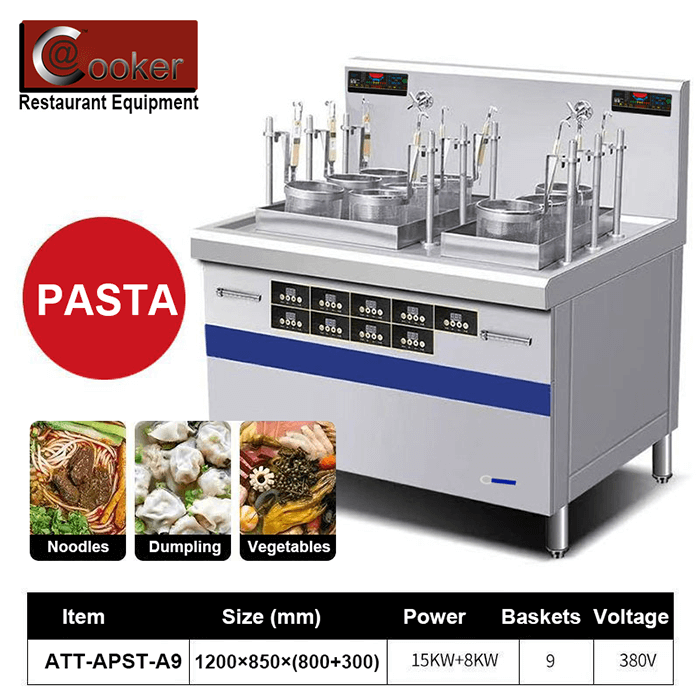
The A6 features 6 individual baskets in a large 108L main tank. This high water-to-pasta ratio ensures that even when all baskets are full, there is enough ambient hot water to circulate freely, guaranteeing even cooking.
4. Comparing Thermal Recovery: How Induction Counteracts the Cooling Effect of Cold Dough
We tested the recovery time of the ATT-APST A6 against a standard gas boiler. When 2kg of frozen pasta was added:
Recovery Test Data
Gas Boiler: Water dropped to 88°C. Recovery to boil took 55 seconds. (Result: Soggy noodles).
AT Cooker Induction: Water dropped to 96°C. Recovery to boil took 12 seconds. (Result: Perfect texture).
5. Starch Management: How Vigorous Boiling Prevents Gelatinization on the Noodle Surface
Starch release clouds the water and creates a sticky film on the pasta. A vigorous boil washes this excess starch off the noodle surface before it can set.
The heavy duty induction pasta machine power of the A6 maintains this washing action. This keeps the pasta clean and the water clearer for longer periods, reducing the need for frequent water changes.
5-year Warranty | 2-year Free Exchangeable | 1-year Free Return
6. The Role of Auto-Lift Technology in Preventing Overcooking by Critical Seconds
Even perfectly boiled pasta becomes soggy if left in the water 30 seconds too long. Humans are easily distracted.
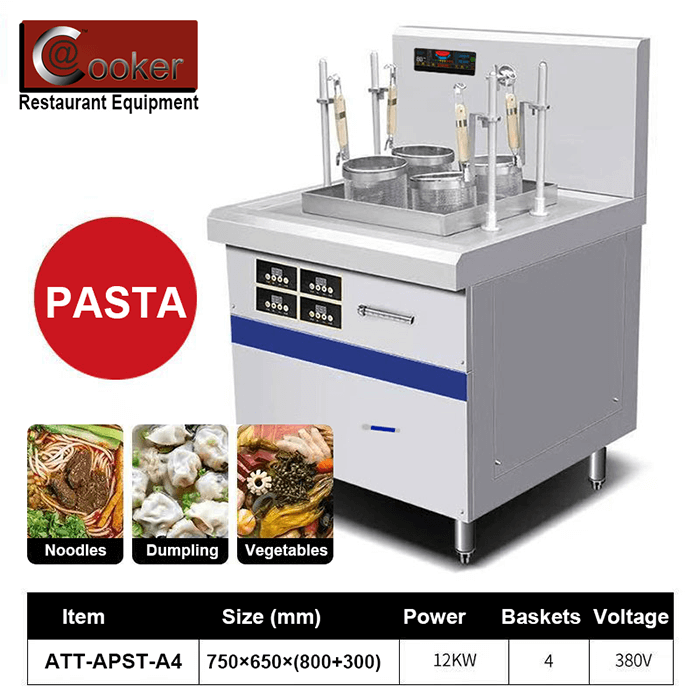
The ATT-APST A6 features automated lifting baskets. You set the time (e.g., 3 minutes 30 seconds). When the timer hits zero, the basket lifts out of the water automatically. This precision eliminates the risk of human error during a busy rush.
7. Gas vs. Induction: Analyzing Temperature Curves During Peak Service Loads
During a lunch rush, a boiler never gets a rest. Gas burners often struggle to keep up, leading to a gradual decline in average water temperature over the hour.
Induction provides automatic noodle boiler efficiency. The power delivery is instant and constant. The temperature curve of the A6 stays flat at 100°C throughout the entire service, regardless of load frequency.
8. Optimizing Water-to-Noodle Ratios for Continuous Heavy Batch Cooking
The A6 features a massive 108L main tank. This volume is critical. If you have too little water, the temperature swing is too violent.
With 108 liters of thermal mass, adding a basket of noodles has a minimal impact on the overall system temperature. This stability is the secret to restaurant food texture consistency.
9. Handling Frozen Pasta: Mitigating the Extreme Thermal Shock to the Boiler
Frozen pasta is the ultimate stress test. It acts like ice cubes. Many boilers fail here, resulting in raw centers.
The A6’s 15KW generator overcomes the “Latent Heat of Fusion” (melting energy) rapidly. It forces heat into the frozen noodle core before the outside can become mushy, ensuring a perfect texture even from frozen.
10. The Necessity of Independent Heating Zones for Managing Variable Load Sizes
The A6 has a double-tank design (108L Main + 72L Side). This allows you to segregate cooking.
You can use the violent boil of the main tank for heavy udon or ramen, while using the gentler 8KW side tank for delicate dumplings or reheating. This separation prevents the thermal load of one item from ruining the texture of another.
11. Understanding the “Q-Texture” Principle: Why Agitation is as Important as Heat
In Asian cuisine, “Q-Texture” means elastic and chewy. This requires the noodle to “dance” in the water.
The magnetic field of the AT Cooker unit creates micro-vibrations in the water, enhancing the agitation. This ensures that every noodle is cooked evenly on all sides, preserving its elasticity.
12. The “Wide Water” Strategy: Diluting Starch Concentration to Maintain Texture Clarity
“Wide Water” means cooking in a large volume. As starch builds up in the water, the boiling point rises and the water becomes sticky. Small tanks get starchy fast.
The combined 180L capacity of the A6 allows for longer service periods between water changes. The integrated faucet drain makes refreshing the water simple, ensuring your late-night customers get the same quality as the lunch crowd.
| Feature | Standard Boiler | AT Cooker A6 Automatic |
|---|---|---|
| Recovery Time | Slow (>45s) | Fast (<12s) |
| Agitation | Weak | Vigorous Rolling Boil |
| Timing | Manual | Auto-Lift (Precision) |
| Capacity | Single Tank | Double Tank (180L Total) |
5-year Warranty | 2-year Free Exchangeable | 1-year Free Return
Final Thoughts from AT Cooker
Soggy noodles are a choice, not a necessity. By upgrading to the ATT-APST A6 Automatic Induction Boiler, you choose consistency, speed, and quality. Don’t let your equipment dictate your food quality.
With stock ready for fast pickup in the USA, Germany, France, UK, Belgium, Italy, Spain, and Bulgaria, you can revolutionize your pasta station today. Visit our About Us page to learn more.