Continuous Boiling Power: Can Induction Handle Peak Service?
5-year Warranty | 2-year Free Exchangeable | 1-year Free Return
In a high-traffic noodle house, the equipment never sleeps. From 11:00 AM to 10:00 PM, the pasta boiler is the heart of the kitchen, required to maintain a rolling boil non-stop. Any dip in temperature means soggy noodles. Any equipment failure means lost revenue.
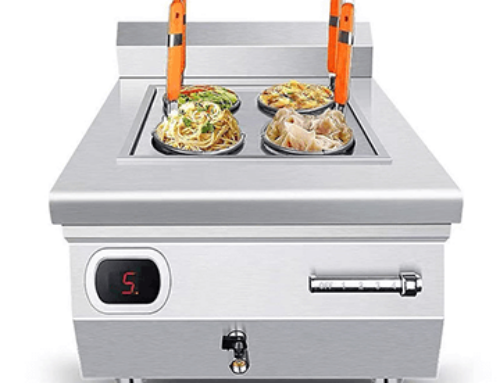
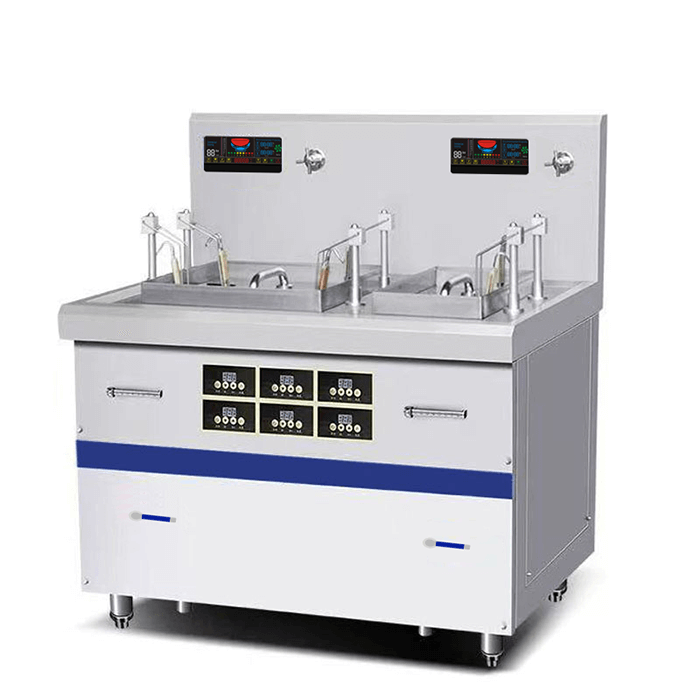
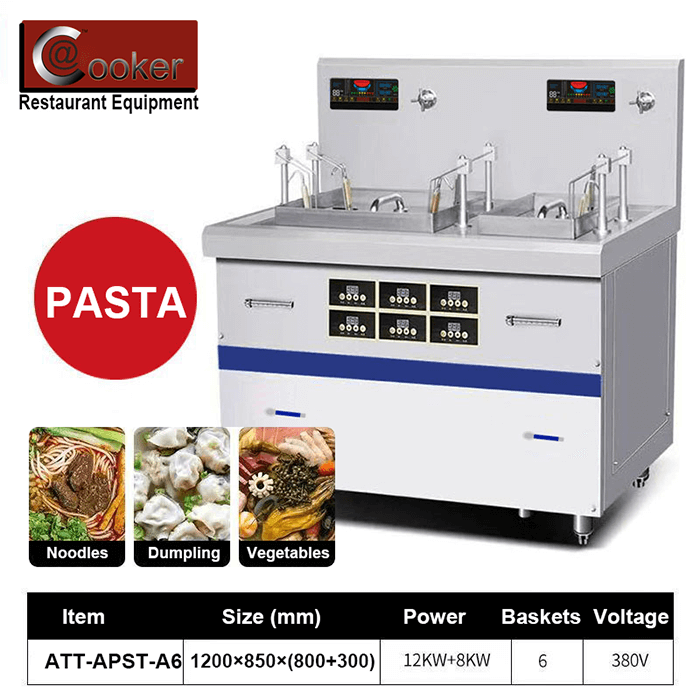
Skeptics often ask: “Can electric equipment really take this punishment?” The answer lies in defining continuous boiling commercial pasta cooker capability. It’s not just about getting water hot once; it’s about thermal endurance. In this article, we analyze how the ATT-APST A6 handles the grueling demands of 24/7 peak service, pitting induction stability against the traditional vulnerabilities of gas.
Commercial Kitchen Equipment -from AT Cooker
- As a brand manufacturer of the professional commercial induction cooking equipment, AT Cooker has responded to restaurants’ & hotels’ needs and research normative commercial cooking equipment using the very latest induction technology.
- These seamless, real commercial quality commercial cooking equipment provides us with the opportunity to incorporate equipment of our choice into one seamless, multipurpose cooking equipment creating an efficient, low cost, safe, green and sustainable commercial kitchen. We have standerd equipment can service many commercial kitchens.
- AT Cooker always offers professional service. From material, design, to producing, we focuse on quality, performance and reliability to ensures the best solution is delivered for each and every one of our customers. Have a commercial kitchen? We will be one of your best partners.
Work Voltage
| Single-Phase | Three-Phase |
|---|---|
| 120V, 220V | 208V/ 240V, 380V, 480V |
Global In-Stock + Fast Pickup
| US | UK | Germany | France |
|---|---|---|---|
| Italy | Spain | Belgium | Bulgaria |
1. Defining “Duty Cycle”: What Does 100% Continuous Operation Mean for Induction?
In engineering terms, “Duty Cycle” refers to the percentage of time a machine can operate safely at maximum power without overheating. A 50% duty cycle means for every 10 minutes on, it needs 10 minutes off.
Commercial kitchens demand a 100% Duty Cycle. The ATT-APST A6 is engineered to run at full load (Level 8) for hours on end. Unlike residential units that throttle power to protect cheap circuits, our heavy-duty inverters are designed to sustain maximum amperage indefinitely, ensuring your boiling water never loses its edge.
2. The Thermodynamics of Continuous Boiling: Balancing Heat Input Against Evaporative Cooling
Boiling is a battle against physics. As water boils, it evaporates, taking massive amounts of heat energy with it (Latent Heat of Vaporization). When you add cold noodles, the heat loss doubles.
To maintain a “Rolling Boil,” the energy input must exceed these losses. The 15KW induction generator provides a relentless stream of energy, creating a surplus of heat that compensates for evaporation and cold food loads instantly, preventing the temperature sag typical of underpowered gas units.
3. The Critical Role of Heavy-Duty Cooling Fans in Preventing Overheating Shut-Downs
The enemy of electronics is heat. While the water boils, the internal IGBTs (Insulated Gate Bipolar Transistors) generate their own heat. If this isn’t managed, the system triggers a safety shutdown.
AT Cooker utilizes high-velocity, dual-ball bearing cooling fans that create a wind tunnel effect over the heatsinks. This active cooling system ensures the internal components stay well below their thermal limits, even when the kitchen ambient temperature soars.
4. Induction vs. Gas: Which Suffers More from “Heat Fade” During Long Shifts?
“Heat Fade” is common in gas equipment. As burners run for hours, jets can clog with carbon, and the oxygen mix changes as the kitchen air gets heavy with steam and grease. This reduces efficiency by up to 20% by the end of a shift.
Induction suffers zero heat fade. Magnetic fields are unaffected by air quality or run time. The power output at hour 12 is identical to hour 1, providing consistent performance from the lunch rush to the late-night close.
5. Managing Water Refills: Does Auto-Fill Kill the Rolling Boil During Peak Service?
Continuous boiling evaporates water fast. Refilling manually with a bucket kills the boil instantly.
Our units feature an intelligent faucet drain and fill system. The trick is “Micro-Dosing.” By adding small amounts of water continuously or in short bursts, the 15KW heating element can heat the incoming trickle instantly without dropping the overall tank temperature. This maintains the boil even while replenishing the water level.
6. The Impact of High Ambient Kitchen Temperatures (40°C+) on Internal Component Reliability
Commercial kitchens are hot. During summer, ambient temps can exceed 40°C. Standard electronics fail at these temps.
The ATT-APST A6 is rated for ambient temperatures from -5℃ to +40℃ and tested well beyond. Our mainboards are conformal coated to resist humidity and encased in isolated tunnels that draw cool air from the floor level, protecting critical logic from the scorching kitchen environment.
5-year Warranty | 2-year Free Exchangeable | 1-year Free Return
7. Starch Buildup Dynamics: How Thick Water Viscosity Affects Energy Transfer Efficiency
After boiling 500 portions of noodles, the water becomes thick with starch. In gas boilers, this sludge insulates the bottom, leading to overheating and tank cracking.
Induction heats the metal tank directly, which then heats the water. While cleaning is still necessary, the high-frequency vibration of induction actually helps prevent starch from caking onto the bottom surface, maintaining better heat transfer efficiency throughout the service than a static gas flame.
8. Assessing IGBT Inverter Stability Under 4-Hour Continuous Full-Load Stress Tests
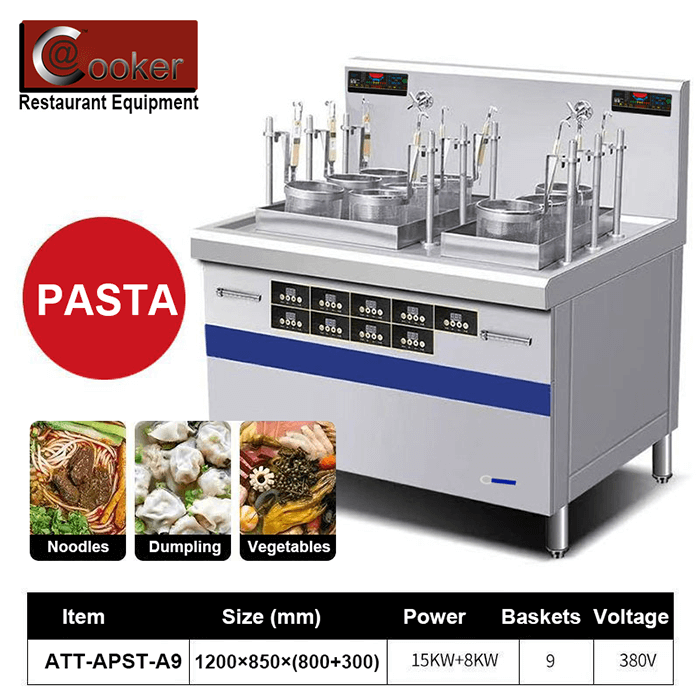
We stress-test our Infineon IGBTs rigorously. A standard QA test involves running the unit at full 15KW load for 4 hours straight.
The result? The junction temperature of the transistors stabilizes well within the safe operating area (SOA). This thermal stability is the bedrock of peak hour restaurant equipment reliability, ensuring the machine doesn’t trip a breaker right when you have a line of customers.
9. Voltage Sag Risks: Ensuring Grid Supply Doesn’t Drop Under Sustained High-Amp Load
When every appliance in the kitchen is on, the building’s voltage can sag. Induction units with poor power supplies will error out (E1/E2 codes).
AT Cooker inverters feature Wide Voltage Adaptation. They can handle fluctuations (e.g., 380V ± 10%) without shutting down. They automatically adjust the amperage to maintain constant power output, ensuring your boil doesn’t falter even if the grid is unstable.
10. Component Fatigue Analysis: Do Copper Coils Degrade After Years of 12-Hour Daily Shifts?
Copper coils are subjected to massive electromagnetic forces. Over time, vibration can wear down insulation.
We use Class H reinforced insulation and double-wound copper coils. These are designed to withstand years of thermal expansion and contraction cycles. The 3D radiation shielding also protects the coil from physical damage and interference, ensuring longevity measured in decades, not years.
5-year Warranty | 2-year Free Exchangeable | 1-year Free Return
11. The Necessity of “Soft-Start” Logic to Protect Circuits During Constant On-Off Cycling
In a busy kitchen, chefs turn machines on and off frequently. Sudden in-rush currents can damage electronics.
Our Soft-Start Logic ramps up the power gradually (in milliseconds) rather than slamming the circuit with 15KW instantly. This protects the internal components and the building’s breakers from shock, significantly extending the lifespan of the electronics.
12. Operational Reality: Do Chefs Actually Need 100% Power 100% of the Time or Just Rapid Recovery?
In reality, you don’t need 100% power all the time; you need 100% power instantly when the temperature drops.
The ATT-APST A6 offers 8 power levels. Smart chefs use Level 8 for recovery (seconds) and Level 5-6 for maintaining the boil (minutes). This dynamic usage reduces strain on the machine while guaranteeing that “burst power” is always available for heavy duty induction noodle machine performance.
Final Thoughts: Built for the Marathon
A commercial kitchen is a marathon, not a sprint. The ATT-APST A6 is built to run the distance. With robust thermal management and industrial-grade components, it delivers the continuous boiling power you need to survive and thrive during peak service.
Need Equipment That Never Quits?
Contact AT Cooker to learn more about our endurance-tested induction pasta boilers.