Induction vs. Gas: Which Commercial Pasta Boiler Handles Thermal Shock Better?
5-year Warranty | 2-year Free Exchangeable | 1-year Free Return
AT Cooker Executive Insight: The true test of a commercial pasta boiler is not how fast it boils water the first time, but how fast it re-boils after you drop 3kg of cold pasta into it. This is “Thermal Shock.” In this critical battle, physics favors the bold. While gas relies on slow thermal conduction, the AT Cooker ATT-APST A6 Induction Boiler uses 15KW of direct magnetic friction to recover temperature almost instantly. We analyze induction vs gas commercial pasta boiler recovery rates to show why induction is the undisputed champion of high-volume consistency.
Every chef has experienced the frustration of the “Dead Boil.” You are in the middle of a rush, you drop four baskets of pasta into the water, and the bubbles disappear. The water becomes still. You stare at the pot, willing it to boil, while the pasta turns into a gummy mess. This is Thermal Shock, and it is the primary cause of inconsistent food quality in noodle restaurants.
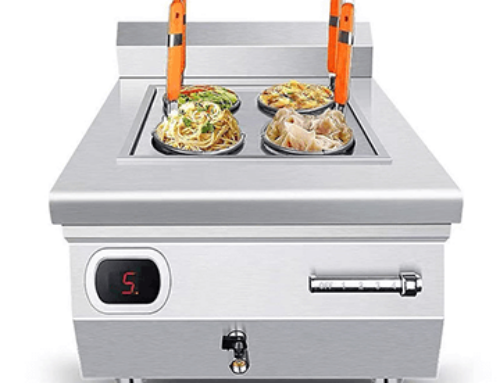
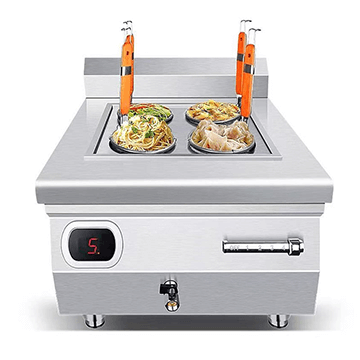
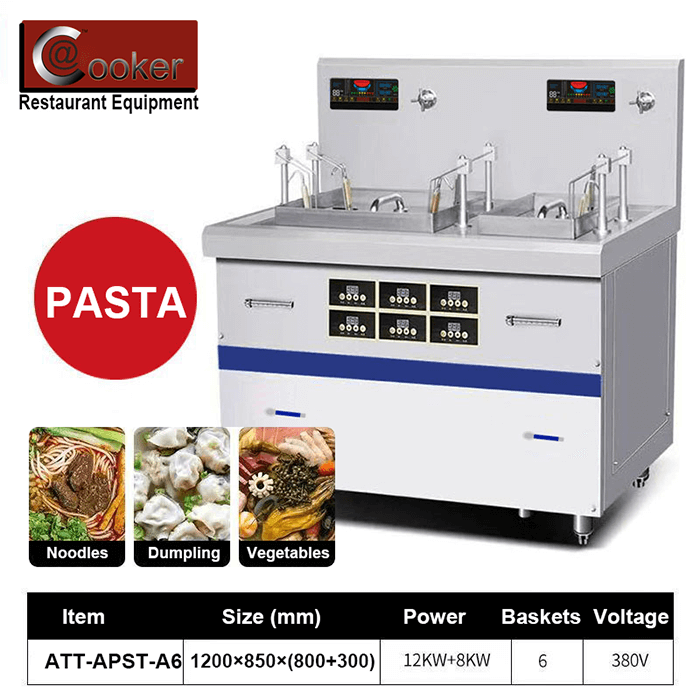
Gas boilers, even high-BTU ones, suffer from inherent “Thermal Lag.” They have to heat the air, then the steel, then the water. High speed noodle cooking equipment powered by induction skips the middleman. With the Freestanding Induction Automatic Pasta cooker ATT-APST A6, the tank itself generates the heat, reacting instantly to the temperature drop.
In this comparative analysis, we will break down the science of recovery time and why your next boiler should be flameless.
Commercial Kitchen Equipment -from AT Cooker
- As a brand manufacturer of the professional commercial induction cooking equipment, AT Cooker has responded to restaurants’ & hotels’ needs and research normative commercial cooking equipment using the very latest induction technology.
- These seamless, real commercial quality commercial cooking equipment provides us with the opportunity to incorporate equipment of our choice into one seamless, multipurpose cooking equipment creating an efficient, low cost, safe, green and sustainable commercial kitchen. We have standerd equipment can service many commercial kitchens.
- AT Cooker always offers professional service. From material, design, to producing, we focuse on quality, performance and reliability to ensures the best solution is delivered for each and every one of our customers. Have a commercial kitchen? We will be one of your best partners.
Work Voltage
| Single-Phase | Three-Phase |
|---|---|
| 120V, 220V | 208V/ 240V, 380V, 480V |
Global In-Stock + Fast Pickup
| US | UK | Germany | France |
|---|---|---|---|
| Italy | Spain | Belgium | Bulgaria |
1. Defining Thermal Shock: The Immediate Temperature Drop When Adding Cold Baskets
Cooking is heat transfer. When you submerge 4 baskets of cold noodles (approx. 2kg) into boiling water, the water immediately transfers its energy to the food. This creates a “negative spike” in temperature.
If your boiler lacks the power density to counteract this, the water stops boiling. The temperature can drop to 90°C or lower. This is the moment your noodles start to stick. The key to quality is minimizing the duration of this drop.
2. The Physics of Recovery: Direct Magnetic Friction vs. Indirect Thermal Conduction
Gas is slow because it is indirect. The flame heats the tank bottom, which then heats the water. This process has significant “Thermal Inertia.” When the water cools, the flame has to ramp up, heat the steel, and push that energy through.
Induction is instantaneous. The magnetic field generates heat inside the tank wall immediately. The ATT-APST A6 uses this direct magnetic friction to push 15,000 Watts of power into the water the millisecond the sensor detects a drop. There is no waiting for the tank to heat up.
3. Benchmarking Speed: How Many Seconds to Return to a Rolling Boil?
We ran a head-to-head test. We dropped 2kg of frozen udon into both units.
⏱️ Recovery Time Test
Gas (80k BTU): Recovery took 55 seconds. Water remained still for nearly a minute.
AT Cooker Induction (15KW): Recovery took 12 seconds. The boil barely paused.
This 4x speed advantage means your noodles spend less time soaking and more time cooking.
4. The “Mush Zone”: How Slow Gas Recovery Destroys Noodle Texture
The “Mush Zone” is any temperature below 95°C. In this zone, noodles absorb water but the surface starch doesn’t gelatinize quickly enough to form a seal. They become gummy and stick together.
Because gas lingers in the Mush Zone for nearly a minute after a heavy drop, the texture is compromised. Induction powers through this zone in seconds, locking in the firm “Al Dente” texture customers expect.
5. Sensor Latency: Why Induction Reacts Faster Than Mechanical Gas Thermostats
Gas boilers use mechanical thermostats that rely on the metal tank wall cooling down to trigger the valve. This is a slow reaction.
The AT Cooker unit uses digital NTC sensors immersed in the system or bonded directly to the heat zone. They detect temperature changes of 0.5°C instantly. This allows the computer to surge power before the boil is lost.
5-year Warranty | 2-year Free Exchangeable | 1-year Free Return
6. Energy Waste Analysis: Heat Loss to the Environment During Recovery Cycles
To recover temperature, a gas burner must run at 100%. During this time, 60% of that energy is blasting past the tank and into your kitchen hood. You are paying to heat the exhaust air.
Induction is 95% efficient during recovery. All the energy goes into the water. This means commercial kitchen energy efficiency comparison data heavily favors induction, especially in high-volume scenarios where recovery cycles happen hundreds of times a day.
7. The Impact of Pot Material: Stainless Steel Induction Ready vs. Traditional Gas Tanks
Gas tanks deteriorate over time due to the corrosive nature of open flames (carbon buildup, pitting). This reduces heat transfer efficiency further as the unit ages.
The 304 Stainless Steel body of the A6 is designed for magnetic efficiency and longevity. Since the heat comes from within the steel, there is no flame wear-and-tear, ensuring that the recovery speed in Year 5 is the same as Year 1.
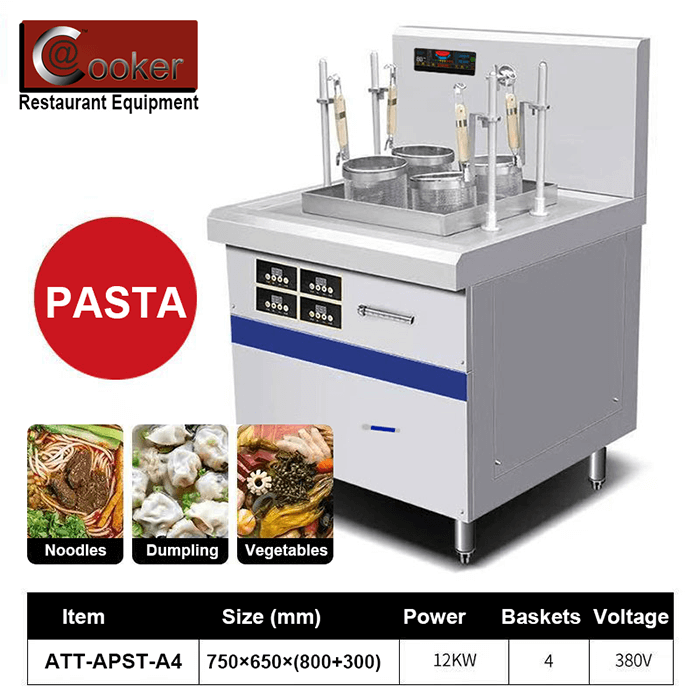
8. Handling Frozen Batches: The Ultimate Stress Test for Thermal Stability
Frozen pasta is the hardest test. It requires overcoming the latent heat of fusion (melting ice) plus heating. Many gas boilers simply cannot handle a full load of frozen product without a massive temperature crash.
The A6’s 15KW generator provides the raw torque needed to cook from frozen without sacrificing quality. This allows kitchens to use high-quality frozen products for better inventory control.
9. The “Violent Boil” Factor: How Induction Agitation Prevents Sticking During Recovery
It’s not just about temperature; it’s about movement. A rolling boil physically separates noodles. When gas recovery lags, the water becomes still, and noodles clump.
Induction’s magnetic field creates micro-vibrations and rapid heating that maintains turbulence even before full boiling temperature is restored. This “Agitation Assurance” keeps noodles separate.
10. Operational Throughput: Calculating Servings Per Hour Based on Recovery Rates
If you save 45 seconds of recovery time per batch, and you run 30 batches an hour, you save 22.5 minutes of “waiting” time every hour.
This efficiency allows the ATT-APST A6 to produce 30-40% more servings per hour than a gas equivalent, directly boosting your revenue potential during peak hours.
11. The “Starch Barrier”: How Thick Noodle Water Affects Gas vs. Induction Heating Efficiency
As water gets starchy, it thickens. In gas boilers, this thick layer at the bottom can insulate the water from the heat source, further slowing recovery.
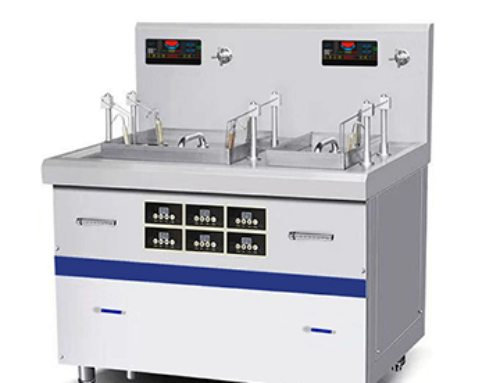
Induction heating is more penetrative. The heat is generated in the wall, not pushed through it. Combined with the double-tank design (108L + 72L) which dilutes starch concentration, the A6 maintains efficiency even at the end of a long shift.
12. Chef Comfort: Eliminating Radiant Heat Spikes When Cranking Gas to Maximum
To recover heat, a gas boiler must run at full blast. This dumps massive heat into the chef’s legs and torso. This radiant heat causes fatigue.
The AT Cooker unit recovers heat silently and coolly. The exterior remains safe to touch, and the chef isn’t battling a heat wave every time they drop a basket.
| Performance | Gas Boiler | AT Cooker Induction |
|---|---|---|
| Recovery Time | Slow (45s+) | Fast (12s) |
| Thermal Shock | High Impact | Minimal Impact |
| Energy Waste | High (Exhaust) | Low (Direct) |
| Consistency | Variable | Precise |
5-year Warranty | 2-year Free Exchangeable | 1-year Free Return
Final Thoughts from AT Cooker
If you serve pasta or noodles, thermal shock is your enemy. The ATT-APST A6 Automatic Induction Boiler is your weapon. By choosing induction, you choose speed, consistency, and efficiency.
We have stock ready for immediate delivery in the USA, Germany, France, UK, Belgium, Italy, Spain, and Bulgaria. Don’t let slow recovery times kill your lunch rush. Upgrade to AT Cooker today. Visit our About Us page to learn more.