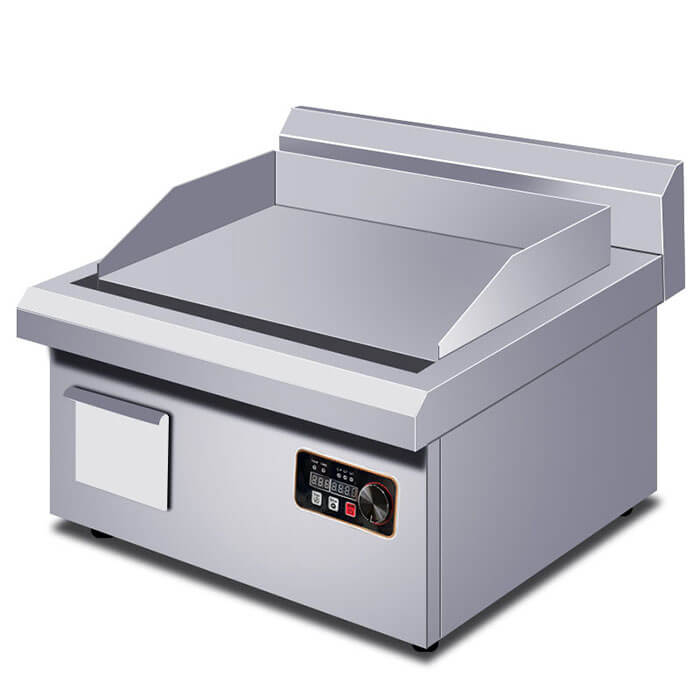
Commercial griddles—essential for breakfast stations, diners, catering—come in three fuel types: gas, electric, and induction. Efficiency (how much fuel converts to usable cooking heat) varies dramatically. AT Cooker’s induksion tijoriy griddles maximize efficiency while meeting commercial demands. Below, we break down each fuel type and explain why induction stands out.
1. Three Fuel Types: Gas, Electric, and Induction
Each fuel source has distinct technology:
- Gaz: Natural gas/propane flame beneath metal surface
- Electric: Metal coil/ribbon transfers heat to surface
- Induksion: Electromagnetic energy heats cookware directly
AT Cooker specializes in induction (3.5-5KW). A Chicago café: “Switched from gas to 5KW induction—$300/month propane down to $150/month electricity. Night and day.”
2. Gas Griddles: Quick Heat-Up but Low Efficiency
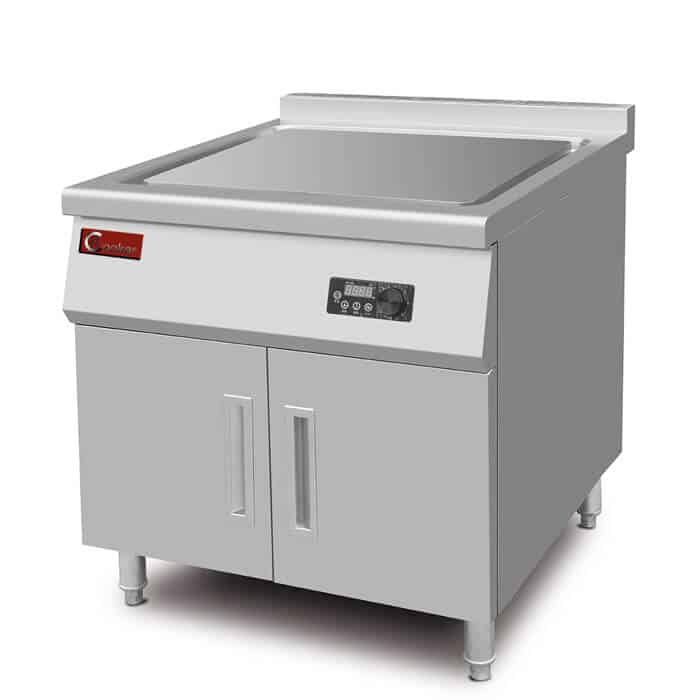
Gas reaches 350°F in 5-7 min. But only 40-45% of energy converts to usable heat. Natural gas ($1.50-$2.00/therm) and propane ($3.00-$4.00/gal) lead to high monthly costs. Ventilation hoods ($1,000-$2,000) add installation expense.
Customer: Dallas diner: “Love how fast it heats, but gas bill is $400/month. Considering induction to cut costs.”
3. Electric Griddles: Consistent Control, Easy Install
Electric griddles need only 240V outlet. Clean operation (no flame/gas), low maintenance, even heating. But only 50-55% efficiency. A Seattle café: “Easy to use, but $250/month electricity. Surface stays hot when not in use—wasting energy.”
4. Induction: Electromagnetic Energy Heats Cookware Directly
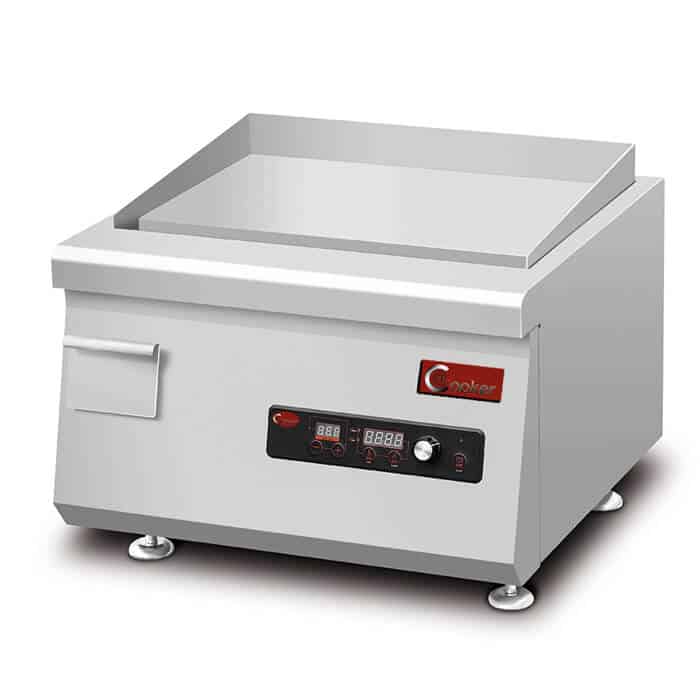
AT Cooker’s induction uses German Infineon IGBT modules for 90-95% efficiency. Nearly all energy cooks food, not heats the kitchen. Pan detection cuts power without cookware (saves 5-10%). An Austin caterer: “Run off generator without draining power. Cool to touch—staff don’t get burned.”
5. Induction Has Highest Energy Efficiency
Efficiency comparison (8 hrs/day):
| Yoqilg'i turi | Самарадорлик | Fuel Cost | Daily Energy | Kunlik xarajat | Monthly Cost |
|---|---|---|---|---|---|
| AT Cooker Induksion (5 kVt) | 90-95% | $0.15/kWh | 42.5 kWh | $6.38 | $191 |
| Electric (5KW) | 50-55% | $0.15/kWh | 72.7 kWh | $10.91 | $327 |
| Gas (17K BTU) | 40-45% | $1.75/therm | 3.11 therms | $5.44 | $163* |
*Gas excludes $100-$150/month vent hood operation and $50/year gas line maintenance.
Induksiya
Highest efficiency
Elektr
Moderate
Gaz
Lowest
6. Gas Griddles Have Higher Operating Costs
Low efficiency = more fuel. Gas needs 17K BTU to match 5KW induction. With 30% gas price hike: $163 → $212/month. Propane for food trucks: $140/month (2x induction). Plus vent hood electricity: $18/month.
Customer Story: Mike, Food Truck (Austin): “Ran gas 5 years, never realized waste. Propane $200/month + vent repairs $150/year = $2,550 annually. AT Cooker induction: $180/month electricity. Saving $2,190/year. Paid for itself in 3 months.”
7. Electric Preferred for Indoor Use but Less Efficient
Electric is cleaner than gas but less efficient than induction. Slow heat recovery (2-3 min) reduces peak productivity. AT Cooker’s induction: heats in 3 min, recovers in 30 sec. A Denver café: “Electric took 10 min to heat, 3 min recovery. Induction: 3 min heat, 30 sec recovery—serve 20% more customers.”
8. Induction Generates Less Ambient Heat
Gas/electric release 50-60% energy as ambient heat. Induction: only 10-15%. A Miami restaurant: “$100/month drop in AC bills. Kitchen was 95°F, now 85°F. Staff happier.”
Ambient Heat Comparison (8 hrs)
- Induksion: Adds 5-8°F (minimal AC impact)
- Electric: Adds 12-15°F (AC runs 20% more)
- Gaz: Adds 18-22°F (AC runs 40% more)
9. Maintenance Simpler for Electric and Induction
Gas has valves, burners, ignition—$350-$500/year maintenance. Electric: coil replacements $100-$150/1-2 yrs. Induction: no wearable parts, only annual cleaning ($20). AT Cooker’s induction comes with 2-year warranty.
10. Precise Temperature Control Reduces Food Waste
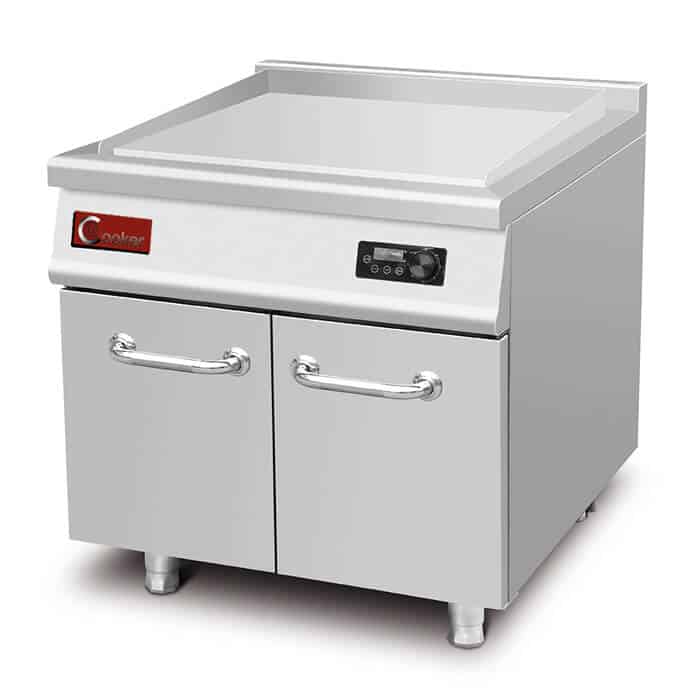
AT Cooker’s induction: ±1°F precision (vs ±10°F gas/electric). 8 power levels, real-time display. A Chicago diner: “Reduced food waste 15%. Used to burn 10% of hash browns from hot spots. With induction, every batch perfect—save $75/month.”
11. Gas Requires Proper Ventilation for Safety
Gas produces CO, NOx, smoke—requiring vent hood ($1,000-$2,000 install, $300-$500/year maintenance). Induction/electric need only basic ventilation (no hood in most regions), saving thousands upfront.
12. Electric Has Slower Heat Recovery Than Gas
Electric takes 2-3 min to recover after cold food (gas: 1 min). Induction: 30-45 sec—faster than both. A Las Vegas breakfast chain: “Electric couldn’t keep up with 7 AM rush—2 min between batches. Induction: cook nonstop.”
13. Induction Increasingly Popular for Savings and Safety
Induction is the fastest-growing segment in commercial cooking:
- Energiya tejash: 40-50% lower operating costs
- Xavfsizlik: Cool-to-touch, no gas leaks
- Tezlik: Faster heat-up and recovery
- Barqarorlik: 90% efficiency vs 45% for gas
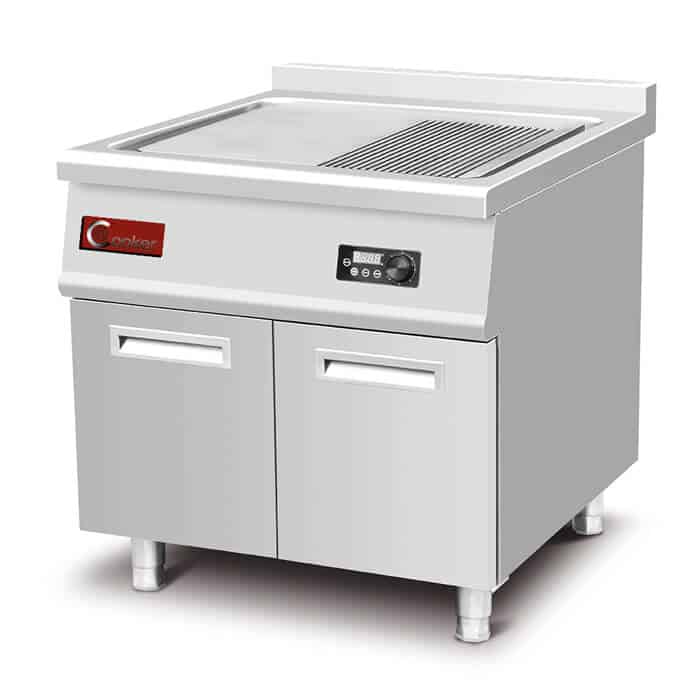
AT Cooker’s induction griddles (3.5KW countertop, 5KW built-in) feature 304# SS bodies and German IGBT modules. Whether small café or large hotel, induction offers the best balance of efficiency, cost, and performance.
Tez-tez so'raladigan savollar
What fuel types are available for commercial griddles?
Commercial griddles come in three fuel types: gas (natural gas or propane, 40-45% efficiency), electric (coil or ribbon elements, 50-55% efficiency), and induction (electromagnetic energy, 90-95% efficiency). AT Cooker specializes in induction griddles (3.5KW to 5KW) with German Infineon IGBT modules.
Which commercial griddle fuel type is most energy-efficient?
Induction griddles are the most efficient at 90-95%, compared to 50-55% for electric and 40-45% for gas. This means nearly all electrical energy is converted to cooking heat. A Chicago cafe reported cutting fuel costs from $300/month (gas propane) to $150/month (induction electricity).
How much can I save by switching from gas to induction?
AT Cooker customers report saving $1,000-$1,500 annually. A food truck operator saved $2,190/year: gas cost $2,550/year (propane + vent repairs) vs induction at $180/month electricity. The induction griddle paid for itself in 3 months. Gas also has hidden costs: $100-$150/month for vent hood operation and $50/year for gas line maintenance.
Do induction griddles require special ventilation?
No. Unlike gas griddles that produce carbon monoxide and require commercial vent hoods ($1,000-$2,000 installation, $300-$500/year maintenance), induction and electric griddles need only basic ventilation. Most regions don’t require a hood for induction, saving thousands upfront.
How does induction griddle maintenance compare to gas?
Gas griddles require $350-$500/year maintenance (burner cleaning, gas line inspection, valve replacement). Electric needs coil replacements every 1-2 years ($100-$150). Induction has no wearable parts—only annual cleaning ($20). AT Cooker induction griddles come with a 2-year warranty covering all components.