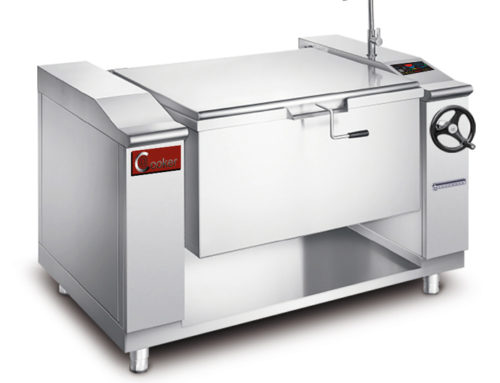
Commercial bratt pans are workhorses in busy kitchens—ideal for sautéing, braising, frying, and simmering large batches. At AT Cooker, our electric bratt pans balance power and efficiency, with models from compact tilting units to large-capacity systems. After analyzing data from hundreds of installations, we’ve compiled a clear guide to their energy consumption.
1. Commercial Bratt Pans Consume 3,000 to 9,000 Watts
Compact models (20-30L) use 3,000-5,000W; large industrial units (80-100L) reach 7,000-9,000W. AT Cooker’s AT-BP50 (50L tilting bratt pan) uses 6,000W. A Chicago diner: “Runs 4 hours daily, uses 24 kWh—about $3.60/day. Manageable for the volume.”
AT-BP50 (50L)
Mid-size restaurant
Large (100L)
Maximum range
2. High Wattage Maintains Consistent Temperatures Over Large Surfaces
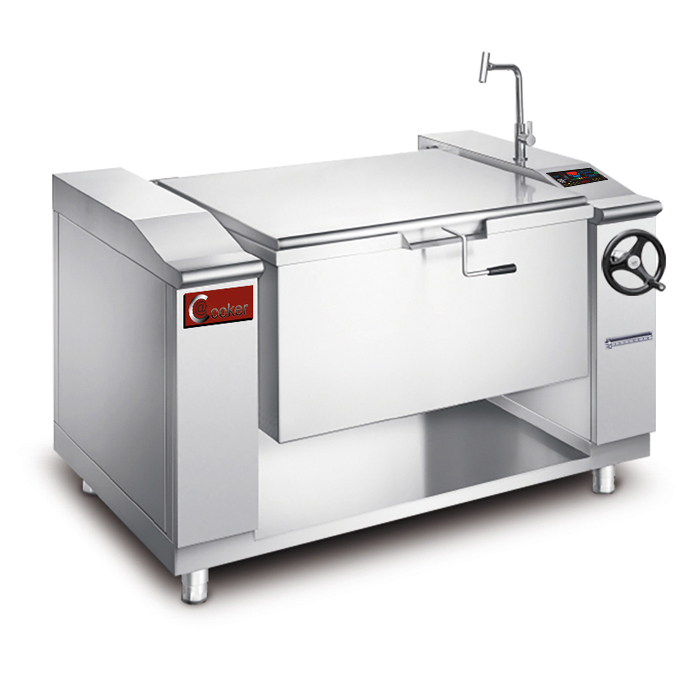
Bratt pans have large flat surfaces (24-36”). A 24” pan needs ≥5,000W to maintain 350°F evenly. AT-BP50 has 3 independent elements (2,000W each) controlled separately. A Texas caterer: “One zone at 375°F for frying, another at 250°F for sauce—no wasting energy heating entire pan to high.” Electric converts 70-75% of energy to heat vs gas (40-50%).
| Equipment | Size | Power | Efficiency | Uniformity |
|---|---|---|---|---|
| AT Cooker Electric (50L) | 24” | 6,000W | 72% | ±5°F |
| Gas Bratt Pan (50L) | 24” | ≈8,790W eq | 48% | ±25°F |
| Commercial Fry Pan | 12” | 2,000W | 65% | ±15°F |
3. Energy Varies with Temperature Settings and Cooking Duration
AT-BP50 uses: 3,000W at 200°F (simmering), 4,500W at 300°F (sautéing), 6,000W at 400°F (frying/searing). A Las Vegas hotel: 2hrs high + 4hrs low = 24 kWh/day ($3.60).
| Task | Temp | Power | Duration | Energy |
|---|---|---|---|---|
| Breakfast fry | 375°F | 5,500W | 1.5 hrs | 8.25 kWh |
| Simmer sauce | 225°F | 3,200W | 3 hrs | 9.6 kWh |
| Dinner searing | 425°F | 6,000W | 1 hr | 6 kWh |
| Total | — | — | 5.5 hrs | 23.85 kWh ($3.58) |
4. Tilting Bratt Pans with Larger Capacities Consume More Power
AT-BP30 (30L) uses 4,000W; AT-BP80 (80L) uses 8,000W. Larger models need more elements and thicker insulation. But bulk cooking is more efficient per portion: 100 servings in 80L uses less energy than 10 batches in 30L.
Customer Story: Maria, City Hospital (Houston): “Switched from two small pans to one AT-BP80, cut daily energy 20%. Bulk cooking is more efficient despite higher wattage.”
5. Energy-Saving Insulation Reduces Heat Loss by 30%
AT Cooker Pro series insulation (ceramic fiber layer) reduces heat loss 15-20%. Insulated AT-BP50 Pro uses 5,100W at 350°F vs 6,000W non-insulated. Over 10hrs: saves 9 kWh ($1.35/day, $492/year). Also keeps kitchen 8°F cooler, lowering AC costs.
Customer Story: Phoenix restaurant: “$75/month drop in AC bills after switching to insulated bratt pans. Kitchen stays 8°F cooler.”
6. Programmable Controls Optimize Heating Times
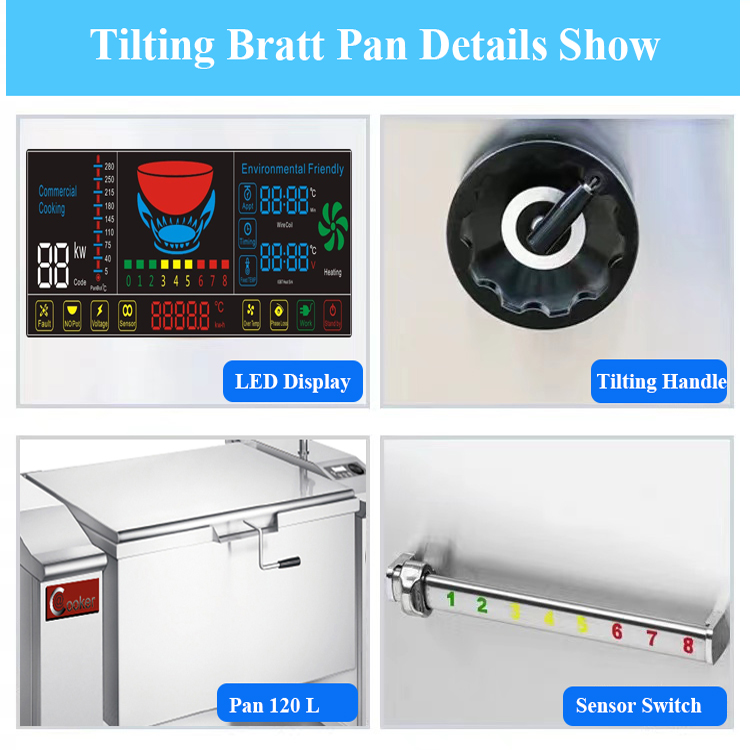
AT Cooker SmartBratt™ models have 10 pre-programmed recipes with auto-adjusting power. Cuts energy 18-22% vs manual. A 10-location chain saved 12,000 kWh/year ($1,800). Features: stage-based heating (saves 15-20%), idle shutdown (prevents 2-3 kWh/day waste), energy tracking, recipe locking.
7. Continuous High Heat Increases Consumption Significantly
6,000W for 8hrs = 48 kWh—nearly double intermittent use. A 24hr Chicago diner: 425°F for 12hrs = 72 kWh ($10.80/day). After scheduling (4hrs high + 8hrs medium): 48 kWh, saving $3.60/day. Recommendations: preheat only when needed, batch cook, turn down during lulls.
8. Energy Depends on Food Type and Cooking Method
High-water foods (soups) heat faster; dense foods (meats) need more power. Boiling 10-gal soup: 6 kWh. Searing 20 lbs beef: 8 kWh. Stir-frying veg: 2 kWh. Frying uses 30% more than braising. A SF Chinese restaurant: “About 15 kWh daily—stir-fry is fast at high heat.”
Frying vs Braising
30% savings braising
Veg vs Meats
55% more for meats
9. Regular Maintenance Ensures Stable Power Consumption
Dirty elements increase consumption 10-15%. AT Cooker recommends: daily wipe, weekly non-abrasive clean, monthly inspect for warping, quarterly calibrate. A 50-location chain saw 12% energy drop after implementing routine. “Regular cleaning keeps energy stable and extends element life 2+ years.”
10. Dedicated Electrical Circuits Required Due to High Power
Electric bratt pans almost always need dedicated circuits. Sharing risks overloads and tripped breakers.
| Model | Wattage | Voltage | Amps | Circuit |
|---|---|---|---|---|
| AT-BP30 (30L) | 4,000W | 240V | 16.7A | 20A dedicated |
| AT-BP50 (50L) | 6,000W | 240V | 25A | 30A dedicated |
| AT-BP80 (80L) | 8,000W | 240V | 33.3A | 40A dedicated |
Customer Story: Boston restaurant: plugged 6,000W into shared 20A circuit—daily breaker trips. $300 for dedicated 30A circuit resolved it. “No more interrupted service or wasted energy.”

11. Advanced Temperature Sensors Reduce Energy Use
Sensor-equipped pans monitor food temp directly, adjusting heat output. When searing steak, lowers from 425°F to 350°F once meat reaches 130°F—saving 20-25% per batch (1.2 kWh per 10 lbs). A Dallas steakhouse: “Sensors save 6 kWh daily ($985/year) cooking 50+ steaks nightly.”
12. Using Lids Retains Heat and Reduces Energy 15-20%
Lids trap heat, reducing element workload. Simmering chili in AT-BP50: 4.5 kWh without lid, 3.6 kWh with—20% savings. An Austin caterer: “Over 50 events/year, lids save $225.” A soup kitchen: 80L with lid saves 5 kWh daily.
Customer Story: Tom, Downtown Deli (Seattle): “Bratt pan energy bill dropped $40/month after using lids. We keep the lid on whenever possible.”
13. Efficient Bratt Pans Lower Operational Costs
AT-BP50 expected costs: $3-5/day energy ($1,095-$1,825/year), 7-10 year lifespan, $7,665-$18,250 total lifetime energy. vs gas (20-30% more to operate) or multiple smaller pans (30-40% more energy). A 20-location hotel chain saved $35,000/year switching to AT Cooker.
Efficiency also reduces labor: faster heating + programmable controls = 2 hours less labor daily.
AT Cooker’s Recommendations for Optimizing Bratt Pan Energy
- Choose right size: Match capacity to typical use
- Programmable controls: Pre-set recipes save 15-20%
- Maintain elements: Clean elements use 10-15% less power
- Use lids: Reduce heat loss 15-20%
- Schedule use: Batch cook + low-heat holding
- Invest in insulation: Cuts heat loss 30%
We offer free energy audits to calculate projected usage based on your menu and volume.
الأسئلة الشائعة
How much energy does a commercial bratt pan use?
Commercial bratt pans typically consume 3,000-9,000 watts depending on size. AT Cooker’s AT-BP50 (50-liter) uses 6,000 watts at maximum power. Actual daily consumption depends on usage patterns: a typical hotel using it 5.5 hours at mixed settings consumes about 23.85 kWh per day (approximately $3.58 at $0.15/kWh).
Are electric bratt pans more efficient than gas models?
Yes. Electric bratt pans convert 70-75% of energy into usable heat, compared to 40-50% for gas models. A 50L electric bratt pan at 6,000W with 72% efficiency provides more even heating (±5°F) than a gas model at 30,000 BTU with 48% efficiency (±25°F). Gas models also cost 20-30% more to operate.
How can I reduce the energy consumption of my bratt pan?
Key strategies: use programmable controls (saves 18-22%), use lids during cooking (saves 15-20%), choose insulated models (saves 15-20%), maintain heating elements regularly (saves 10-15%), avoid continuous high-heat operation, and batch cook instead of continuous heating. Combined, these can reduce energy use by 30-40%.
What electrical circuit does a commercial bratt pan require?
Most commercial bratt pans require dedicated 240V circuits. A 30L model (4,000W) needs a 20-amp circuit; a 50L model (6,000W) needs 30-amp; an 80L model (8,000W) needs 40-amp. Sharing circuits with other equipment risks overloads and tripped breakers.
How much does it cost to operate a bratt pan daily?
A mid-sized AT-BP50 (50L) costs approximately $3-5 per day in energy (based on $0.15/kWh), or $1,095-$1,825 annually. Over its 7-10 year lifespan, total energy cost is $7,665-$18,250. This is 20-30% less than gas bratt pans and 30-40% less than using multiple smaller pans.