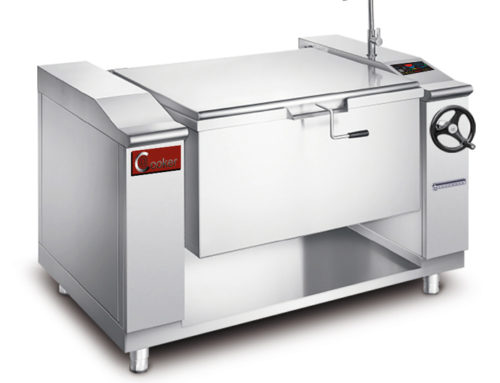
Commercial bratt pans are workhorses in busy kitchens—ideal for sautéing, braising, frying, and simmering large batches. At AT Cooker, 우리의 4. 전기 브래트 팬 balance power and efficiency, with models from compact tilting units to large-capacity systems. After analyzing data from hundreds of installations, we’ve compiled a clear guide to their energy consumption.
1. Commercial Bratt Pans Consume 3,000 to 9,000 Watts
Compact models (20-30L) use 3,000-5,000W; large industrial units (80-100L) reach 7,000-9,000W. AT Cooker’s AT-BP50 (50L 기울임 브랫 팬) uses 6,000W. A Chicago diner: “Runs 4 hours daily, uses 24 kWh—about $3.60/day. Manageable for the volume.”
AT-BP50 (50L)
Mid-size restaurant
Large (100L)
Maximum range
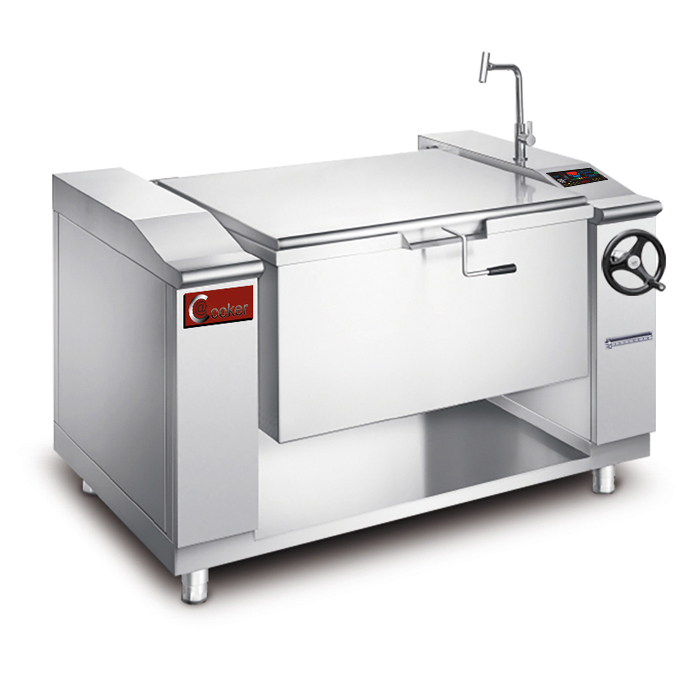
2. High Wattage Maintains Consistent Temperatures Over Large Surfaces
Bratt pans have large flat surfaces (24-36”). A 24” pan needs ≥5,000W to maintain 350°F evenly. AT-BP50 has 3 independent elements (2,000W each) controlled separately. A Texas caterer: “One zone at 375°F for frying, another at 250°F for sauce—no wasting energy heating entire pan to high.” Electric converts 70-75% of energy to heat vs gas (40-50%).
| Equipment | 크기 | 전력 | 효율성 | 균일성 |
|---|---|---|---|---|
| AT Cooker Electric (50L) | 24” | 6,000W | 72% | ±5°F |
| 가스 브랫 팬 (50L) | 24” | ≈8,790W eq | 48% | ±25°F |
| 상업용 프라이팬 | 12” | 2,000W | 65% | ±15°F |
3. Energy Varies with Temperature Settings and Cooking Duration
AT-BP50 uses: 3,000W at 200°F (simmering), 4,500W at 300°F (sautéing), 6,000W at 400°F (frying/searing). A Las Vegas hotel: 2hrs high + 4hrs low = 24 kWh/day ($3.60).
| 작업 | Temp | 전력 | 시간 | 에너지 |
|---|---|---|---|---|
| Breakfast fry | 375°F | 5,500W | 1.5 hrs | 8.25 kWh |
| Simmer sauce | 225°F | 3,200W | 3 hrs | 9.6 kWh |
| Dinner searing | 425°F | 6,000W | 1 hr | 6 kWh |
| Total | — | — | 5.5 hrs | 23.85 kWh ($3.58) |
4. Tilting Bratt Pans with Larger Capacities Consume More Power
AT-BP30 (30L) uses 4,000W; AT-BP80 (80L) uses 8,000W. Larger models need more elements and thicker insulation. But bulk cooking is more efficient per portion: 100 servings in 80L uses less energy than 10 batches in 30L.
Customer Story: Maria, City Hospital (Houston): “Switched from two small pans to one AT-BP80, cut daily energy 20%. Bulk cooking is more efficient despite higher wattage.”
5. Energy-Saving Insulation Reduces Heat Loss by 30%
AT Cooker Pro series insulation (ceramic fiber layer) reduces heat loss 15-20%. Insulated AT-BP50 Pro uses 5,100W at 350°F vs 6,000W non-insulated. Over 10hrs: saves 9 kWh ($1.35/day, $492/year). Also keeps kitchen 8°F cooler, lowering AC costs.
Customer Story: Phoenix restaurant: “$75/month drop in AC bills after switching to insulated bratt pans. Kitchen stays 8°F cooler.”
6. Programmable Controls Optimize Heating Times
AT Cooker SmartBratt™ models have 10 pre-programmed recipes with auto-adjusting power. Cuts energy 18-22% vs manual. A 10-location chain saved 12,000 kWh/year ($1,800). Features: stage-based heating (saves 15-20%), idle shutdown (prevents 2-3 kWh/day waste), energy tracking, recipe locking.
7. Continuous High Heat Increases Consumption Significantly
6,000W for 8hrs = 48 kWh—nearly double intermittent use. A 24hr Chicago diner: 425°F for 12hrs = 72 kWh ($10.80/day). After scheduling (4hrs high + 8hrs medium): 48 kWh, saving $3.60/day. Recommendations: preheat only when needed, batch cook, turn down during lulls.
8. Energy Depends on Food Type and Cooking Method
High-water foods (soups) heat faster; dense foods (meats) need more power. Boiling 10-gal soup: 6 kWh. Searing 20 lbs beef: 8 kWh. Stir-frying veg: 2 kWh. Frying uses 30% more than braising. A SF Chinese restaurant: “About 15 kWh daily—stir-fry is fast at high heat.”
Frying vs Braising
30% savings braising
Veg vs Meats
55% more for meats
9. Regular Maintenance Ensures Stable Power Consumption
Dirty elements increase consumption 10-15%. AT Cooker recommends: daily wipe, weekly non-abrasive clean, monthly inspect for warping, quarterly calibrate. A 50-location chain saw 12% energy drop after implementing routine. “Regular cleaning keeps energy stable and extends element life 2+ years.”
10. Dedicated Electrical Circuits Required Due to High Power
Electric bratt pans almost always need dedicated circuits. Sharing risks overloads and tripped breakers.
| 모델 | 와트 수 | 전압 | Amps | Circuit |
|---|---|---|---|---|
| AT-BP30 (30L) | 4,000W | 240V | 16.7A | 20A dedicated |
| AT-BP50 (50L) | 6,000W | 240V | 25A | 30A dedicated |
| AT-BP80 (80L) | 8,000W | 240V | 33.3A | 40A dedicated |
Customer Story: Boston restaurant: plugged 6,000W into shared 20A circuit—daily breaker trips. $300 for dedicated 30A circuit resolved it. “No more interrupted service or wasted energy.”

11. Advanced Temperature Sensors Reduce Energy Use
Sensor-equipped pans monitor food temp directly, adjusting heat output. When searing steak, lowers from 425°F to 350°F once meat reaches 130°F—saving 20-25% per batch (1.2 kWh per 10 lbs). A Dallas steakhouse: “Sensors save 6 kWh daily ($985/year) cooking 50+ steaks nightly.”
12. Using Lids Retains Heat and Reduces Energy 15-20%
Lids trap heat, reducing element workload. Simmering chili in AT-BP50: 4.5 kWh without lid, 3.6 kWh with—20% savings. An Austin caterer: “Over 50 events/year, lids save $225.” A soup kitchen: 80L with lid saves 5 kWh daily.
Customer Story: Tom, Downtown Deli (Seattle): “Bratt pan energy bill dropped $40/month after using lids. We keep the lid on whenever possible.”
13. Efficient Bratt Pans Lower Operational Costs
AT-BP50 expected costs: $3-5/day energy ($1,095-$1,825/year), 7-10 year lifespan, $7,665-$18,250 total lifetime energy. vs gas (20-30% more to operate) or multiple smaller pans (30-40% more energy). A 20-location hotel chain saved $35,000/year switching to AT Cooker.
Efficiency also reduces labor: faster heating + programmable controls = 2 hours less labor daily.
AT Cooker’s Recommendations for Optimizing Bratt Pan Energy
- Choose right size: Match capacity to typical use
- Programmable controls: Pre-set recipes save 15-20%
- Maintain elements: Clean elements use 10-15% less power
- Use lids: Reduce heat loss 15-20%
- Schedule use: Batch cook + low-heat holding
- Invest in insulation: Cuts heat loss 30%
We offer free energy audits to calculate projected usage based on your menu and volume.
자주 묻는 질문
How much energy does a commercial bratt pan use?
Commercial bratt pans typically consume 3,000-9,000 watts depending on size. AT Cooker’s AT-BP50 (50-liter) uses 6,000 watts at maximum power. Actual daily consumption depends on usage patterns: a typical hotel using it 5.5 hours at mixed settings consumes about 23.85 kWh per day (approximately $3.58 at $0.15/kWh).
Are electric bratt pans more efficient than gas models?
Yes. Electric bratt pans convert 70-75% of energy into usable heat, compared to 40-50% for gas models. A 50L electric bratt pan at 6,000W with 72% efficiency provides more even heating (±5°F) than a gas model at 30,000 BTU with 48% efficiency (±25°F). Gas models also cost 20-30% more to operate.
How can I reduce the energy consumption of my bratt pan?
Key strategies: use programmable controls (saves 18-22%), use lids during cooking (saves 15-20%), choose insulated models (saves 15-20%), maintain heating elements regularly (saves 10-15%), avoid continuous high-heat operation, and batch cook instead of continuous heating. Combined, these can reduce energy use by 30-40%.
What electrical circuit does a commercial bratt pan require?
Most commercial bratt pans require dedicated 240V circuits. A 30L model (4,000W) needs a 20-amp circuit; a 50L model (6,000W) needs 30-amp; an 80L model (8,000W) needs 40-amp. Sharing circuits with other equipment risks overloads and tripped breakers.
How much does it cost to operate a bratt pan daily?
A mid-sized AT-BP50 (50L) costs approximately $3-5 per day in energy (based on $0.15/kWh), or $1,095-$1,825 annually. Over its 7-10 year lifespan, total energy cost is $7,665-$18,250. This is 20-30% less than gas bratt pans and 30-40% less than using multiple smaller pans.