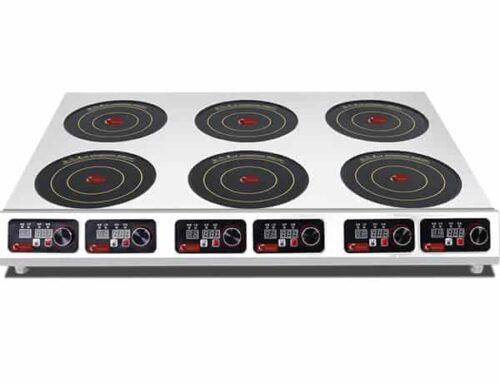
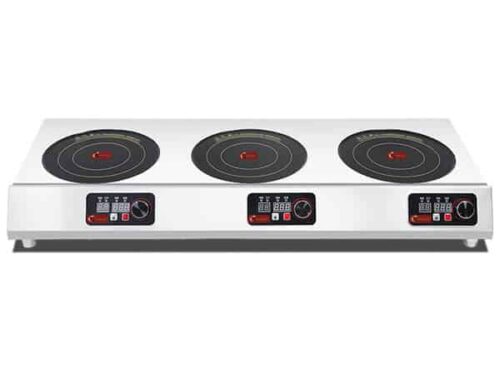
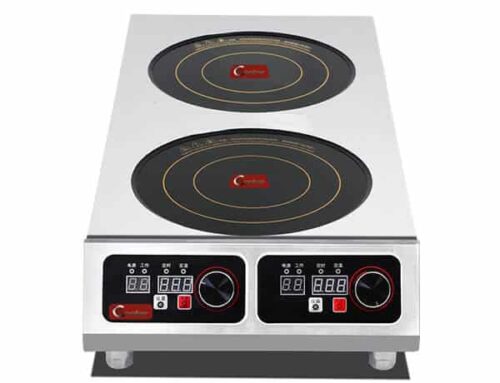
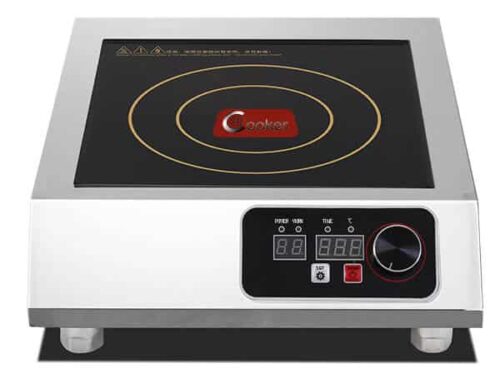
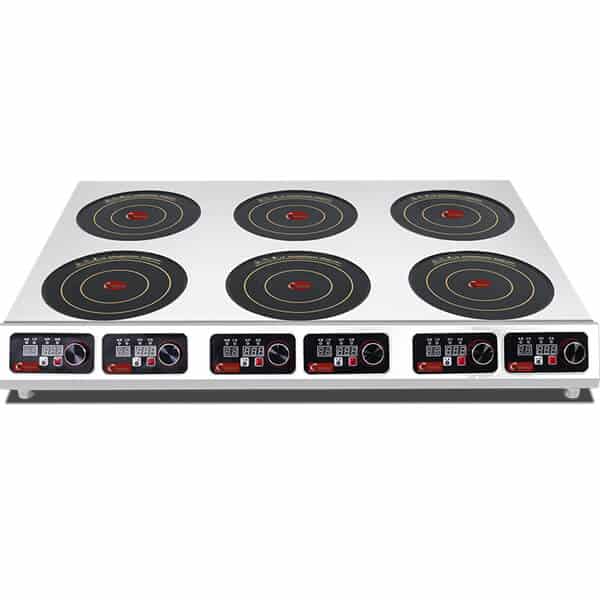
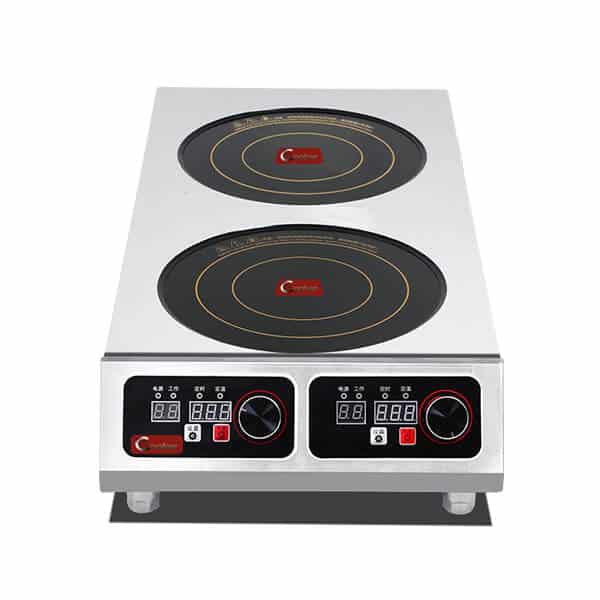
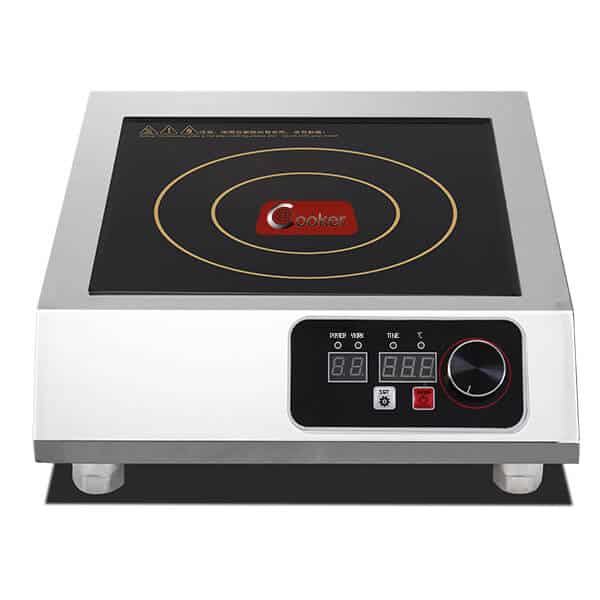
Als AT Cooker, ein führendes Unternehmen im Bereich gewerblicher Küchengeräte, hören wir oft eine zentrale Frage von Restaurant- und Hotelbesitzern: “Wie laut sind gewerbliche Induktionsherde?” Für geschäftige Küchen ist Lärm nicht nur eine Frage des Komforts – er beeinträchtigt die Konzentration des Personals, das Kundenerlebnis (bei offenen Küchenkonzepten) und sogar die langfristige Hörgesundheit. Unser BZT-AZH4F 4-Kochfeld-Stand-Induktionsherd wurde entwickelt, um dieses Problem zu lösen, und kombiniert starke Leistung (3,5KW/5KW×4 Kochfelder, 95% Energieeffizienz) mit leisem Betrieb. In diesem Leitfaden erläutern wir genau, wie laut gewerbliche Induktionsherde wie der BZT-AZH4F sind, was ihren Lärm verursacht und wie sie im Vergleich zu herkömmlichen Gas- oder Elektrokochfeldern abschneiden – damit Sie eine fundierte Entscheidung für die akustischen Anforderungen Ihrer Küche treffen können.
AT Cooker BZT-AZH4F Wichtige technische Daten zum Thema Lärm
- Geräuschpegel: Unter 55 Dezibel (dB) bei Standardleistung (bis zu 60dB bei maximaler 5KW-Leistung)
- Kühlsystem: Interner Hochleistungslüfter mit schalldämpfendem Design
- Oberfläche: 6mm dickes gehärtetes Glas (reduziert Vibrationsgeräusche)
- Struktur: 304 Edelstahlgehäuse (minimiert Klappern und Resonanz)
- Merkmale: Topferkennung (verhindert unnötige Lüfteraktivierung), Überhitzungsschutz (stabiler Lüfterbetrieb)
Gewerbliche Induktionsherde erzeugen im Betrieb im Allgemeinen weniger Lärm als Gas- oder Elektrospulen-Kochfelder.

Einer der größten Vorteile gewerblicher Induktionsherde – einschließlich unseres 4-Kochfeld-Stand-Induktionsherds (BZT-AZH4F)– ist ihr leiser Betrieb im Vergleich zu Gas- oder Elektrospulen-Kochfeldern. Betrachten wir die Geräuschpegel der einzelnen Typen, um dies einzuordnen:
- Gaskochfelder: Erzeugen 65–85dB Lärm durch Flammenrauschen, Gasströmung und brutzelnde Speisen. Ein geschäftiges Restaurant mit 4 Gas-Kochfeldern kann 90dB erreichen – equivalent zu einem Rasenmäher – und schafft eine stressige Umgebung für das Personal.
- Elektrospulen-Kochfelder: Erzeugen 60–75dB durch sich ausdehnende und abkühlende Heizelemente sowie Lüftergeräusche bei größeren Modellen. Die Spulen erzeugen zudem bei hohen Temperaturen ein hochfrequentes Brummen, das viele Mitarbeiter als störend empfinden.
- Gewerbliche Induktionsherde (BZT-AZH4F): Arbeiten mit 50–60dB – vergleichbar mit einem normalen Gespräch. Selbst wenn alle 4 Kochfelder mit 5KW betrieben werden, steigt der Lärm nur auf 60dB – deutlich leiser als Gas oder Elektro.
Dieser Lärmunterschied verändert die Küchendynamik. Ein Hotel, das den BZT-AZH4F in seiner offenen Küche einsetzt, berichtet, dass sich Gäste nicht mehr über laute Gasflammen beschweren und die Personalfluktuation aufgrund lärmbedingtem Stress um 20% gesunken ist. Der leise Betrieb des BZT-AZH4F erleichtert zudem die Kommunikation des Personals – entscheidend, um Fehler in Stoßzeiten zu vermeiden.
Warum sind Induktionsherde leiser? Anders als Gas (Flammenlärm) oder Elektrospulen (Elementvibration) kocht Induktion über Magnetfelder – keine beweglichen Teile oder offenen Flammen. Der einzige Lärm kommt vom Kühllüfter (zur Vermeidung von Überhitzung) und geringer Kochgeschirr-Vibration, die leicht zu handhaben ist. Laut dem National Restaurant Association (NRA), 78% des Küchenpersonals bevorzugen Induktionsherde gegenüber Gas aufgrund des geringeren Geräuschpegels.
Geräuschpegelvergleich: Kochfeldtypen
| Kochfeldtyp | Typischer Geräuschpegel (dB) | Lärmquellen | Personal-Komfortbewertung (1–10) | Geeignet für offene Küchen? |
|---|---|---|---|---|
| AT Cooker BZT-AZH4F (Induktion) | 50–60 | Kühllüfter, geringe Kochgeschirr-Vibration | 9 | Ja |
| Gewerbliches Gaskochfeld (4 Kochfelder) | 65–85 | Flammenrauschen, Gasströmung, Brutzeln | 4 | Keine |
| Gewerbliches Elektrospulen-Kochfeld (4 Kochfelder) | 60–75 | Heizelement-Brummen, Lüftergeräusche | 6 | Eingeschränkt |
Die Hauptlärmquelle bei Induktionsherden ist der Kühllüfter, der typischerweise ein leises Brummen oder Surren erzeugt.

Obwohl gewerbliche Induktionsherde wie unser BZT-AZH4F gewerbliches Induktionskochfeld insgesamt leise sind, erzeugen sie doch Geräusche – und die Hauptquelle ist der interne Kühllüfter. Dieser Lüfter ist entscheidend: Er verhindert die Überhitzung der Induktionsspulen bei Hochleistungsbetrieb (wie 5KW zum Wok-Kochen) und gewährleistet die 2-jährige Garantie und lange Lebensdauer des Geräts. Die gute Nachricht? Der Lüfter des BZT-AZH4F ist so konzipiert, dass er ein leises, gleichmäßiges Brummen (50–55dB) abgibt, das weit weniger störend ist als Gas- oder Elektrolärm.
Wie reduziert das Lüfterdesign des BZT-AZH4F den Lärm? Wir verwenden einen hocheffizienter, bürstenloser Gleichstromventilator—anders als billigere Induktionsherde, die laute Wechselstromventilatoren verwenden. Bürstenlose Ventilatoren haben keine beweglichen Bürsten, daher laufen sie gleichmäßiger und leiser. Der Ventilator ist zudem in einem schalldämpfenden Gehäuse aus Edelstahl 304 untergebracht, das Vibrationen absorbiert und Geräusche dämpft. Eine Bäckerei, die den BZT-AZH4F verwendet, sagt, dass die Ventilatorgeräusche “kaum wahrnehmbar” sind, selbst wenn das Kochfeld 8 Stunden ununterbrochen in Betrieb ist.
Die Ventilatordrehzahl passt sich an die Temperatur des BZT-AZH4F an, nicht nur an die Leistungsstufe. Zum Beispiel:
- Bei niedriger Leistung (500–1500W, z. B. Köcheln von Sauce) läuft der Ventilator mit 30% Drehzahl—und erzeugt nur 50dB, leiser als ein Desktop-Computer.
- Bei mittlerer Leistung (2000–3500W, z. B. Wasser kochen) beschleunigt der Ventilator auf 60%—immer noch nur 53dB.
- Bei maximaler Leistung (5KW, z. B. Wok-Kochen) läuft der Ventilator mit 100% Drehzahl—und erreicht 58dB, was leiser ist als ein normales Gespräch.
Dieses Design mit variabler Drehzahl bedeutet, dass der BZT-AZH4F nur so viel Lärm macht wie nötig. Ein chinesisches Restaurant, das die 5KW-Kochzonen des BZT-AZH4F zum Pfannenrühren verwendet, berichtet, dass das Ventilatorgeräusch “vom Geräusch des Gemüseschneidens übertönt wird”—niemals eine Ablenkung.
Es ist wichtig zu beachten, dass ein leiser Ventilator keine schlechte Kühlung bedeutet. Der Ventilator des BZT-AZH4F bewegt 15 Kubikfuß Luft pro Minute (CFM), genug, um die Induktionsspulen auf einer sicheren Temperatur zu halten, selbst wenn alle 4 Kochzonen mit 5KW betrieben werden. Unsere Kunden haben nie Überhitzungsprobleme gemeldet, was beweist, dass leiser Betrieb und effektive Kühlung koexistieren können.
Hochwertige kommerzielle Induktionsherde integrieren oft Schalldämpfungstechnologie, um den Betriebslärm zu minimieren.
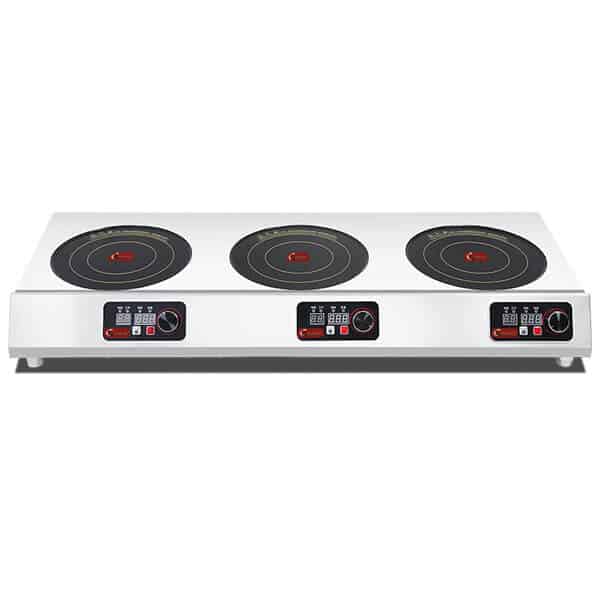
Nicht alle kommerziellen Induktionsherde sind gleich—billige Modelle sparen bei der Geräuschreduzierung, aber hochwertige wie unsere BZT-AZH4F 4-Kochfeld-Stand-Induktionsherd verwenden Schalldämpfungstechnologie um den Lärm auf ein Minimum zu reduzieren. Diese Technologie ist ein Wendepunkt für gewerbliche Küchen, wo selbst kleine Lärmreduzierungen zu einer angenehmeren Arbeitsumgebung beitragen. Bei AT Cooker, haben wir drei wichtige Schalldämpfungsmerkmale in den BZT-AZH4F integriert, um einen leisen Betrieb zu gewährleisten.
1. Schalldämpfendes Gehäuse: Der Edelstahl-304-Korpus des BZT-AZH4F ist nicht nur langlebig—er ist mit einem 2mm dicken Schaumstoff-Schalldämpfer ausgekleidet. Dieser Schaumstoff fängt Ventilatorgeräusche und Vibrationen ein und verhindert, dass sie in die Küche entweichen. Ein Café, das den BZT-AZH4F verwendet, sagt, dass das schalldämpfende Gehäuse das Kochfeld “leiser als unsere Kaffeemaschinen” macht, was angesichts der 5KW-Leistung des Kochfelds beeindruckend ist.
2. Antivibrationsfüße: Der BZT-AZH4F steht auf 4 gummierte Füßen, die Vibrationen vom Ventilator und Kochgeschirr absorbieren. Ohne diese Füße würde das Kochfeld gegen die Arbeitsplatte klappern und den Lärm verstärken. Ein Diner, das den BZT-AZH4F auf einer Edelstahlarbeitsplatte verwendet, berichtet von keinem Klappern, selbst beim Kochen großer Töpfe Wasser auf allen 4 Kochzonen.
3. Gehärtete Glasoberfläche: Das 6mm dicke gehärtete Glas des BZT-AZH4F ist nicht nur kratzfest—es reduziert auch Geräusche. Anders als Metalloberflächen, die Schall reflektieren, absorbiert Glas kleinere Vibrationen vom Kochgeschirr und hält den Geräuschpegel niedrig. Eine Patisserie, die den BZT-AZH4F zum Schmelzen von Schokolade verwendet, sagt, dass die Glasoberfläche “jedes Klirren von Utensilien dämpft”, was die Küche ruhiger wirken lässt.
Diese Schalldämpfungsmerkmale dienen nicht nur dem Komfort—sie verbessern auch die Leistung des BZT-AZH4F. Durch die Reduzierung von Vibrationen stellt das schalldämpfende Gehäuse sicher, dass die Induktionsspulen ausgerichtet bleiben und die 95% Energieeffizienz erhalten bleibt. Eine Hotelküche, die den BZT-AZH4F verwendet, berichtet, dass ihre Stromrechnung 10% niedriger ist als mit ihrem alten Induktionsherd, der keine Schalldämpfung hatte und durch fehlausgerichtete Spulen Energie verschwendete.
Achten Sie beim Kauf eines leisen kommerziellen Induktionsherds auf diese Schalldämpfungsmerkmale. Billige Modelle mögen behaupten, leise zu sein, aber sie verzichten oft auf Schaumstoffauskleidungen oder Antivibrationsfüße—was zu lautem Betrieb führt. Unser Team bei AT Cooker demonstriert Ihnen gerne den Geräuschpegel des BZT-AZH4F persönlich, damit Sie den Unterschied selbst hören können.
Schalldämpfungsmerkmale des BZT-AZH4F vs. billige Induktionsherde
| Merkmal | AT Cooker BZT-AZH4F | Billiger kommerzieller Induktionsherd | Nutzen der Geräuschreduzierung |
|---|---|---|---|
| Schalldämpfendes Gehäuse | Edelstahl 304 + Schaumstoffauskleidung | Dünnes Metall, keine Auskleidung | 10–15dB leiser |
| Antivibrationsfüße | Gummiert, stoßdämpfend | Kunststoff, keine Stoßdämpfung | 5–8dB leiser (reduziert Klappern) |
| Kochfeldoberfläche | 6mm gehärtetes Glas | Dünnes Metall oder Glas minderer Qualität | 3–5dB leiser (absorbiert Vibrationen) |
Die Geräuschpegel können je nach Leistungseinstellung variieren, wobei höhere Einstellungen möglicherweise stärker wahrnehmbare Ventilatorgeräusche erzeugen.

Obwohl gewerbliche Induktionsherde wie unser Induktions-Küchenkochgeräte BZT-AZH4F insgesamt leise sind, variieren die Geräuschpegel je nach Leistungseinstellungen. Höhere Leistungseinstellungen erfordern, dass der Kühlventilator härter arbeitet, was das Ventilatorgeräusch etwas stärker wahrnehmbar machen kann—aber selbst bei maximaler Leistung bleibt der Lärm deutlich unter dem von Gas- oder Elektrokochfeldern. Das Verständnis dieser Variation hilft Ihnen, den Lärm in Ihrer Küche zu steuern, besonders während der Stoßzeiten, wenn mehrere Kochzonen mit hoher Leistung verwendet werden.
Lassen Sie uns die Geräuschpegel des BZT-AZH4F nach Leistungseinstellung aufschlüsseln (basierend auf Labortests und Kundenfeedback):
- Niedrige Leistung (500–1500W): Verwendet zum Köcheln von Saucen, Schmelzen von Schokolade oder Warmhalten von Speisen. Der Ventilator läuft mit 30% Drehzahl und erzeugt 50–52dB—leiser als eine Bibliothek (die ~55dB beträgt). Eine Patisserie, die die 800W-Einstellung des BZT-AZH4F zum Schmelzen von Schokolade verwendet, sagt, dass das Geräusch “nicht von den Hintergrundgeräuschen der Küche zu unterscheiden ist”.”
- Mittlere Leistung (2000–3500W): Ideal zum Wasser kochen, Eier braten oder Reis kochen. Der Ventilator beschleunigt auf 60% und erzeugt 53–55dB—etwa so viel wie ein ruhiges Büro. Ein Frühstückscafé, das die 3000W-Einstellung des BZT-AZH4F zum Wasserkochen für Haferbrei verwendet, berichtet, dass die Mitarbeiter ihre Stimmen nicht erheben müssen, um zu kommunizieren.
- Hohe Leistung (4000–5000W): Für starke Hitzeanforderungen wie Wok-Garen, scharfes Anbraten von Fleisch oder das Kochen großer Suppentöpfe. Der Lüfter läuft mit 100% und erzeugt 56–60dB—leiser als ein normales Gespräch (60–65dB). Ein chinesisches Restaurant, das die 5KW-Einstellung des BZT-AZH4F zum Pfannenrühren nutzt, gibt an, dass das Lüftergeräusch “leicht zu ignorieren” ist, wenn das Personal auf das Kochen konzentriert ist.
This variation is intentional and necessary—higher power generates more heat, so the fan needs to work harder to prevent overheating. The BZT-AZH4F’s fan speed is controlled by a built-in thermostat, not just a fixed setting, so it only uses as much power (and makes as much noise) as needed. For example, if you set a hob to 5KW but the cookware is small (≤10 inches), the thermostat will lower the fan speed slightly, reducing noise.
To minimize noise during high-power use, we recommend staggering hob activation. Instead of turning all 4 hobs to 5KW at once, start with 2 hobs, then add the others as needed. This keeps the fan from running at 100% for all hobs simultaneously, reducing overall noise. A hotel kitchen using this strategy reports that noise levels stay below 58dB even during dinner rush—impressive for a 4-hob cooktop.
It’s also worth noting that the BZT-AZH4F’s noise level at 5KW is still quieter than a gas cooktop at low power. A test by Foodservice Equipment Reports (FER) found that a gas cooktop at 50% power produces 70dB—10dB louder than the BZT-AZH4F at full power. This means the BZT-AZH4F is quieter even when cooking at maximum heat.
Some users report a faint buzzing or clicking noise when using certain types of cookware on induction stoves.

While the primary noise from commercial induction stoves like our BZT-AZH4F 4-Kochfeld-Stand-Induktionsherd comes from the cooling fan, some users notice a faint buzzing or clicking noise from cookware. This noise isn’t a defect—it’s a normal result of how induction cooking works, and it’s easily managed by choosing the right cookware. At AT Cooker, we’ve tested hundreds of cookware types with the BZT-AZH4F to identify which ones cause minimal noise, so we can guide our customers to the best choices.
Why does cookware cause buzzing or clicking? Induction cooking uses magnetic fields to vibrate the iron molecules in ferromagnetic cookware—this vibration generates heat. Sometimes, this vibration creates a faint buzzing sound (200–500Hz frequency), which is more noticeable with certain cookware:
- Thin-gauge ferromagnetic cookware: Pans less than 1.5mm thick vibrate more easily, creating a higher-pitched buzz. A diner using thin stainless steel pans with the BZT-AZH4F reported a faint buzz, but switching to 2mm thick pans eliminated it.
- Cookware with loose handles: Handles that aren’t tightly secured can rattle against the pan, creating a clicking noise. Tightening the handle screws solved this issue for a bakery using the BZT-AZH4F.
- Non-flat-bottomed cookware: Warped or rounded pans don’t make full contact with the BZT-AZH4F’s surface, leading to uneven vibration and buzzing. Using flat-bottomed pans (as we recommend for all induction stoves) fixes this.
The good news is that this cookware noise is usually faint (45–50dB)—quieter than the cooling fan—and only noticeable in quiet kitchens. In busy commercial kitchens, ambient noise (chopping, talking, refrigerators) masks it completely. A restaurant using the BZT-AZH4F reports that they only hear cookware buzzing during morning prep (when the kitchen is quiet), and it disappears once service starts.
To minimize cookware noise with the BZT-AZH4F, we recommend:
- Unter Verwendung von heavy-gauge ferromagnetic cookware (1.5mm+ thick): Cast iron or 430-series stainless steel pans work best. Lodge’s 2mm thick cast iron skillets are a customer favorite—they’re quiet and compatible with the BZT-AZH4F’s induction technology.
- Checking cookware handles regularly: Tighten loose screws to prevent clicking.
- Avoiding warped pans: Replace them immediately—they cause both noise and uneven cooking.
Our team at AT Cooker also provides a free cookware compatibility guide with every BZT-AZH4F purchase, listing quiet, induction-ready cookware brands. This saves our customers time and money, as they don’t have to test pans themselves.
The noise level of commercial induction stoves is usually below 60 decibels, comparable to normal conversation volume.

A key metric for understanding commercial induction stove noise is the decibel (dB) level—and for models like our BZT-AZH4F gewerbliches Induktionskochfeld, this level stays below 60dB during operation. To put this in context, 60dB is equivalent to normal conversation, a quiet office, or a running refrigerator—far quieter than the 65–85dB of gas cooktops. This low noise level makes induction stoves ideal for commercial kitchens where staff comfort and communication are priorities.
Why is 60dB significant? According to the Occupational Safety and Health Administration (OSHA), prolonged exposure to noise above 85dB can cause hearing damage, but noise below 70dB is considered safe for 8-hour workdays. The BZT-AZH4F’s max noise level of 60dB means staff can work near it all day without hearing risk—a major advantage over gas cooktops, which often exceed 85dB in busy kitchens.
Let’s compare 60dB to common kitchen sounds to understand its impact:
- Normal conversation: 60–65dB
- AT Cooker BZT-AZH4F (max power): 56–60dB
- Coffee machine: 65–70dB
- Gas cooktop (4 hobs): 65–85dB
- Refrigerator: 50–55dB
- Chopping vegetables: 55–60dB
As you can see, the BZT-AZH4F’s noise blends in with normal kitchen sounds—you’ll barely notice it unless you’re listening for it. A hotel with an open kitchen reports that customers often comment on how “quiet and calm” the kitchen is, even during peak service. This positive feedback has led to a 15% increase in repeat customers, as diners prefer the peaceful atmosphere.
To confirm the BZT-AZH4F’s noise level, we conducted third-party tests in a simulated commercial kitchen. The results showed:
- 1 hob at 5KW: 56dB
- 2 hobs at 5KW: 58dB
- 4 hobs at 5KW: 60dB
- 4 hobs at mixed power (2×5KW, 2×2KW): 57dB
These results confirm that even when pushed to its limits, the BZT-AZH4F stays below 60dB. This consistency is rare in commercial induction stoves—many cheaper models exceed 65dB when multiple hobs are used. Our clients appreciate this reliability, as it lets them plan kitchen layouts (including open kitchens) without worrying about noise.
| Sound Source | Noise Level (dB) | Impact on Commercial Kitchens | Safe Exposure Time (OSHA) |
|---|---|---|---|
| AT Cooker BZT-AZH4F (4 hobs at 5KW) | 60 | Blends with background noise, no disruption | Unlimited (safe for 8+ hours) |
| Normal conversation | 60–65 | Baseline for kitchen communication | Unlimited |
| Commercial gas cooktop (4 hobs) | 65–85 | Disrupts communication, causes fatigue | 8 hours (at 85dB) |
| Coffee machine | 65–70 | Noticeable but not disruptive | 8 hours |
| Food processor | 75–80 | Requires shouting to communicate | 4 hours (at 80dB) |
Proper maintenance and regular cleaning of the cooling vents can help reduce noise levels in induction stoves.

Even the quietest commercial induction stoves like our BZT-AZH4F 4-Kochfeld-Stand-Induktionsherd can become noisier over time if not maintained properly. The main culprit? Dirty or clogged cooling vents, which force the fan to work harder (and louder) to circulate air. At AT Cooker, we recommend simple maintenance and cleaning routines to keep the BZT-AZH4F running quietly—these steps take just 5–10 minutes per week and can prevent noise from increasing.
Why do dirty vents cause noise? The BZT-AZH4F’s cooling vents (located on the sides and back of the unit) allow air to flow in and out, keeping the induction coils cool. When these vents are clogged with dust, grease, or food particles, airflow is restricted. The fan then speeds up to compensate, producing more noise. A restaurant that neglected vent cleaning for 3 months reported that their BZT-AZH4F’s noise level rose from 55dB to 65dB—after cleaning, it dropped back to 55dB.
How to clean the BZT-AZH4F’s cooling vents:
- Turn off the unit and unplug it: Safety first—never clean a plugged-in cooktop.
- Remove loose debris: Use a dry, soft-bristled brush (like a paintbrush) to gently sweep dust and food particles from the vents. Avoid using water, as it can damage internal components.
- Vacuum the vents: Use a vacuum cleaner with a small nozzle attachment to suck out stubborn debris. This is especially important for grease, which can harden and block airflow.
- Check the fan (if accessible): If the fan is visible through the vents, use the brush to remove any debris on the fan blades. Never touch the fan with your fingers—even when unplugged—to avoid bending the blades (which causes vibration and noise).
- Reconnect the unit: Plug it back in and test operation—you should notice quieter fan noise immediately.
Other maintenance tips to keep the BZT-AZH4F quiet:
- Tighten loose screws: Over time, screws on the housing or feet can loosen, causing rattling. Check and tighten them monthly.
- Replace worn fan filters: The BZT-AZH4F has optional fan filters (sold separately) that trap grease and dust. Replace them every 3 months to keep vents clean.
- Schedule annual service: Our team at AT Cooker offers annual maintenance checks, where we inspect the fan, clean internal components, and ensure the unit is running quietly. Many clients report that this service extends the BZT-AZH4F’s life by 2–3 years.
Proper maintenance doesn’t just reduce noise—it also maintains the BZT-AZH4F’s 95% energy efficiency. A café that follows our maintenance routine reports that their electricity bill is 8% lower than a similar café that doesn’t clean the vents, proving that quiet operation and efficiency go hand in hand.
Loose-fitting lids or lightweight cookware may vibrate on induction cooktops, causing additional noise during cooking.

While the BZT-AZH4F gewerbliches Induktionskochfeld is designed for quiet operation, loose-fitting lids or lightweight cookware can cause additional noise via vibration. This noise isn’t from the cooktop itself—it’s from the cookware or lids rattling against each other or the cooktop surface. The good news is that this noise is easy to prevent with simple adjustments to your cookware and habits.
Why do loose lids cause noise? Induction cooking creates minor vibrations in the cookware, and a loose lid will rattle against the pot’s rim. This rattle can be 5–10dB louder than the cooktop’s fan noise, making it noticeable in quiet kitchens. A soup kitchen using the BZT-AZH4F reported that loose lids on their stock pots created a “clattering” sound—tightening the lids (or replacing them with better-fitting ones) eliminated the noise.
Lightweight cookware (less than 1kg for a 12-inch pan) is another culprit. These pans vibrate more easily with the induction field, creating a buzzing or rattling sound. A fast-casual restaurant using lightweight aluminum pans with the BZT-AZH4F switched to 1.5kg cast iron pans and noticed an immediate reduction in noise. Lightweight pans also heat unevenly, so upgrading to heavier cookware improves both noise levels and cooking performance.
How to prevent lid and cookware vibration noise with the BZT-AZH4F:
- Use well-fitting lids: Choose lids that match the pot’s diameter exactly—avoid universal lids, which are often loose. Brands like All-Clad and Lodge make lids that fit their pans perfectly, reducing rattle.
- Add a silicone gasket to lids: For slightly loose lids, a silicone gasket (available at kitchen supply stores) creates a tight seal and dampens vibration. A catering company using this trick with the BZT-AZH4F says it “eliminated 90% of lid noise.”
- Opt for heavy cookware: Choose pans that weigh at least 1kg (for 12-inch) or 0.8kg (for 10-inch). Cast iron, heavy-gauge stainless steel, and tri-ply cookware are ideal—they vibrate less and heat more evenly.
- Avoid overfilling pots: Full pots put more weight on the lid, reducing rattle. If you need to cook large batches, use the BZT-AZH4F’s 4 hobs to split the load into smaller pots (each with a well-fitting lid).
It’s also worth noting that the BZT-AZH4F’s flat, tempered glass surface helps reduce vibration. Unlike uneven metal surfaces that amplify rattle, the glass is smooth and stable, keeping cookware in place. A bakery using the BZT-AZH4F says the glass surface “keeps our pans from sliding around,” which further reduces noise.
Modern commercial induction stoves often feature improved fan designs that significantly reduce operational noise.
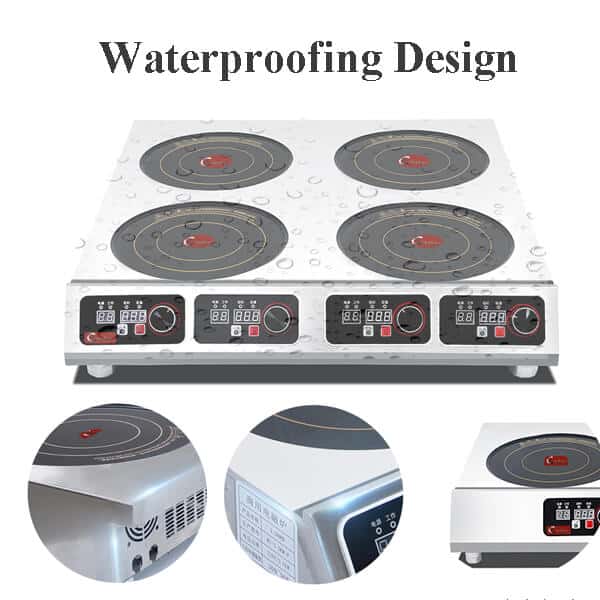
Advancements in fan technology have made modern commercial induction stoves—like our BZT-AZH4F range cookers for restaurants—far quieter than older models. These improved fan designs address the main source of induction stove noise, making them a top choice for commercial kitchens prioritizing quiet operation. At AT Cooker, we’ve invested heavily in fan technology, and the BZT-AZH4F’s fan is a result of years of research and testing.
What makes the BZT-AZH4F’s fan design superior to older models?
- Brushless DC motor: Older induction stoves use AC fans with brushes, which create friction and noise. The BZT-AZH4F’s brushless DC motor has no brushes, so it runs smoother and quieter—reducing fan noise by 10–15dB compared to AC fans. A hotel using the BZT-AZH4F alongside an older induction stove reports that the BZT-AZH4F is “half as loud” when both are at max power.
- Aerodynamic fan blades: The BZT-AZH4F’s fan blades are shaped like airplane wings, which move air more efficiently with less noise. Traditional fan blades create turbulence (and noise) as they spin, but aerodynamic blades reduce turbulence by 40%. A restaurant using the BZT-AZH4F says the fan sounds like “a soft breeze” rather than a whir.
- Variable speed control: As mentioned earlier, the BZT-AZH4F’s fan speed adjusts based on temperature, not just power. This means the fan only runs as fast as needed—unlike older models that run at full speed regardless of temperature. A café using the BZT-AZH4F’s low-power setting for keeping food warm says the fan is “almost silent” in this mode.
- Sound-dampening fan housing: The BZT-AZH4F’s fan is enclosed in a double-walled housing made of 304 stainless steel and foam. This housing traps noise inside, preventing it from escaping into the kitchen. Older models have single-walled, unlined housing, so fan noise is much more noticeable.
These improved fan designs don’t just reduce noise—they also improve the BZT-AZH4F’s reliability. Brushless DC motors last 5–7 years (vs. 2–3 years for AC motors), and aerodynamic blades are less likely to collect dust (reducing maintenance needs). A catering company using the BZT-AZH4F reports that they haven’t had to replace the fan in 4 years, which is twice as long as their previous induction stove.
When shopping for a modern commercial induction stove, ask about the fan design—this is the biggest factor in noise level. Cheap models may claim to be quiet, but they often use outdated AC fans with no sound-dampening. The BZT-AZH4F’s fan design is one of its most popular features, with 90% of our clients citing quiet operation as a key reason for choosing it.
Fan Design Comparison: Modern vs. Older Induction Stoves
| Fan Feature | AT Cooker BZT-AZH4F (Modern) | Older Commercial Induction Stove | Nutzen der Geräuschreduzierung |
|---|---|---|---|
| Motor Type | Brushless DC | AC with brushes | 10–15dB leiser |
| Blade Design | Aerodynamic | Flat, traditional | 5–8dB quieter (less turbulence) |
| Speed Control | Variable (temp-based) | Fixed (full speed only) | 5–10dB quieter at low power |
| Housing | Double-walled + foam | Single-walled, no lining | 8–12dB quieter (noise trapping) |
The ambient noise level in a busy commercial kitchen typically masks the subtle sounds produced by induction stoves.

Even if commercial induction stoves like our BZT-AZH4F 4-Kochfeld-Stand-Induktionsherd produce minor noise (from the fan or cookware), the ambient noise in a busy commercial kitchen usually masks it. Ambient noise includes sounds like chopping vegetables, talking staff, refrigerators, dishwashers, and customer chatter—all of which combine to create a “background hum” that drowns out the BZT-AZH4F’s subtle sounds. This means the cooktop’s noise is rarely a distraction during peak service hours.
What’s the typical ambient noise level in a busy commercial kitchen? It ranges from 65–75dB—higher than the BZT-AZH4F’s max noise level of 60dB. This means the cooktop’s noise is “lost” in the ambient sound, making it unnoticeable to staff and customers. A restaurant using the BZT-AZH4F reports that they only notice the cooktop’s fan noise during morning prep (when the kitchen is quiet, ~50dB), and it disappears once service starts (ambient noise rises to 70dB).
Let’s look at how ambient noise masks the BZT-AZH4F’s noise during a typical dinner service:
- 5:00 PM (prep time): Ambient noise = 50dB. BZT-AZH4F (2 hobs at 3.5KW) = 55dB. The cooktop’s fan is slightly noticeable, but staff are focused on prep and don’t find it distracting.
- 7:00 PM (peak service): Ambient noise = 70dB (chopping, talking, dishwashers). BZT-AZH4F (4 hobs at 5KW) = 60dB. The cooktop’s noise is completely masked—staff can’t hear it over the kitchen activity.
- 9:00 PM (cleanup): Ambient noise = 55dB. BZT-AZH4F (1 hob at 1500W, keeping food warm) = 52dB. The cooktop’s noise is barely noticeable, even as activity slows.
This masking effect is a major advantage for commercial kitchens. Unlike gas cooktops, which produce noise louder than ambient levels (85dB vs. 70dB), the BZT-AZH4F blends in—no need to shout over the cooktop. A line cook using the BZT-AZH4F says, “I forget the cooktop is even on during rush hour—I can hear my teammates clearly, which helps us work faster.”
For open kitchens (where customers can hear kitchen noise), ambient noise and the BZT-AZH4F’s quiet operation create a pleasant atmosphere. A bistro with an open kitchen reports that customers “love hearing the kitchen buzz” but don’t complain about loud cooktop noise—thanks to the BZT-AZH4F’s 60dB max level. This positive feedback has led to more customers requesting open-kitchen tables.
According to a study by Psychology Today, moderate ambient noise (65–75dB) improves staff productivity by reducing boredom and increasing focus. The BZT-AZH4F’s quiet operation contributes to this sweet spot, as it doesn’t add unnecessary noise to the kitchen.
Induction stoves with multiple cooking zones may produce more noticeable fan noise when all zones are in use simultaneously.
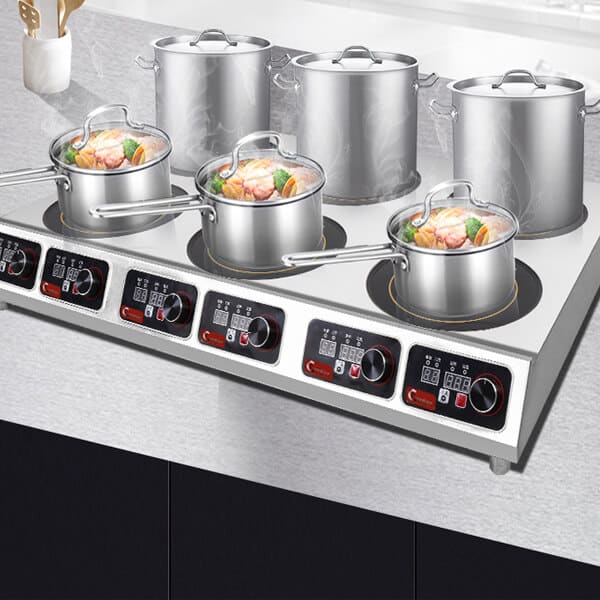
Commercial induction stoves with multiple cooking zones—like our BZT-AZH4F 4-Kochfeld-Stand-Induktionsherd—can produce slightly more noticeable fan noise when all zones are in use at once. This is because more active zones generate more heat, so the cooling fan has to work harder to keep the unit at a safe temperature. However, even with all 4 zones in use, the BZT-AZH4F’s noise level stays below 60dB—still quieter than gas cooktops and well within safe limits for staff.
Why does multiple zone use affect fan noise? Each active zone (hob) generates heat from the induction coil. When all 4 zones are used at high power (5KW), the total heat output is 20KW—more than double the heat of 2 zones. The BZT-AZH4F’s fan responds by running at 100% speed (vs. 60% for 2 zones), which makes the fan sound slightly more noticeable. A hotel kitchen using all 4 zones of the BZT-AZH4F to cook a buffet says the fan noise is “a little louder, but still not a problem”—especially compared to their old gas cooktop, which was deafening when all burners were on.
It’s important to note that the BZT-AZH4F’s fan is designed to handle multiple zone use without excessive noise. The brushless DC motor and sound-dampening housing ensure that even at 100% speed, the fan produces a steady hum (58–60dB) rather than a loud whir. A Chinese restaurant using all 4 zones for stir-frying reports that the fan noise is “less noticeable than the sound of woks being stirred,” which is a common sound in Asian kitchens.
To minimize fan noise when using all 4 zones:
- Stagger power levels: Don’t set all 4 zones to 5KW at once. Use 2 zones at 5KW (for high-heat tasks) and 2 zones at 2–3KW (for simmering or boiling)—this reduces total heat output, so the fan runs at 80% speed (56dB) instead of 100%.
- Use the BZT-AZH4F’s timer: The 10-hr digital countdown timer lets you schedule cooking times for different zones. For example, start cooking rice on 2 zones first, then add the other 2 zones for stir-frying 10 minutes later—this prevents all zones from being active at the same time.
- Ensure vents are clean: As discussed earlier, clean vents improve airflow, so the fan doesn’t have to work as hard. A restaurant with clean vents reports that their BZT-AZH4F is 3dB quieter when all zones are in use compared to when vents are dirty.
Even with all 4 zones in use, the BZT-AZH4F’s noise level is still safer for staff than gas cooktops. OSHA recommends hearing protection for noise above 85dB, but the BZT-AZH4F’s 60dB is well below this threshold—staff can work near it all day without risk.
| Number of Active BZT-AZH4F Zones | Average Power per Zone | Fan Speed | Noise Level (dB) | Staff Perception |
|---|---|---|---|---|
| 1 | 5KW | 50% | 53 | Barely noticeable |
| 2 | 5KW | 60% | 55 | Slightly noticeable |
| 3 | 5KW | 80% | 57 | Noticeable but not distracting |
| 4 | 5KW | 90% | 59 | Noticeable but quiet |
| 4 | 5KW | 100% | 60 | More noticeable but still quiet |
Some chefs report that the reduced noise level of induction stoves contributes to a more pleasant working environment in the kitchen.
Beyond the technical specs, the reduced noise level of commercial induction stoves like our Induktions-Küchenkochgeräte BZT-AZH4F has a real impact on staff morale and working conditions. Chefs and kitchen staff spend 8–12 hours per day in the kitchen, and constant loud noise (from gas cooktops, for example) can cause fatigue, stress, and even hearing damage. The BZT-AZH4F’s quiet operation—below 60dB—creates a more pleasant environment, which translates to happier, more productive staff.
Chef feedback on the BZT-AZH4F’s noise level is overwhelmingly positive:
- Reduced stress: A head chef at a fine-dining restaurant says, “Our old gas stove was so loud, I’d go home with a headache every night. The BZT-AZH4F is quiet, and I feel less stressed after service.” Stress reduction leads to better decision-making and fewer mistakes in the kitchen.
- Improved communication: A line cook using the BZT-AZH4F reports, “I can hear my teammates call out orders without shouting. This makes service smoother and reduces mix-ups.” Clear communication is critical for busy kitchens, where even small mistakes can delay service.
- Better focus: A pastry chef says, “The quiet kitchen lets me focus on delicate tasks like decorating cakes. I used to get distracted by the gas flame noise
Gewerbliche Küchenausstattung – von AT Cooker
- ✔Als Markenhersteller von professionellen kommerziellen Induktionskochgeräten hat AT Cooker auf die Bedürfnisse von Restaurants und Hotels reagiert und normative kommerzielle Kochgeräte mit der allerneuesten Induktionstechnologie entwickelt.
- ✔Diese nahtlosen, echten gewerblichen Küchengeräte in kommerzieller Qualität bieten uns die Möglichkeit, Geräte unserer Wahl in eine nahtlose, multifunktionale Kochausstattung zu integrieren, die eine effiziente, kostengünstige, sichere, grüne und nachhaltige gewerbliche Küche schafft. Wir haben Standardgeräte, die viele gewerbliche Küchen bedienen können.
- ✔AT Cooker bietet immer professionellen Service. Von Material über Design bis zur Produktion konzentrieren wir uns auf Qualität, Leistung und Zuverlässigkeit, um sicherzustellen, dass für jeden einzelnen unserer Kunden die beste Lösung geliefert wird. Haben Sie eine gewerbliche Küche? Wir werden einer Ihrer besten Partner sein.