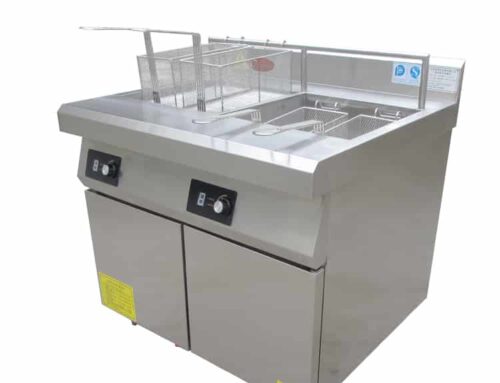
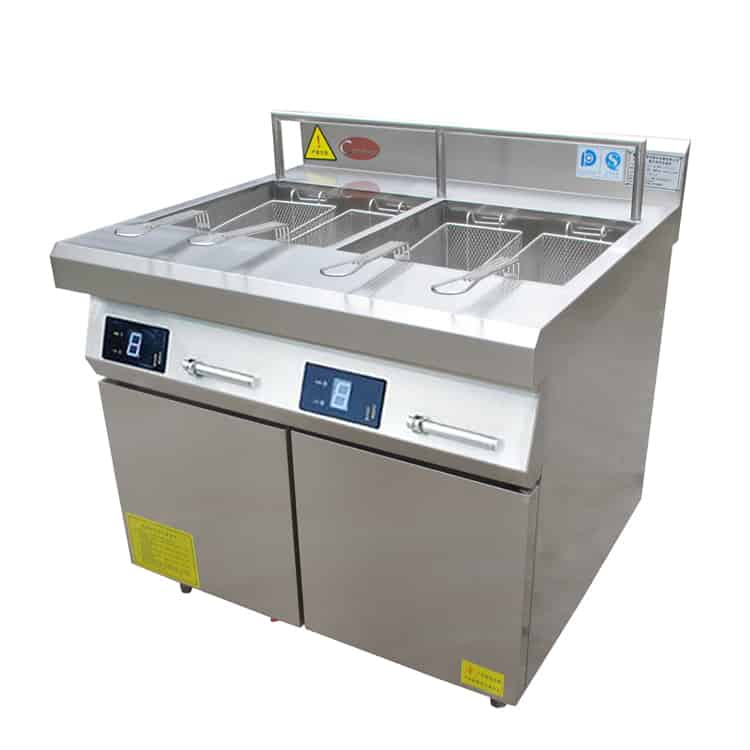
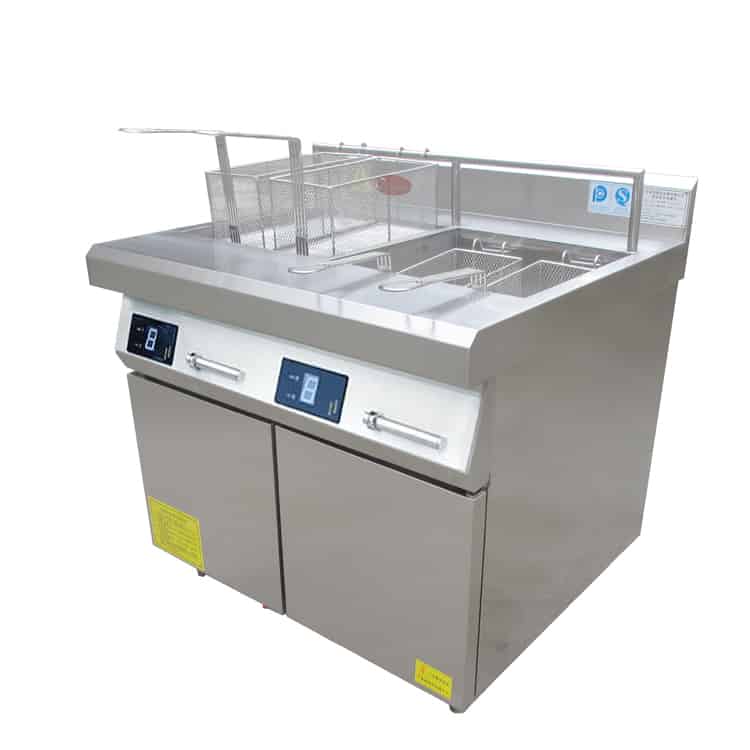
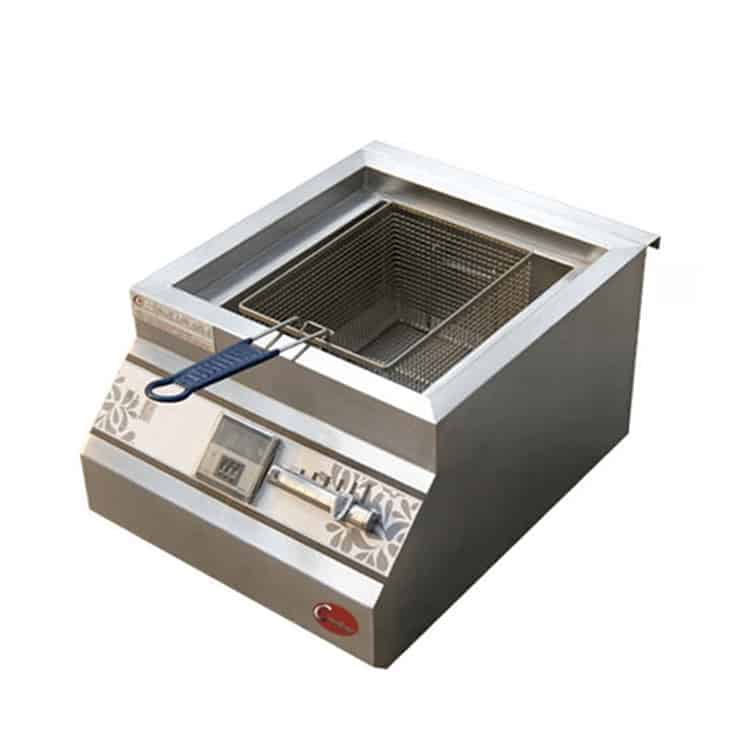
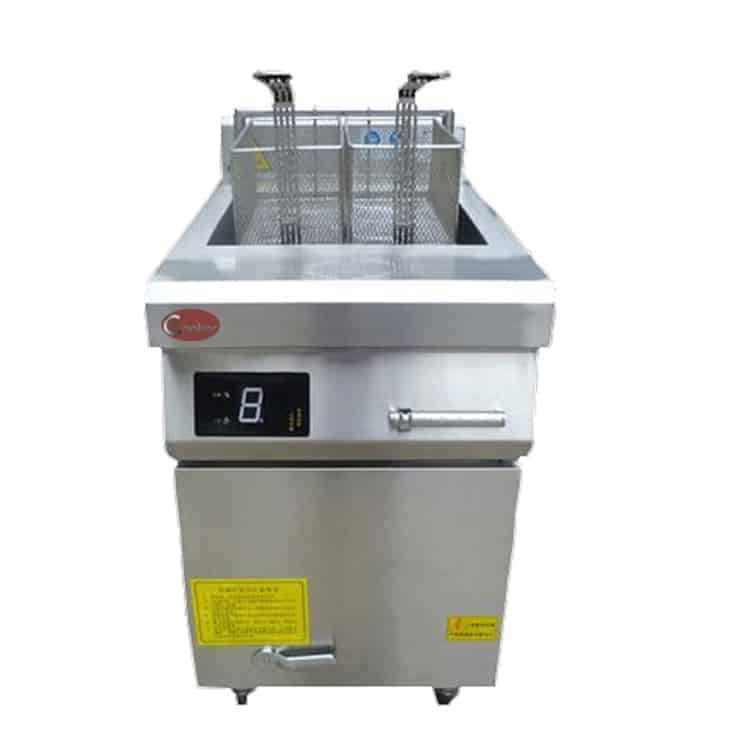
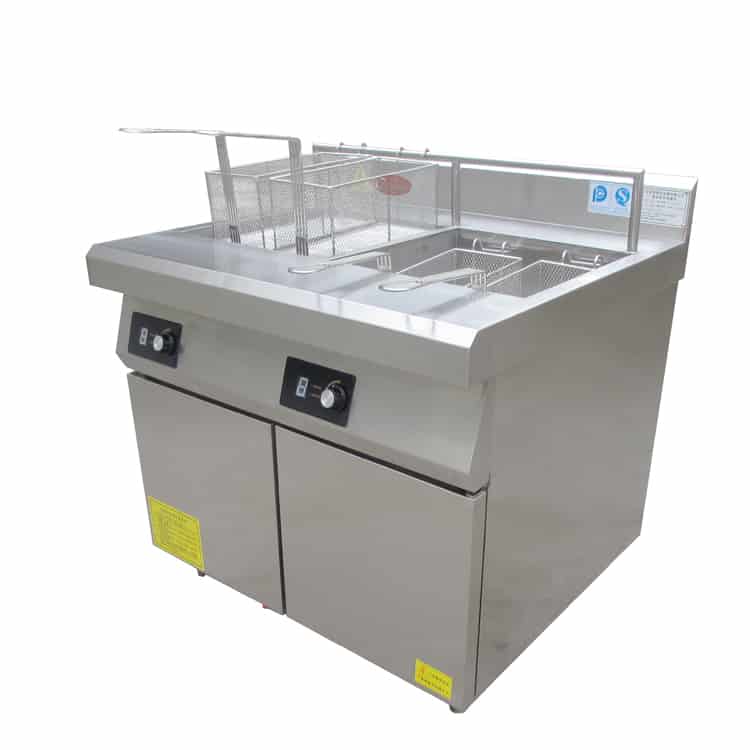
Commercial fryers’ oil hold capacity spans a wide range, and consumption rates vary drastically based on usage. AT Cooker offers models from 10L countertop to 80L dual-tank. Below, 14 factors that determine how much oil your fryer holds and how fast it consumes.
1. Commercial Fryers Typically Hold 15 to 60 Pounds of Oil
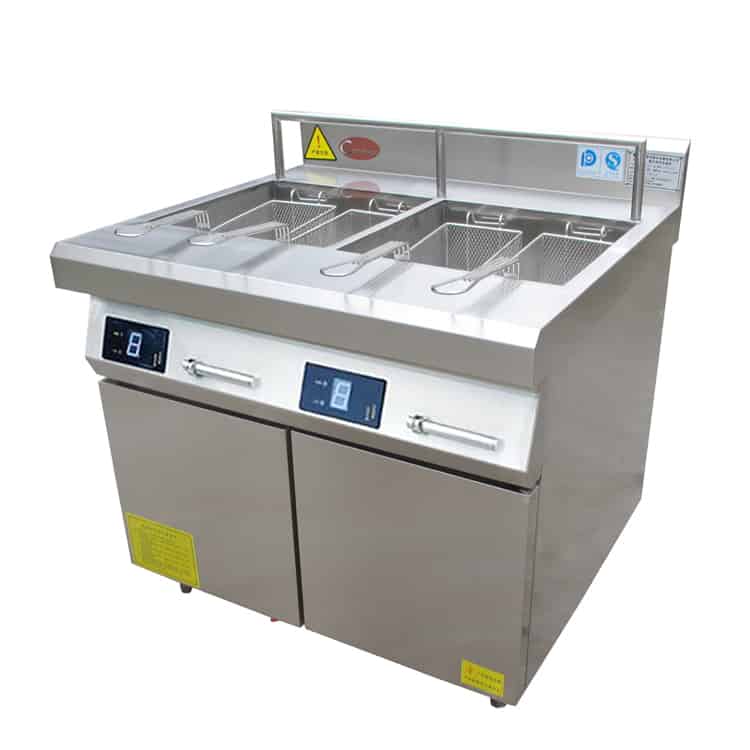
Most standard models fall between 15–60 lbs (17–65L), while industrial-grade units (like AT Cooker’s 40L×2 model) can hold up to 73 lbs (80L). The key is matching capacity to output: a small café needs far less oil than a busy burger chain.
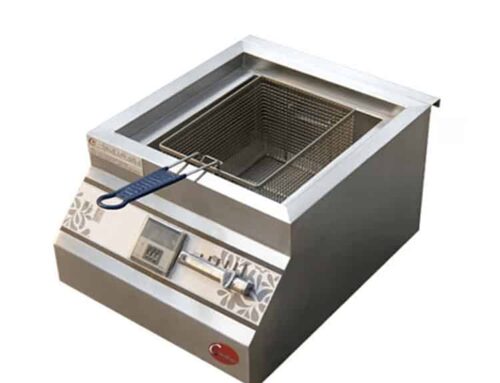
- Compact Countertop (5KW): 8.5–13.8 lbs (10–15L). Perfect for cafés or food trucks frying 50–100 portions daily.
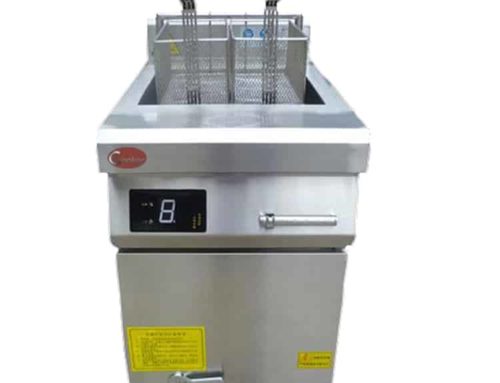
- Mid-Volume Freestanding (8–15KW): 19.5–21.16 lbs (23L). The 23L induction fryer is a bestseller—enough for 200–300 portions daily.
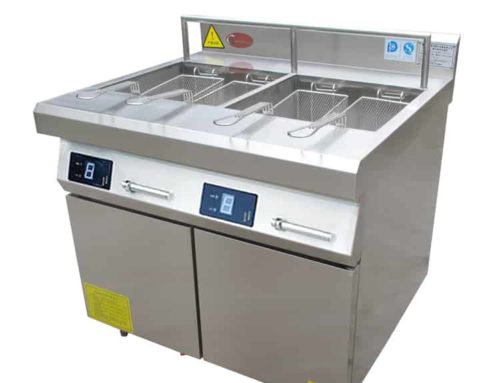
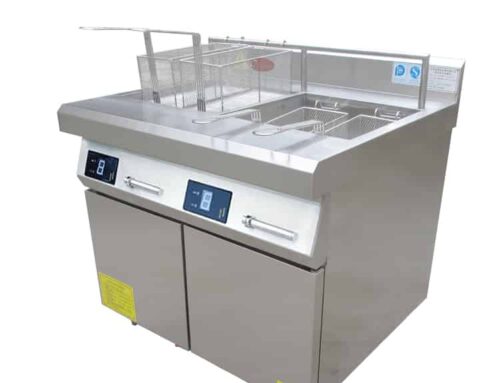
- High-Volume Dual-Tank (10–12KW×2): 68–73.6 lbs (80L total). Handles 500+ portions with separate tanks.
Oil Conversion: 1L vegetable oil = ~0.85 lbs; 1L peanut oil = ~0.92 lbs. All AT Cooker specs reference net oil capacity (usable volume).
| Model AT Cooker | Pojemność oleju (L) | Oil Capacity (lbs) | Moc | Ideal Kitchen | Daily Output |
|---|---|---|---|---|---|
| 5KW Single-Basket Countertop | 10L | 3,85 kg | 5KW | Cafés, food trucks | 50–100 |
| 5KW Dual-Basket Countertop | 15L | 5,78 kg | 5KW | Small restaurants | 100–150 |
| 23L Freestanding Induction | 23L | 8,87 kg | 8–15KW | Mid-sized restaurants | 200–300 |
| 40L×2 Dual-Tank | 80L (40L×2) | 30,84 kg | 10–12KW×2 | Stadiums, hotels | 500+ |
2. Wskaźnik zużycia oleju zależy od częstotliwości użytkowania
High-volume operations (4+ hours daily) consume oil 2–3x faster than low-volume kitchens (1–2 hours daily). AT Cooker’s popular models and typical replacement cycles (vegetable oil):
- Low-Volume (1–2 hrs/day): 10L countertop, oil replacement every 5–7 days. ~42–60L monthly.
- Mid-Volume (3–4 hrs/day): 23L freestanding, replacement every 3–4 days. ~172–228L monthly.
- High-Volume (5+ hrs/day): 40L×2, replacement every 2–3 days. ~780–1,200L monthly.
FFA Threshold: Once free fatty acid exceeds 1%, oil produces off-flavors and smoke. AT Cooker’s 10-hour auto-shutoff timer reduces idle degradation by 15%.
3. Regularna filtracja przedłuża żywotność oleju, zmniejszając zużycie
Food particles left in oil accelerate degradation by burning and releasing acids. Filtration removes these particles, extending oil life by 30–50%. AT Cooker’s fryers simplify filtration with built-in faucet drains, cool-touch oil handles, and compatibility with commercial filtration machines.
| Filtration Method | Replacement Cycle | Monthly Consumption |
|---|---|---|
| Brak filtracji | 3 days | 230L |
| Codzienna filtracja | 5 days | 138L |
| Filtracja maszynowa | 6 days | 115L |
Case Study: A catering company in Miami: with daily filtration (10 min after closing), oil replacement went from every 3 days to every 5 days—saving 40% on oil costs monthly. For a 23L fryer, that’s $192/month savings.
4. Induction Precise Temperature Control Slows Oil Degradation
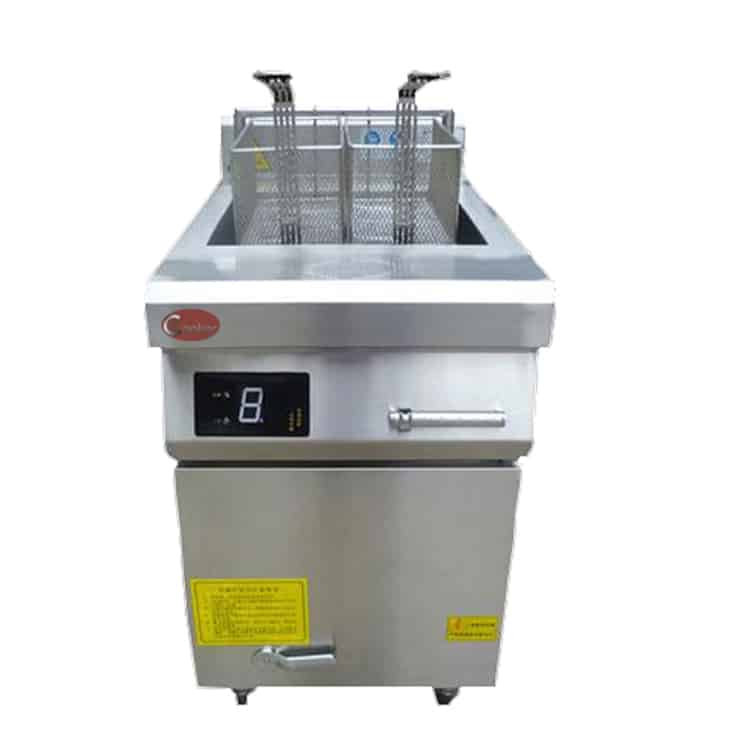
Oil degradation accelerates above 375°F (190°C). AT Cooker’s induction fryers use PID controllers adjusting heat 10 times/sec, maintaining ±2°F—far more precise than gas (±5–8°F) or standard electric (±3–4°F). Result: oil lasts longer.
A chicken chain: “Gas fryer bounced 360–385°F, oil degraded every 2 days. Induction stays at 370°F exactly, oil lasts 4 days. Cut oil costs in half.” Anti-high-temperature warnings alert staff if oil nears 390°F, saving 10–15L monthly.
5. Oil Capacity Is Proportional to Fryer Size
Larger fryers hold more oil because they’re designed for higher demand. AT Cooker’s dimensions:
- Countertop 10L: 400×400×450mm, tank 200×280×180mm.
- Freestanding 23L: 500×800×950mm, tank 340×340×200mm.
- Dual-Tank 80L: 1000×800×1100mm, tank 400×400×250mm×2.
Lesson: A Las Vegas hotel: “Bought a small countertop fryer with 20L tank—weighed 60 lbs full, couldn’t move it. Switched to AT Cooker’s 15L countertop, lightweight enough to store when not in use.”
6. Food Type Influences Oil Consumption
Breaded/battered foods shed crumbs and absorb more oil, accelerating degradation. Plain foods produce fewer particles. A kitchen frying mostly breaded foods replaces oil 20–30% more frequently.
- Breaded (chicken): 23L fryer, oil every 3 days. Monthly: 230L. “Breading sheds crumbs that burn in oil.”
- Plain (fries): Same 23L fryer, oil every 4 days. Monthly: 172L. “Fries produce almost no crumbs.”
Tip: AT Cooker recommends separate fryers for breaded and plain foods. A Chicago diner: “Separate fryers let us keep fry oil 4 days, chicken oil 3 days—saving 15L monthly.”
7. Zaawansowane systemy zarządzania olejem monitorują jakość
Modern fryers include oil quality sensors measuring FFA levels or conductivity in real time. AT Cooker’s 40L×2 offers an optional sensor integrated with digital display:
- Measures conductivity every 15 minutes.
- Displays “Quality Score” (1–10): 10=fresh, 3=replace soon, 1=replace immediately.
- Alert at score 3, giving staff time to plan replacement.
Result: A hotel with 10 fryers: “Before, changed oil every 3 days regardless. Now only when sensor says so—sometimes lasts 4 days, saving 50L monthly.”
8. Electric Fryers’ Consistent Heat Lowers Consumption
Gas fryers have hot spots (areas of higher temperature) that cause oil to degrade faster locally. AT Cooker’s induction fryers use magnetic heating across the entire tank bottom, eliminating hot spots.
- Gaz: Hot spots 390°F, rest 370°F. FFA 1.5% in hot spots vs 0.8% elsewhere—entire batch replaced, wasting 50%.
- Kuchenka AT Indukcyjna: 370°F uniform. FFA 0.8% everywhere—no wasted oil.
Hidden Benefit: Electric fryer users replace oil 15–20% less frequently than gas users. A 20-location chain: “Switched from gas—went from 10,000L to 8,500L monthly.”
9. Szybkość obrotu oleju wpływa na jakość i zużycie
High turnover (large volumes daily) means oil doesn’t degrade much. Low turnover means oil sits longer, degrading from idle heat. Two kitchens with the same fryer can have drastically different consumption.
- High Turnover: Burger chain, 23L, 300 portions/day. Oil lasts 3 days (7.6L/day). Monthly: 228L.
- Low Turnover: Café, same 23L, 50 portions/day. Oil lasts 4 days (5.75L/day). Monthly: 172L. But quality is lower.
Optimization: A Seattle café: “Switched from 23L to 10L fryer for 50 portions/day. Oil lasts 3 days, tastes fresh. Monthly use dropped 172L to 100L.”
10. Environmental Factors Increase Evaporation
High ambient temperature (>80°F) or humidity (>60%) accelerates oil evaporation—5–10% of monthly consumption. AT Cooker’s 23L fryer has 3-layer insulation reducing evaporation by 70%.
Florida Test: “Old uninsulated fryer lost 1L/day to evaporation. AT Cooker insulated fryer loses 0.3L daily—saving 21L monthly ($63).”
Tips: keep lid closed when not in use, install exhaust fans, monitor levels weekly. An Arizona bakery: “Lid closed + exhaust fan—evaporation 0.8L to 0.4L daily. 146L saved/year.”
11. Praktyki konserwacyjne przedłużają żywotność oleju
AT Cooker recommends three maintenance areas:
- Czyszczenie zbiornika: Weekly (non-abrasive cleaner + soft brush). Dirty tank reduces oil life by 20%.
- Element Inspection: Quarterly. Faulty elements cause hot spots. AT Cooker induction coils are sealed—just wipe with dry cloth.
- Wymiana uszczelki: Annually. Worn seal increases evaporation and temperature fluctuations.
Case Study: School cafeteria with 5 AT Cooker fryers: “Before maintenance, oil every 3 days. After weekly cleaning + quarterly checks, oil lasts 4 days—saving 50L monthly.”
12. Początkowe napełnienie olejem a rzeczywiste zużycie
Initial fill = one-time cost to fill to max level. Actual consumption = recurring replacement. Confusing the two leads to budget errors.
- 10L Countertop: Initial = 10L. Daily consumption = ~1.4–2L.
- 23L Freestanding: Initial = 23L. Daily consumption = ~5.75–7.6L.
- 40L×2 Dual-Tank: Initial = 80L. Daily consumption = ~26–40L.
Budget Tip: A new restaurant owner: “Budgeted for 23L initial fill ($69) but forgot monthly consumption (172L = $516). AT Cooker helped adjust budget to include both.” Use their Consumption Calculator on the website.
13. Czujniki poziomu oleju zapobiegają nadmiernemu zużyciu i rozlewaniu
AT Cooker’s fryers have two sensor types:
- Czujnik niskiego poziomu oleju: Alerts when below minimum safe level. Prevents overheating and degradation. Displays “Low Oil” on screen.
- Overfill Sensor (high-end): Stops oil flow at max level. Prevents spills during cooking.
Real Impact: A fast-food chain: “Low oil sensor saved us from ruining oil multiple times. Used to waste 5L monthly from overheating; now zero.”
14. Analiza kosztów: Zakup oleju + koszty utylizacji
Total oil costs include both purchase and disposal (hidden cost, 10–15% of total). Monthly analysis for AT Cooker’s 23L fryer (172L consumption):
| Cost Item | Calculation | Monthly |
|---|---|---|
| Oil Purchase | 172L × $3/L | $516 |
| Disposal | 172L × $0.30/L | $51.60 |
| Total | $567.60 |
Many AT Cooker customers partner with biodiesel companies for free pickup + $0.10/L rebate. A Miami hotel: “Cuts disposal to zero, adds $17.20/month.” Optimizing both can reduce total oil costs 15–20% annually ($1,021–$1,362 for a $6,811/yr kitchen).
5-letnia gwarancja | 2-letnia bezpłatna wymiana | 1-roczny bezpłatny zwrot
Jaka jest optymalna pojemność oleju dla komercyjnej frytkownicy głębokiej?
Komercyjne frytkownice głębokie zazwyczaj mają pojemność oleju od 10 do 50 litrów. Optymalna pojemność zależy od dziennej ilości smażenia. Restauracje o dużym natężeniu ruchu korzystają ze zbiorników 30-50L, podczas gdy mniejsze placówki mogą używać jednostek 10-20L. AT Cooker oferuje modele od 15L do 40L, aby dopasować się do różnych skal działalności.
Jak często należy wymieniać olej w komercyjnej frytkownicy?
Częstotliwość wymiany oleju zależy od ilości użycia i rodzaju żywności. Placówki o dużym natężeniu (smażenie 4+ godzin dziennie) powinny wymieniać olej co 3-5 dni. Umiarkowane użycie (2-3 godziny dziennie) pozwala na interwały 5-7 dni. Zawsze monitoruj jakość oleju za pomocą pasków testowych lub kontroli wizualnej pod kątem ciemnego koloru, pienienia się lub nieprzyjemnych zapachów.
Jakie czynniki wpływają na tempo zużycia oleju we frytkownicy?
Kluczowe czynniki obejmują: temperaturę smażenia (wyższe temperatury przyspieszają rozkład), zawartość wilgoci w żywności (mokre potrawy wprowadzają wodę), absorpcję panierki/ciasta, częstotliwość filtracji i rodzaj oleju. Frytkownice indukcyjne z precyzyjną kontrolą temperatury mogą zmniejszyć zużycie oleju o 15-20% w porównaniu do modeli gazowych.
Jak mogę zmniejszyć zużycie oleju w mojej komercyjnej frytkownicy?
Najlepsze praktyki: utrzymuj optymalną temperaturę (175-190°C), filtruj olej codziennie, aby usunąć cząstki żywności, unikaj przeładowywania koszy, używaj wysokiej jakości oleju o wysokim punkcie dymienia, przykrywaj frytkownicę, gdy nie jest używana, aby zapobiec utlenianiu, i wybieraj frytkownice indukcyjne dla precyzyjnej kontroli temperatury i efektywności energetycznej.
Jaka jest różnica między wydajnością oleju we frytkownicy indukcyjnej a gazowej?
Frytkownice indukcyjne oferują 90-95% efektywności energetycznej w porównaniu do 30-45% dla modeli gazowych. Precyzyjna kontrola temperatury zmniejsza degradację oleju, wydłużając jego żywotność o 20-30%. Indukcja eliminuje również gorące punkty powodujące miejscowe przypalanie oleju. Rezultatem jest niższe zużycie oleju, lepsza jakość żywności i zmniejszone koszty operacyjne w czasie.
Wybierz odpowiednią frytkownicę komercyjną do swoich potrzeb w zakresie pojemności oleju i zużycia
Share your daily frying volume, food type, and kitchen size—we’ll recommend the ideal fryer to minimize consumption and costs.