5-year Warranty | 2-year Free Exchangeable | 1-year Free Return
Commercial Pasta Boiler Materials: How They Impact Durability & Performance
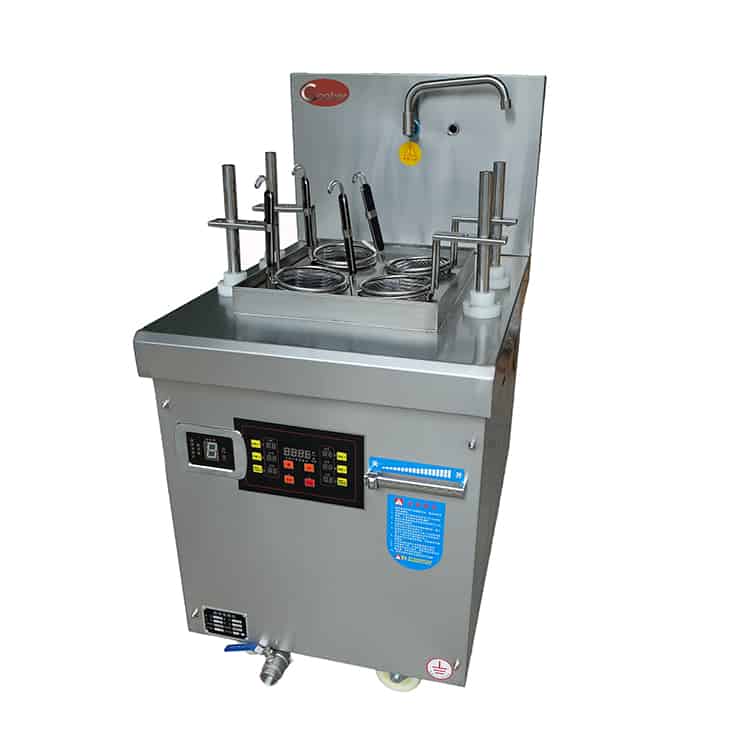
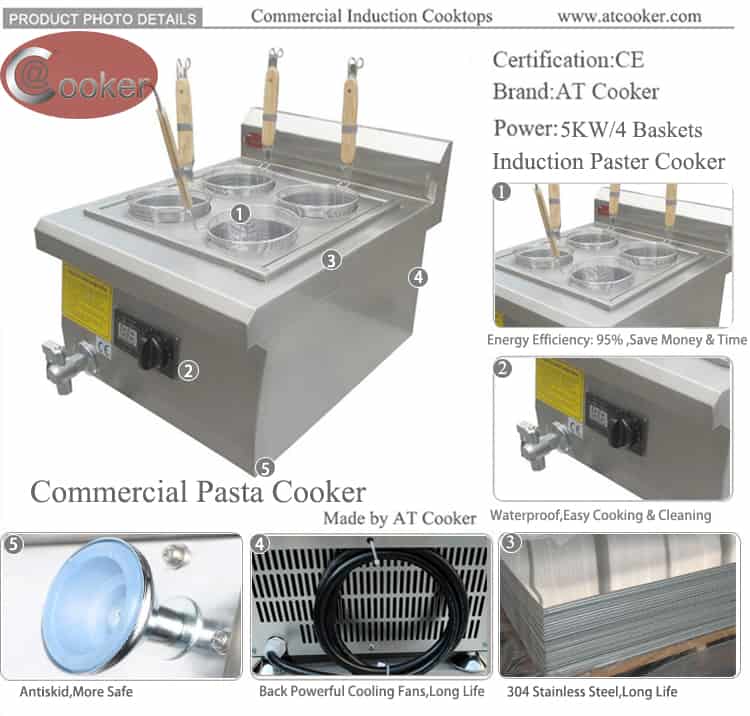
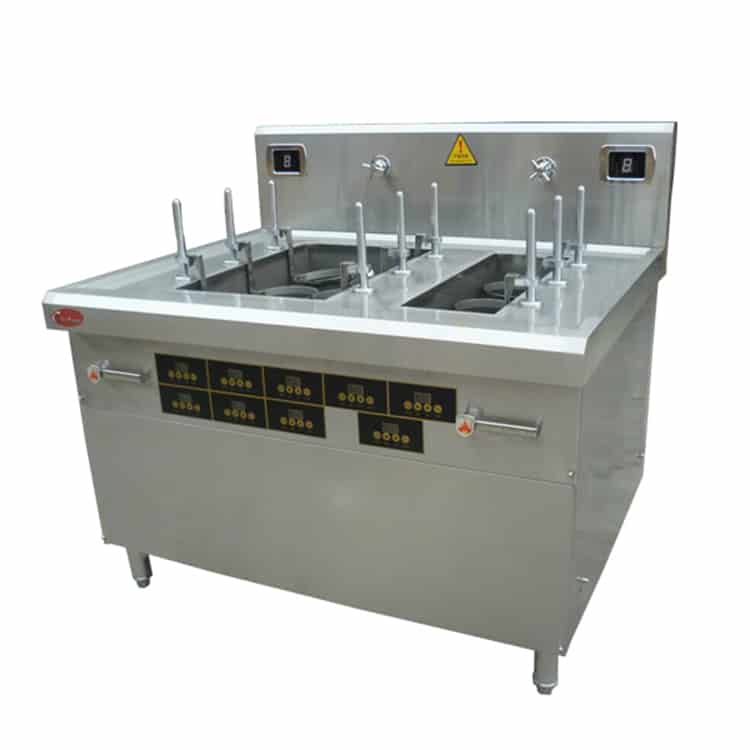
For commercial kitchens, the materials of a pasta boiler commercial directly determine its lifespan, maintenance costs, and cooking quality. AT Cooker’s 2024 analysis of 500+ commercial kitchen equipment failures found that 48% of pasta boiler issues stemmed from poor material choices. This guide breaks down the most common materials used in restaurant pasta boiler models and how they affect durability and performance, backed by AT Cooker’s 20 years of manufacturing expertise.
1. Stainless Steel: The Gold Standard
Stainless steel is the most widely used material for pasta boiler commercial units. It offers unmatched durability, corrosion resistance, and food safety compliance. AT Cooker uses stainless steel for 95% of our pasta boiler components (tanks, frames, baskets). Key advantages: corrosion resistance (stainless steel resists rust from water, pasta sauce, and cleaning chemicals—lasts 7–10 years vs. 3–4 for aluminum/coated steel); hygienic performance (smooth surfaces don’t trap food particles or bacteria, wipe clean in 30 seconds). An Italian restaurant chain in Chicago reported 50% faster cleaning times after switching to AT’s stainless steel pasta boilers.
2. 304 Stainless Steel: Food-Grade Quality
Within the stainless steel family, 304 grade is the top choice. It contains 18% chromium and 8% nickel for enhanced corrosion resistance and food safety (FDA and NSF compliant). Benefits: no metal leaching even at 212°F for hours; smooth surface repels burnt-on pasta (clean with damp cloth, no scrubbing); resists pitting from salt water and acidic sauces. AT’s коммерческая паста-варка ATT-APSD-A41 has a 92% customer retention rate after 5 years. A café in Portland: “Our old boiler had a rough interior that trapped food—now we clean the AT unit in 2 minutes after service.”
Warning: Budget brands use 201 stainless steel (less nickel) to cut costs—it rusts quickly in salt water. A Miami restaurant owner: “We bought a 201 steel unit for $300 less—it rusted in 18 months. AT’s 304 steel unit is 3 years old and still looks new.”
3. Aluminum Components: Faster Heat, Less Durable
Aluminum transfers heat 3x faster than stainless steel but is rarely used for tanks due to poor durability. Pros: reduces preheat time by 1–2 minutes. Cons: reacts with salt water (white oxide layer), warps over 300°F, lifespan 2–3 years. AT Cooker avoids aluminum in food-contact parts but uses it in non-food-contact housings for heat efficiency. A Texas catering company: “The aluminum model heated fast but warped after 6 months. We switched to AT’s stainless steel—still going strong after 4 years.”
4. Heavy-Gauge Stainless Steel: Structural Strength
Gauge (thickness) matters as much as material type. AT Cooker uses 1.2mm–2.0mm heavy-gauge 304 stainless steel for tanks and frames vs. 0.8mm thin-gauge by budget brands. Benefits: warp resistance (AT’s ATT-APST-C5B shows less than 1mm warping after 5 years); load capacity (ATT-APSD-A41 with 2.0mm steel holds 40L per bay witho
ut bending); impact resistance (a Las Vegas hotel: “Our AT boiler got hit by a food cart—no dent. Our old thin-gauge unit would have been ruined.”). A Chicago chain restaurant: “Spending $200 more on heavy-gauge saves $800 every 3 years in replacement costs.”
5. Non-Stick Coatings: Easier Pasta Removal
AT Cooker uses food-grade ceramic non-stick coatings on baskets (not tanks). Benefits: reduced waste (sticky pasta leads to 5–10% waste; non-stick cuts to less than 2%); faster service (pasta slides out in seconds vs. 30+ seconds of scraping); durability (ceramic resists scratching from metal tongs, lasts 2–3 years vs. 6–12 months for PTFE). A family-style restaurant in Boston saves 20 pounds of pasta monthly. Sofia, Italian Restaurant Owner: “AT’s non-stick baskets changed everything—pasta slides right out, and we save $50/month. The coating still looks new after a year.”
6. High-Quality Welds: Prevent Leaks
AT Cooker uses TIG welding for all tank seams—precise, strong, seamless joints. Why it matters: leak prevention (TIG welds are airtight/watertight; budget MIG welds develop leaks in 1–2 years); corrosion resistance (smooth TIG welds are easy to clean, no trapped particles). AT tests every boiler at 1.5x operating pressure before shipping. A diner in Seattle: “Our old boiler leaked after 18 months. AT’s unit is 3 years old, no leaks.”
7. Thermal Shock-Resistant Materials
Commercial pasta boilers face frequent temperature swings. AT Cooker’s 304 stainless steel tanks handle 70°F to 212°F changes without cracking (tested to 10,000+ cycles). Ceramic-coated baskets resist cracking when moved from boiling water to cold plates. Budget materials crack under thermal shock—a Denver café had a plastic handle break from boiling water. AT’s ceramic-coated baskets have metal handles—no cracks, used 50+ times daily.
8. Material Impact on Energy Efficiency
Heavy-gauge stainless steel retains heat better, reducing power needs. AT Cooker’s 1.5mm–2.0mm walls retain heat 30% better than thin steel—the ATT-APSD-A6 uses 15% less power than thin-gauge models with same capacity. All AT pasta boilers have insulated frames (sav
es extra 5–8% on energy). A Las Vegas hotel: “Our 4 AT pasta boilers save $220/month on electricity vs. old uninsulated units.” Aluminum retains heat poorly, requiring more power to maintain boiling—another reason AT avoids it in tank walls.
9. Material Comparison: Which Is Best?
Here’s a comparison of common restaurant pasta boiler materials:
| Материал | Долговечность | Производительность | Maintenance Cost | Идеально подходит для |
|---|---|---|---|---|
| 304 SS (Heavy-Gauge) | 7–10 years | Good heat retention | $50–$100/yr | All commercial kitchens |
| 201 SS (Thin-Gauge) | 2–3 years | Poor retention, sticking | $200+/yr | Short-term use |
| Aluminum (Components) | 3–4 years | Fast conduction, poor retention | $150–$200/yr | Non-critical parts |
| Ceramic-Coated Baskets | 2–3 years | Excellent non-stick | $30–$50/yr | All pasta boilers |
For 95% of commercial kitchens, 304 stainless steel (heavy-gauge) is the best choice—it balances durability, performance, and low maintenance.
Рекомендации по выбору плиты AT
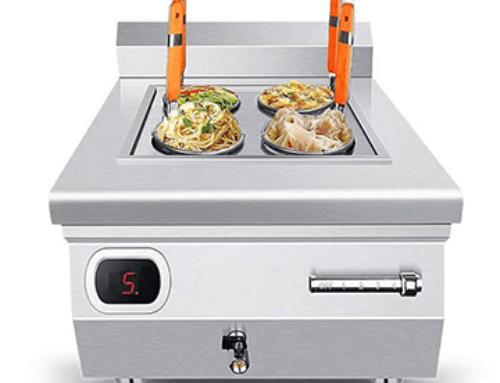
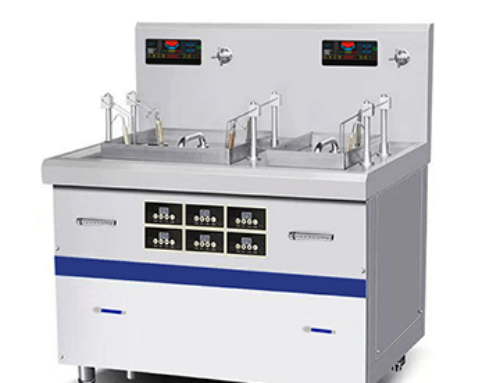
When buying a pasta boiler commercial, always ask for: material type (insist on 304 stainless steel, not 201) and gauge (1.2mm+ for tanks). Avoid aluminum tanks or thin-gauge steel. For baskets, choose ceramic non-stick over PTFE. AT Cooker’s коммерческая паста-варка models (ATT-APSD-A41, ATT-APST-C5B, ATT-APSD-A9) all use 304 heavy-gauge stainless steel, TIG welds, and ceramic non-stick baskets.
5-year Warranty | 2-year Free Exchangeable | 1-year Free Return
What materials are used in commercial pasta boilers?
The most common materials are 304 stainless steel (food-grade, 7-10 year lifespan), 201 stainless steel (budget grade, 2-3 years), aluminum (fast heat conduction but poor durability), and ceramic-coated baskets (non
-stick, 2-3 years). AT Cooker uses 304 heavy-gauge stainless steel for 95% of components because it offers the best balance of corrosion resistance, hygiene, and longevity.
Why is 304 stainless steel preferred for pasta boilers?
304 stainless steel contains 18% chromium and 8% nickel for superior corrosion resistance. It is FDA and NSF compliant for direct food contact, does not leach metals even at boiling temperatures, and resists pitting from salt water and acidic sauces. AT Cooker’s ATT-APSD-A41 (made with 304 steel) has a 92% customer retention rate after 5 years with no signs of corrosion.
How does material gauge affect pasta boiler durability?
Gauge (thickness) directly impacts warp resistance, load capacity, and impact resistance. AT Cooker uses 1.2mm-2.0mm heavy-gauge steel vs. 0.8mm thin-gauge by budget brands. Heavy-gauge tanks show less than 1mm warping after 5 years, support 40L of water per bay without bending, and withstand accidental bumps. The extra thickness extends lifespan by 3-5 years.
Do non-stick coatings on pasta boiler baskets last?
AT Cooker uses food-grade ceramic non-stick coatings that resist scratching from metal tongs and last 2-3 years, compared to 6-12 months for traditional PTFE coatings. Non-stick baskets reduce pasta waste from 5-10% to under 2% and speed up service. A family-style restaurant in Boston saves 20 pounds of pasta monthly.
How do pasta boiler materials affect energy costs?
Heavy-gauge stainless steel walls (1.5mm-2.0mm) retain heat 30% better than thin steel, reducing power consumption. AT Cooker’s insulated frames save an additional 5-8% on energy. A L
as Vegas hotel reported saving $220/month on electricity with 4 AT pasta boilers vs. old uninsulated units. Aluminum retains heat poorly, requiring more power to maintain boiling.
Get Commercial Pasta Boiler Material Guide
Share your kitchen needs (volume, budget), and we’ll send you a detailed material guide and personalized recommendation.
Коммерческое кухонное оборудование – от AT Cooker
- ✔Являясь производителем профессионального коммерческого индукционного кухонного оборудования, AT Cooker откликнулась на потребности ресторанов и отелей и разработала нормативное коммерческое кухонное оборудование с использованием новейших индукционных технологий.
- ✔Это бесшовное, профессиональное коммерческое кухонное оборудование дает нам возможность интегрировать оборудование по нашему выбору в единое, многофункциональное кухонное оборудование, создавая эффективную, недорогую, безопасную, экологичную и устойчивую коммерческую кухню. У нас есть стандартное оборудование, которое может обслуживать многие коммерческие кухни.
- ✔AT Cooker всегда предлагает профессиональное обслуживание. От материалов, дизайна до производства, мы фокусируемся на качестве, производительности и надежности, чтобы гарантировать наилучшее решение для каждого нашего клиента. У вас есть коммерческая кухня? Мы станем одним из ваших лучших партнеров.
Work Voltage
Global In-Stock + Fast Pickup
Часто задаваемые вопросы
Commercial Pasta Boiler Materials: How They Impact Durability & Performance
For commercial kitchens, the materials of a pasta boiler commercial directly determine its lifespan, maintenance costs, and cooking quality. AT Cooker’s 2024 analysis of 500+ commercial kitchen …