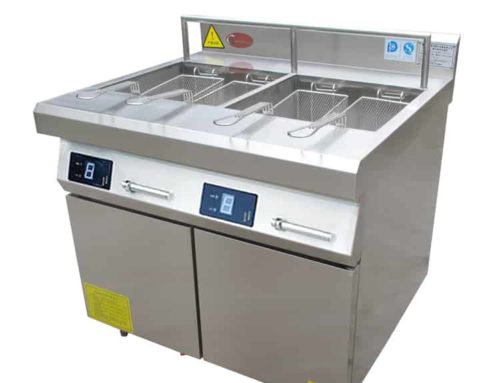
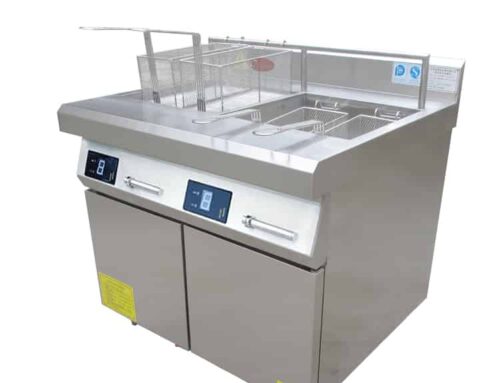
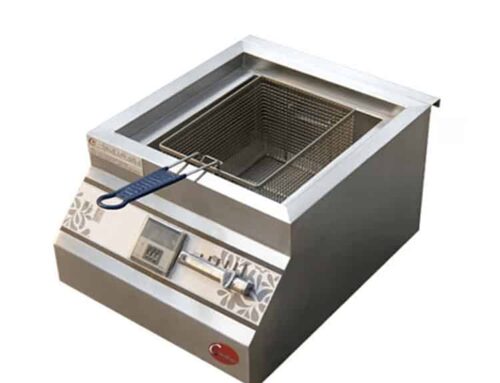
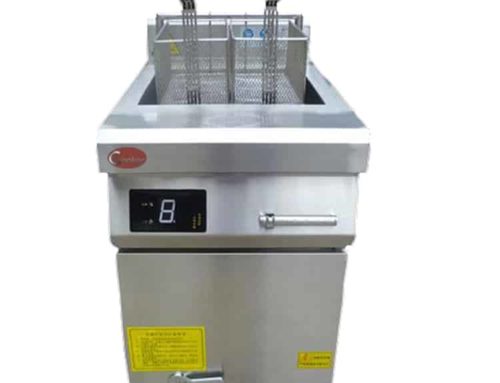
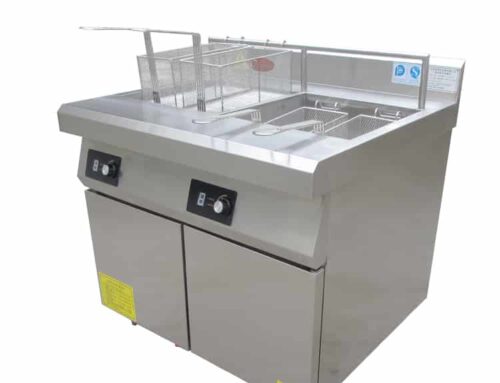
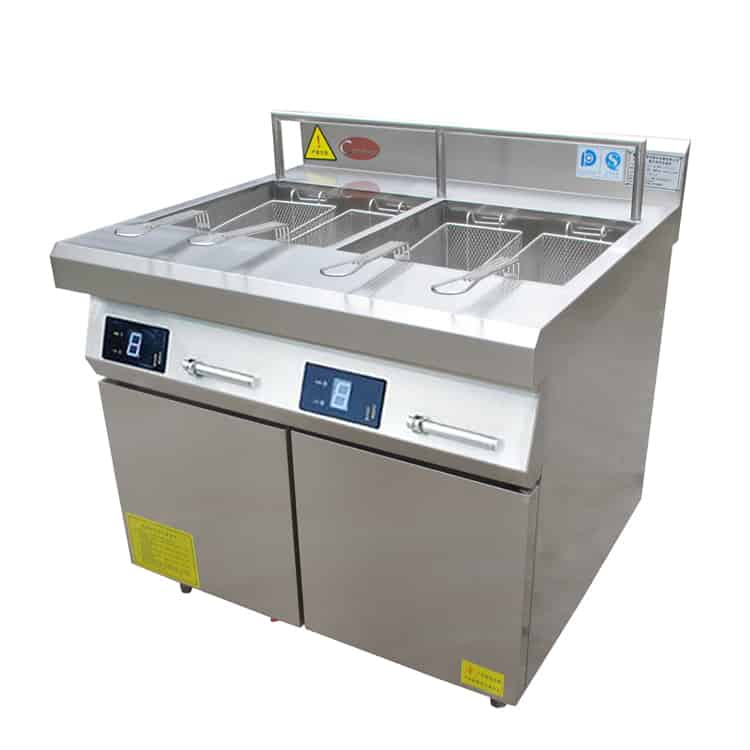
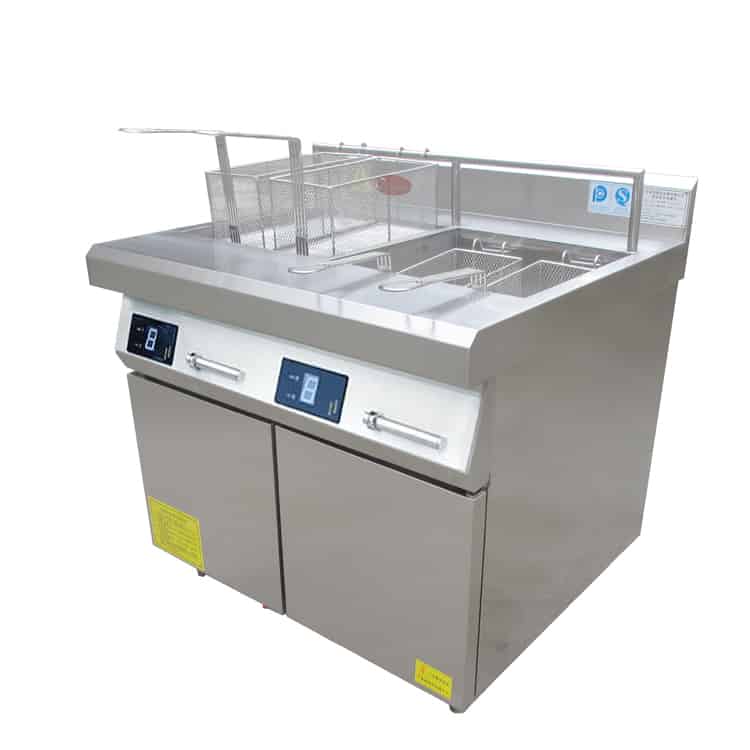
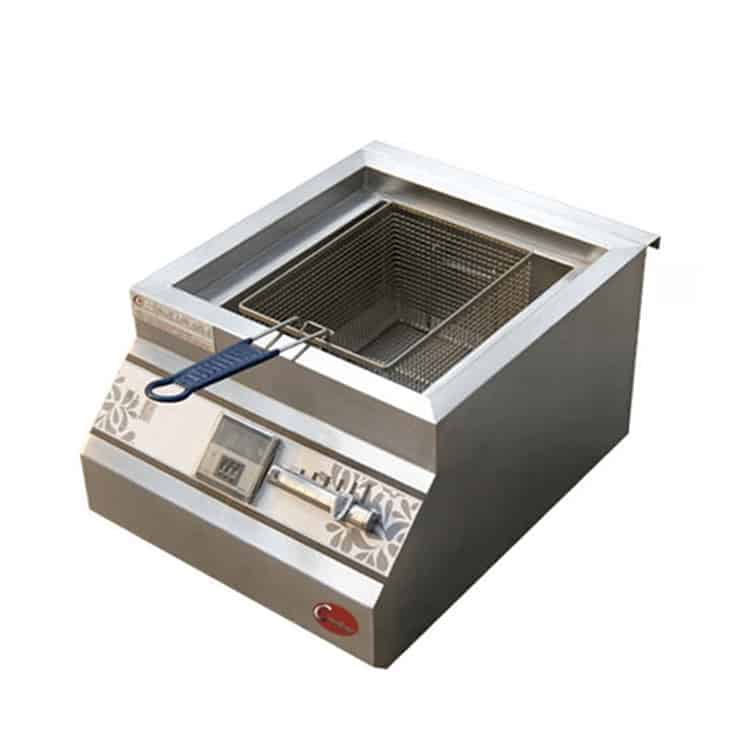
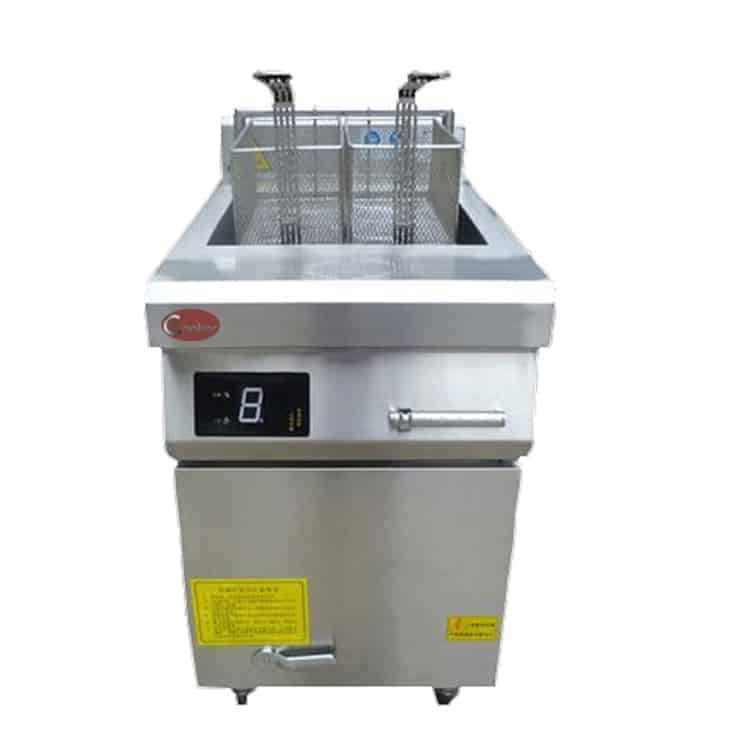
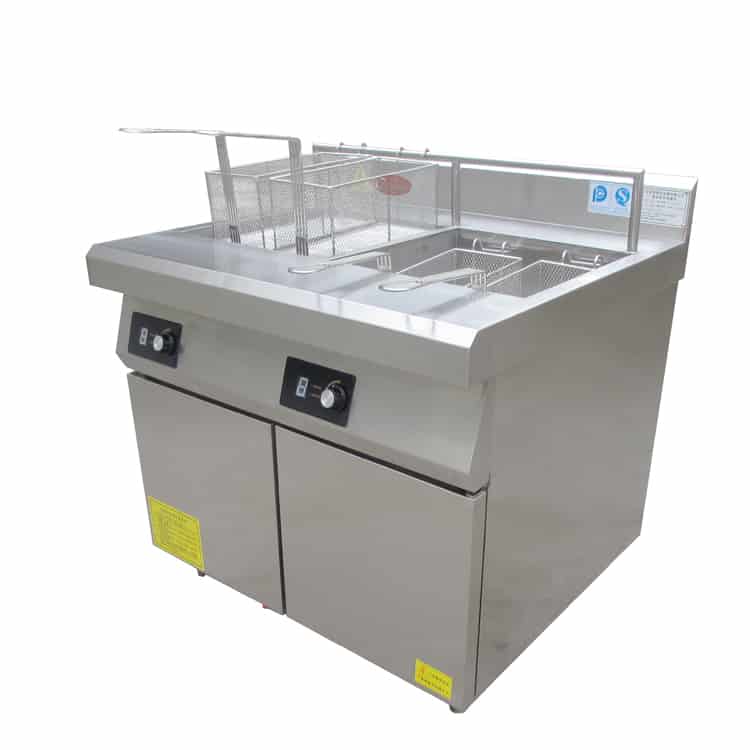
La capacità di olio delle friggitrici commerciali varia ampiamente e i tassi di consumo variano drasticamente in base all'utilizzo. AT Cooker offre modelli da 10L da banco a 80L a doppia vasca. Di seguito, 14 fattori che determinano quanto olio contiene la tua friggitrice e quanto velocemente lo consuma.
Le friggitrici commerciali contengono tipicamente da 15 a 60 libbre di olio
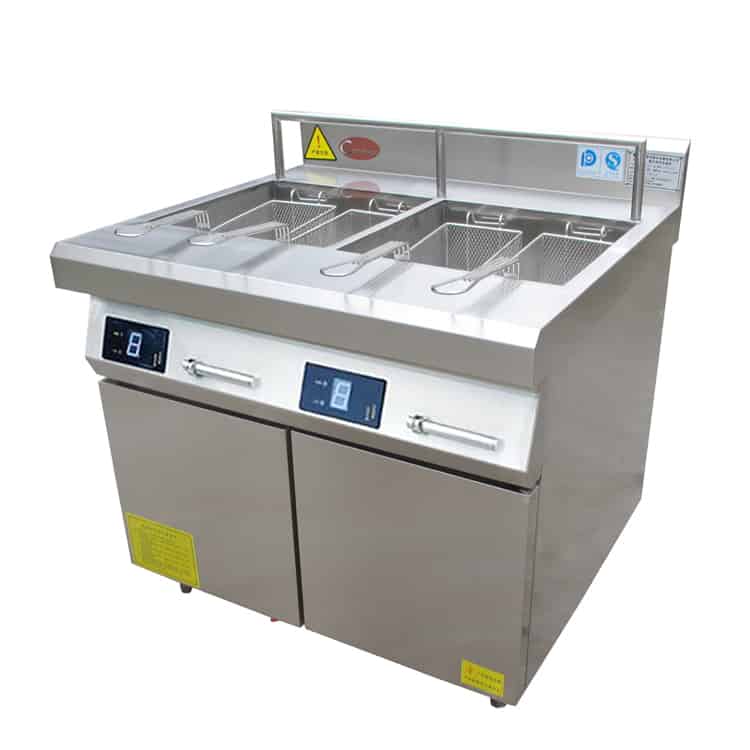
La maggior parte dei modelli standard si colloca tra 15–60 lbs (17–65L), mentre le unità di grado industriale (come AT Cooker’il modello 40L×2 di) possono contenere fino a 73 lbs (80L). La chiave è abbinare la capacità alla produzione: un piccolo caffè necessita di molto meno olio rispetto a una catena di hamburger affollata.
- Da banco compatto (5KW): 8,5–13,8 lbs (10–15L). Perfetto per caffè o food truck che friggono 50–100 porzioni al giorno.
- Freestanding a volume medio (8–15KW): 19,5–21,16 lbs (23L). La friggitrice a induzione da 23L è un bestseller—sufficiente per 200–300 porzioni al giorno.
- Doppia vasca ad alto volume (10–12KW×2): 68–73,6 lbs (80L totali). Gestisce oltre 500 porzioni con vasche separate.
Conversione dell'olio: 1L di olio vegetale = ~0,85 lbs; 1L di olio di arachidi = ~0,92 lbs. Tutte le specifiche AT Cooker si riferiscono alla capacità netta di olio (volume utilizzabile).
| Perché | Oil Capacity (L) | Capacità olio (lbs) | Potenza | Cucina ideale | Produzione giornaliera |
|---|---|---|---|---|---|
| Da banco a cestello singolo 5KW | 10L | 8.5 lbs | 5KW | Caffè, food truck | 50–100 |
| Da banco a doppio cestello 5KW | 15L | 12.75 lbs | 5KW | Piccoli ristoranti | 100–150 |
| Freestanding a induzione 23L | 23 L | 19.55 lbs | 8–15KW | Ristoranti di medie dimensioni | 200–300 |
| Doppia vasca 40L×2 | 80L (40L×2) | 68 lbs | 10–12KW×2 | Stadi, hotel | 500+ |
2. Oil Consumption Rate Depends on Usage Frequency
Le operazioni ad alto volume (4+ ore al giorno) consumano olio 2–3 volte più velocemente rispetto alle cucine a basso volume (1–2 ore al giorno). I modelli più diffusi di AT Cooker e i cicli di sostituzione tipici (olio vegetale):
- Basso volume (1–2 ore/giorno): Da banco 10L, sostituzione olio ogni 5–7 giorni. ~42–60L al mese.
- Volume medio (3–4 ore/giorno): Freestanding 23L, sostituzione ogni 3–4 giorni. ~172–228L al mese.
- Alto volume (5+ ore/giorno): 40L×2, sostituzione ogni 2–3 giorni. ~780–1.200L al mese.
Soglia FFA: Una volta che gli acidi grassi liberi superano 1%, l'olio produce sapori sgradevoli e fumo. Il timer di spegnimento automatico a 10 ore di AT Cooker riduce il degrado a riposo del 15%.
La filtrazione regolare prolunga la vita dell'olio, riducendo il consumo
Le particelle di cibo lasciate nell'olio accelerano il degrado bruciando e rilasciando acidi. La filtrazione rimuove queste particelle, prolungando la vita dell'olio del 30–50%. AT Cooker’Le friggitrici di semplificano la filtrazione con scarichi a rubinetto integrati, maniglie dell'olio cool-touch e compatibilità con macchine per filtrazione commerciali.
| Metodo di filtrazione | Ciclo di sostituzione | Consumo mensile |
|---|---|---|
| No Filtration | 3 days | 230L |
| Daily Filtration | 5 days | 138L |
| Machine Filtration | 6 days | 115L |
Case Study: A catering company in Miami: with daily filtration (10 min after closing), oil replacement went from every 3 days to every 5 days—saving 40% on oil costs monthly. For a 23L fryer, that’s $192/month savings.
4. Induction Precise Temperature Control Slows Oil Degradation
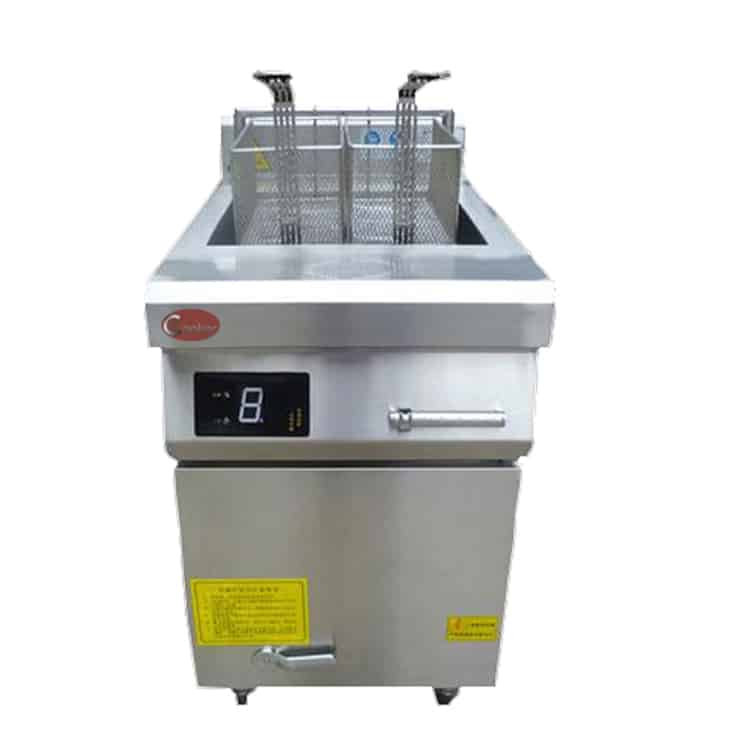
Oil degradation accelerates above 375°F (190°C). AT Cooker’s induction fryers use PID controllers adjusting heat 10 times/sec, maintaining ±2°F—far more precise than gas (±5–8°F) or standard electric (±3–4°F). Result: oil lasts longer.
A chicken chain: “Gas fryer bounced 360–385°F, oil degraded every 2 days. Induction stays at 370°F exactly, oil lasts 4 days. Cut oil costs in half.” Anti-high-temperature warnings alert staff if oil nears 390°F, saving 10–15L monthly.
5. Oil Capacity Is Proportional to Fryer Size
Larger fryers hold more oil because they’re designed for higher demand. AT Cooker’s dimensions:
- Countertop 10L: 400×400×450mm, tank 200×280×180mm.
- Freestanding 23L: 500×800×950mm, tank 340×340×200mm.
- Dual-Tank 80L: 1000×800×1100mm, tank 400×400×250mm×2.
Lesson: A Las Vegas hotel: “Bought a small countertop fryer with 20L tank—weighed 60 lbs full, couldn’t move it. Switched to AT Cooker’s 15L countertop, lightweight enough to store when not in use.”
6. Food Type Influences Oil Consumption
Breaded/battered foods shed crumbs and absorb more oil, accelerating degradation. Plain foods produce fewer particles. A kitchen frying mostly breaded foods replaces oil 20–30% more frequently.
- Breaded (chicken): 23L fryer, oil every 3 days. Monthly: 230L. “Breading sheds crumbs that burn in oil.”
- Plain (fries): Same 23L fryer, oil every 4 days. Monthly: 172L. “Fries produce almost no crumbs.”
Tip: AT Cooker recommends separate fryers for breaded and plain foods. A Chicago diner: “Separate fryers let us keep fry oil 4 days, chicken oil 3 days—saving 15L monthly.”
7. Advanced Oil Management Systems Monitor Quality
Modern fryers include oil quality sensors measuring FFA levels or conductivity in real time. AT Cooker’s 40L×2 offers an optional sensor integrated with digital display:
- Measures conductivity every 15 minutes.
- Displays “Quality Score” (1–10): 10=fresh, 3=replace soon, 1=replace immediately.
- Alert at score 3, giving staff time to plan replacement.
Result: A hotel with 10 fryers: “Before, changed oil every 3 days regardless. Now only when sensor says so—sometimes lasts 4 days, saving 50L monthly.”
8. Electric Fryers’ Consistent Heat Lowers Consumption
Gas fryers have hot spots (areas of higher temperature) that cause oil to degrade faster locally. AT Cooker’s induction fryers use magnetic heating across the entire tank bottom, eliminating hot spots.
- Gas: Hot spots 390°F, rest 370°F. FFA 1.5% in hot spots vs 0.8% elsewhere—entire batch replaced, wasting 50%.
- Induzione AT Cooker: 370°F uniform. FFA 0.8% everywhere—no wasted oil.
Hidden Benefit: Electric fryer users replace oil 15–20% less frequently than gas users. A 20-location chain: “Switched from gas—went from 10,000L to 8,500L monthly.”
9. Oil Turnover Rate Impacts Quality & Consumption
High turnover (large volumes daily) means oil doesn’t degrade much. Low turnover means oil sits longer, degrading from idle heat. Two kitchens with the same fryer can have drastically different consumption.
- High Turnover: Burger chain, 23L, 300 portions/day. Oil lasts 3 days (7.6L/day). Monthly: 228L.
- Low Turnover: Café, same 23L, 50 portions/day. Oil lasts 4 days (5.75L/day). Monthly: 172L. But quality is lower.
Optimization: A Seattle café: “Switched from 23L to 10L fryer for 50 portions/day. Oil lasts 3 days, tastes fresh. Monthly use dropped 172L to 100L.”
10. Environmental Factors Increase Evaporation
High ambient temperature (>80°F) or humidity (>60%) accelerates oil evaporation—5–10% of monthly consumption. AT Cooker’s 23L fryer has 3-layer insulation reducing evaporation by 70%.
Florida Test: “Old uninsulated fryer lost 1L/day to evaporation. AT Cooker insulated fryer loses 0.3L daily—saving 21L monthly ($63).”
Tips: keep lid closed when not in use, install exhaust fans, monitor levels weekly. An Arizona bakery: “Lid closed + exhaust fan—evaporation 0.8L to 0.4L daily. 146L saved/year.”
11. Maintenance Practices Extend Oil Life
AT Cooker recommends three maintenance areas:
- Tank Cleaning: Weekly (non-abrasive cleaner + soft brush). Dirty tank reduces oil life by 20%.
- Element Inspection: Quarterly. Faulty elements cause hot spots. AT Cooker induction coils are sealed—just wipe with dry cloth.
- Seal Replacement: Annually. Worn seal increases evaporation and temperature fluctuations.
Case Study: School cafeteria with 5 AT Cooker fryers: “Before maintenance, oil every 3 days. After weekly cleaning + quarterly checks, oil lasts 4 days—saving 50L monthly.”
12. Initial Oil Fill vs. Actual Consumption
Initial fill = one-time cost to fill to max level. Actual consumption = recurring replacement. Confusing the two leads to budget errors.
- 10L Countertop: Initial = 10L. Daily consumption = ~1.4–2L.
- 23L Freestanding: Initial = 23L. Daily consumption = ~5.75–7.6L.
- 40L×2 Dual-Tank: Initial = 80L. Daily consumption = ~26–40L.
Budget Tip: A new restaurant owner: “Budgeted for 23L initial fill ($69) but forgot monthly consumption (172L = $516). AT Cooker helped adjust budget to include both.” Use their Consumption Calculator on the website.
13. Oil Level Sensors Prevent Overuse & Spills
AT Cooker’s fryers have two sensor types:
- Low Oil Sensor: Alerts when below minimum safe level. Prevents overheating and degradation. Displays “Low Oil” on screen.
- Overfill Sensor (high-end): Stops oil flow at max level. Prevents spills during cooking.
Real Impact: A fast-food chain: “Low oil sensor saved us from ruining oil multiple times. Used to waste 5L monthly from overheating; now zero.”
14. Cost Analysis: Oil Purchase + Disposal Expenses
Total oil costs include both purchase and disposal (hidden cost, 10–15% of total). Monthly analysis for AT Cooker’s 23L fryer (172L consumption):
| Cost Item | Calculation | Monthly |
|---|---|---|
| Oil Purchase | 172L × $3/L | $516 |
| Disposal | 172L × $0.30/L | $51.60 |
| Total | $567.60 |
Many AT Cooker customers partner with biodiesel companies for free pickup + $0.10/L rebate. A Miami hotel: “Cuts disposal to zero, adds $17.20/month.” Optimizing both can reduce total oil costs 15–20% annually ($1,021–$1,362 for a $6,811/yr kitchen).
Garanzia 5 anni | Sostituzione gratuita 2 anni | Reso gratuito 1 anno
What is the optimal oil capacity for a commercial deep fryer?
Commercial deep fryers typically range from 10 to 50 liters of oil capacity. The optimal capacity depends on your daily frying volume. High-volume restaurants benefit from 30-50L tanks, while smaller operations can use 10-20L units. AT Cooker offers models from 15L to 40L to match different business scales.
How often should commercial fryer oil be changed?
Oil change frequency depends on usage volume and food type. High-volume operations (frying 4+ hours daily) should change oil every 3-5 days. Moderate use (2-3 hours daily) allows 5-7 day intervals. Always monitor oil quality using test strips or visual inspection for dark color, foaming, or off-odors.
What factors affect fryer oil consumption rate?
Key factors include: frying temperature (higher temps accelerate breakdown), food moisture content (wet foods introduce water), batter/breading absorption, filtration frequency, and oil type. Induction fryers with precise temperature control can reduce oil consumption by 15-20% compared to gas models.
How can I reduce oil consumption in my commercial fryer?
Best practices: maintain optimal temperature (175-190°C), filter oil daily to remove food particles, avoid overloading baskets, use high-quality oil with high smoke point, cover fryer when not in use to prevent oxidation, and choose induction fryers for precise temperature control and energy efficiency.
What is the difference between induction and gas fryer oil efficiency?
Induction fryers offer 90-95% energy efficiency vs 30-45% for gas models. Precise temperature control reduces oil degradation, extending oil life by 20-30%. Induction also eliminates hot spots that cause localized oil burning. The result is lower oil consumption, better food quality, and reduced operating costs over time.
Choose the Right Commercial Fryer for Your Oil Capacity & Consumption Needs
Share your daily frying volume, food type, and kitchen size—we’ll recommend the ideal fryer to minimize consumption and costs.